
What Actually Gets Content Cited in AI-Generated Answers
A peer-reviewed study tested nine content techniques against AI-generated answers. Three produced large, measurable gains, and smaller sites benefited most.
8 min readVoice of Business
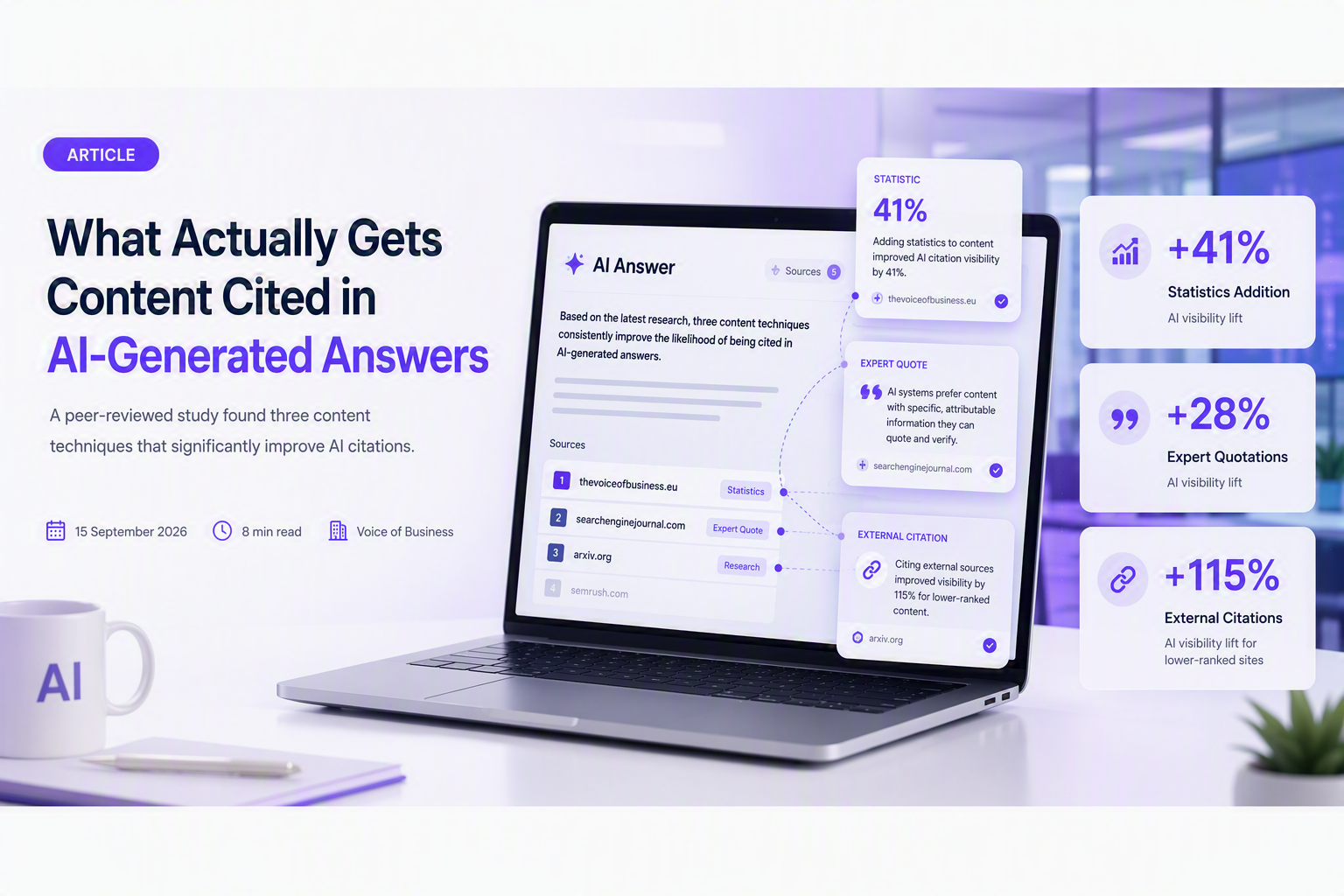
A peer-reviewed study tested nine specific content techniques against AI-generated answers, and three of them produced large, consistently measurable gains in how often that content got cited. The result is one of the few genuinely evidence-based answers to a question most businesses are currently guessing at.
This article sets out what that study actually found, which techniques matter most, why smaller and lower-ranked sites often gain more than established ones, and how this connects to the SEO work most organisations are already doing.
Key Takeaways
- Adding statistics to content improved AI citation visibility by 41%, the single largest gain of any technique tested.
- Adding direct quotations improved visibility by 28%, and citing external sources improved visibility by 115% specifically for lower-ranked content.
- Keyword stuffing produced no meaningful benefit and in some cases reduced visibility.
- The overlap between top-ten Google rankings and AI citations has fallen from around 75% to between 17% and 38% over the past year, opening room for content that was never ranking first to still be cited.
- Brand mentions correlate roughly three times more strongly with AI visibility than backlinks do.
- Simply adding more words to a page produced no improvement, the signal is data density, not length.
- GEO techniques build on traditional SEO fundamentals rather than replacing them.
The Study Behind the Numbers
The research behind almost every specific figure in this field traces back to one paper on generative engine optimisation, presented at the ACM SIGKDD Conference in 2024 by a team from Princeton University, Georgia Tech, the Allen Institute for AI, and IIT Delhi. It remains the first, and still the most cited, peer-reviewed study to systematically quantify what content changes actually move the needle inside AI-generated answers, rather than relying on anecdotal observation of what seems to work.
The team built a benchmark called GEO-bench, spanning roughly 10,000 queries across nine content domains, ranging from medical topics to product comparisons. For each query, they simulated a generative engine pipeline, retrieving candidate sources and generating a synthesised answer with citations, then tested nine distinct content modification strategies against that pipeline to see which ones changed how often, and how prominently, a given source got cited. The strongest findings were then validated on Perplexity as a real-world check, rather than left purely as a simulation result.
That combination, a large query set, a controlled comparison of specific techniques, and a real-world validation step, is what separates this study from most of the advice currently circulating on the topic. Many of the specific percentages repeated across marketing content trace back to this one source, sometimes with slightly different framing depending on which metric is being quoted, but the underlying pattern is consistent across every credible summary of the work.
The Techniques That Actually Move Citations
Of the nine techniques tested, three produced the largest, most consistent gains, and all three share a common thread: they add verifiable, attributable information rather than simply restating a claim more persuasively.
Statistics addition, embedding concrete, quantitative data directly into content, produced the single largest improvement measured, a 41% increase in AI visibility. This makes intuitive sense once the underlying mechanism is understood: AI systems generating an answer are effectively risk-minimising, they preferentially cite content that offers something specific and checkable over content that offers only general assertion. A page that says “adoption is increasing” is less citable than one that says adoption increased by a specific, sourced percentage.
Quotation addition, incorporating direct quotes from named sources or experts, produced a 28% improvement. Quotes function similarly to statistics in this respect, they are specific, attributable, and easy for a generative system to lift cleanly into a synthesised answer without paraphrasing risk.
Citing external sources produced a substantial gain overall, and a genuinely striking one for content that started from a weaker position: a 115% improvement in visibility for lower-ranked content specifically. That is a very different story from the modest lift the same technique produces on content that was already performing well, and it is the clearest evidence in the whole study that GEO is not simply a game that rewards whoever was already winning at traditional SEO.
Fluency optimisation, writing in clean, well-structured, readable language rather than dense or convoluted prose, added a further, smaller but still meaningful lift on top of the techniques above. Combining fluency optimisation with statistics addition specifically produced the largest combined effect of any pairing tested, better than either technique produced alone.
Why Smaller, Lower-Ranked Sites Have the Most to Gain
The 115% figure for lower-ranked content is worth dwelling on, because it inverts a common assumption about how visibility works online. Under traditional SEO, an established, highly-ranked site tends to keep most of the advantage that got it there in the first place, ranking position is comparatively sticky. GEO does not appear to work the same way.
Part of the explanation sits in a separate, related finding: the overlap between a page’s position in conventional Google rankings and whether that same page actually gets cited by an AI system has fallen sharply, from roughly 75% overlap in mid-2025 down to somewhere between 17% and 38% by early 2026. Put plainly, ranking first is no longer a reliable predictor of getting cited. AI systems are drawing on a meaningfully different pool of sources than the one traditional search rankings would suggest.
That redistribution is precisely what creates the opportunity for smaller or newer sites. A page that has never cracked the top three organic results for its target query, but that embeds clear statistics, cites credible sources, and reads cleanly, is competing on genuinely different terms than it would under conventional SEO. The playing field has not become level in every respect, but it has become considerably less tilted in favour of whoever arrived first.
There is a second, related signal worth noting here: brand mentions correlate roughly three times more strongly with AI visibility than backlinks do, measured at 0.664 for mentions against 0.218 for backlinks. Earning a mention of a brand or organisation’s name across other sites and publications, even where no link is attached, appears to carry meaningful weight with AI systems in a way that traditional link-building metrics do not fully capture. That is a genuinely different lever than the one most SEO strategy has historically pulled.
What Doesn’t Work, and Why That Matters
Two findings from the same study are as useful as the positive ones, because they redirect effort away from tactics that no longer pay off. Keyword stuffing, packing content with repeated target phrases, produced negligible or outright negative effects on AI visibility. That is a meaningful departure from older SEO practice, where keyword density was, for a long time, treated as a meaningful signal in its own right.
Similarly, simply adding more words to a page produced no measurable improvement on its own. Length alone is not the signal AI systems respond to, data density and source credibility are. This is genuinely good news for smaller organisations without the resource to produce large volumes of content: the techniques that actually move the needle, adding a specific statistic, a credible citation, or a relevant quotation, are additions to existing content rather than a requirement to produce substantially more of it.
How This Connects to Traditional SEO
None of this is an argument for abandoning conventional SEO practice. A large majority of citations inside AI-generated answers still align closely with pages that also perform well under long-established search fundamentals, clear structure, credible sourcing, and genuine relevance to the query being answered. GEO techniques sit on top of that foundation rather than replacing it.
The practical implication is straightforward: an organisation that has already invested in solid, well-structured content is closer to benefiting from GEO than one starting from nothing, since the specific additions that move AI visibility, statistics, citations, and quotations, are refinements to already-sound content rather than a separate discipline built from scratch. The gap most organisations actually need to close is not a rewrite of their entire content strategy, it is a targeted pass adding the specific elements this research has shown to matter.
Tracking Whether Any of This Is Working
None of the techniques above are worth much without a way to see whether they are actually changing anything. Our partner tool, Am I Cited, tracks how often and how prominently a brand or piece of content is cited across AI-generated answers over time, which turns “we added some statistics and citations” into a measurable before-and-after rather than a guess.
What follows
Start with an audit to identify which existing pages already perform reasonably well under conventional SEO, since that is the content best positioned to benefit from GEO refinement first. Add specific, sourced statistics and credible external citations to that content first, since those two techniques produced the largest measured gains. Treat lower-ranked or newer pages as genuine opportunities rather than lost causes, since the evidence shows they stand to gain the most from exactly these techniques, not the least.
Frequently asked questions
What is generative engine optimisation (GEO)?
Generative engine optimisation is the practice of structuring content so it is more likely to be cited inside AI-generated answers, from tools such as ChatGPT, Perplexity, and Google AI Overviews. It is distinct from traditional SEO, which optimises for ranking position on a results page rather than for inclusion inside a synthesised answer.
Which single content change produces the biggest improvement in AI citation visibility?
Adding statistics to content produced the largest single improvement measured in the peer-reviewed study behind this field, a 41% increase in AI visibility. Embedding concrete, quantitative data into a page was the most effective individual technique out of nine tested.
Does citing external sources in an article actually improve its own AI visibility?
Yes, and the effect is strongest for content that starts from a weaker position. Citing external sources improved AI visibility by 115% for lower-ranked content specifically, a far larger lift than the same technique produced for already highly-ranked pages.
Does keyword stuffing improve a page's odds of being cited by AI systems?
No. Keyword stuffing produced negligible or negative effects on AI visibility in the peer-reviewed study that tested it directly, unlike statistics, quotations, and source citations, which all produced measurable gains. Effort spent stuffing keywords is effort not spent on the techniques that actually work.
Does ranking well on Google guarantee a citation in AI-generated answers?
No, and the relationship has weakened further over time. The overlap between a search engine's top-ten organic results and what AI systems actually cite has fallen from roughly 75% in mid-2025 to somewhere between 17% and 38% in early 2026. Ranking first no longer means an automatic AI citation.
Do brand mentions matter more than backlinks for AI visibility?
Brand mentions correlate roughly three times more strongly with AI visibility than backlinks do, based on measured correlation coefficients of 0.664 for mentions against 0.218 for backlinks. A brand appearing in text across the web, even without a link attached, carries meaningful weight with AI systems in a way traditional SEO does not fully account for.
Should a business abandon traditional SEO in favour of GEO?
No. The overlap between AI citations and conventional search fundamentals remains substantial: a large majority of AI citations still align with pages that also perform well under long-established SEO practice. GEO adds specific techniques on top of that foundation, it does not replace the foundation itself.
Is more content always better for AI visibility?
No. The same research that identified the techniques above also found that simply adding more words to a page produced no improvement on its own. The signal AI systems respond to is data density and source credibility, not length, which is good news for organisations without the resource to produce large volumes of content.