
What Predicts Whether an AI Project Reaches Production
A structured readiness assessment before launch correlates with a 45% higher success rate on an organisation's first AI production deployment.
9 min readVoice of Business
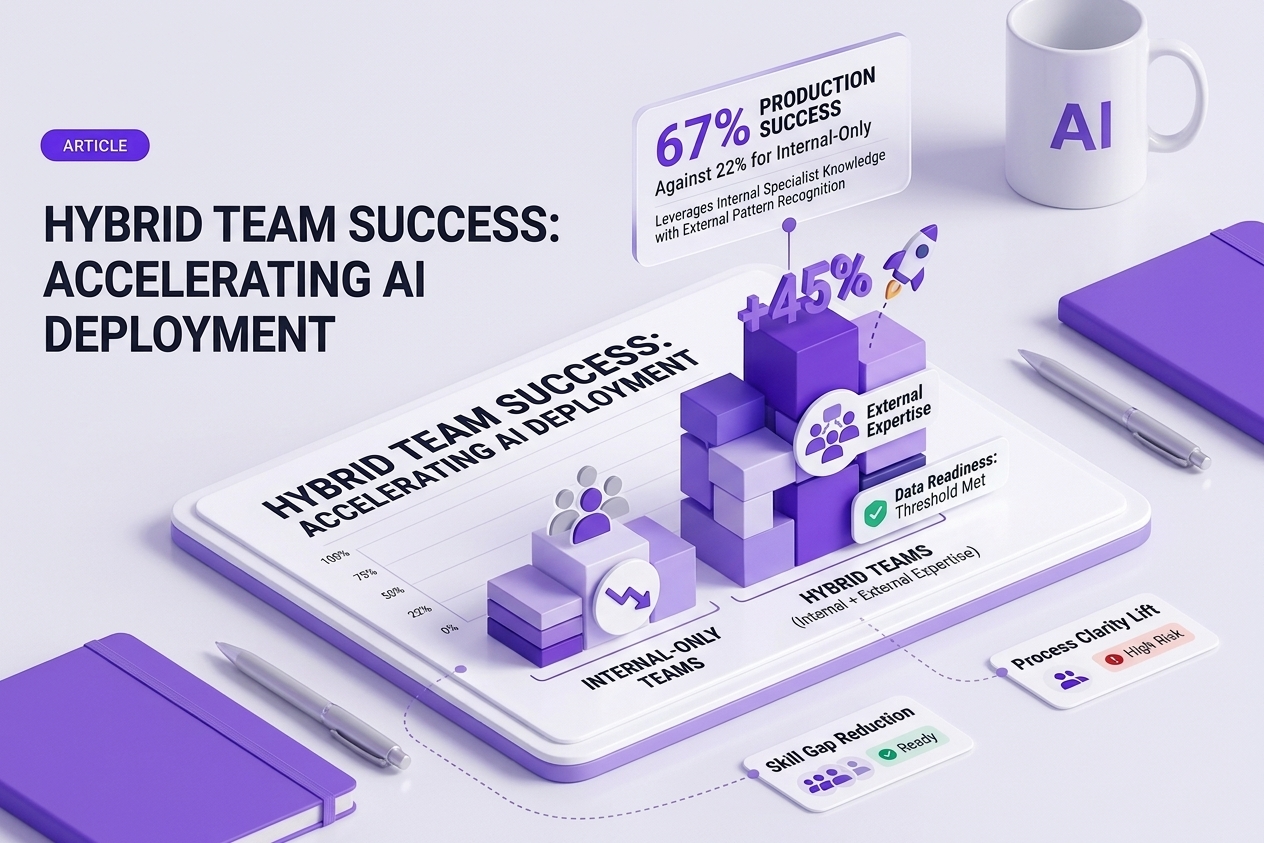
A structured readiness assessment before launch correlates with a 45% higher success rate on an organisation’s first AI production deployment. That is not a marginal edge, it is close to half again as many projects actually reaching production.
This article sets out what the evidence says about why that gap exists, the specific factors that separate AI projects that reach production from ones that stall, and what an organisation can do with that information before committing budget to the next initiative.
Key Takeaways
- A formal readiness assessment before launch correlates with a 45% higher success rate on an organisation’s first AI production deployment.
- Organisations with properly governed data deploy AI roughly 2.4 times faster than those without it.
- Projects with a named executive sponsor, a defined success metric, and an internal champion consistently move from pilot to production, projects without these traits consistently drift.
- Projects combining internal specialists with outside expertise succeed at 67%, against 22% for internal-only builds.
- AI capability itself has become cheap and abundant, the share of organisations using AI in at least one business function has climbed from 55% to 88% in two years. Organisational readiness to use it well has not moved at the same pace.
- Assessment adds time upfront but reliably prevents far more expensive pivots later in a project.
Why the Readiness Gap Exists
The starting point worth understanding is that almost every organisation is already spending on AI, but very few are actually prepared to execute on it well. Adoption has become close to universal, the share of organisations reporting AI use in at least one business function has climbed from 55% two years ago to 88% today. Capability itself is cheap and widely available now in a way it simply wasn’t a few years ago.
Organisational readiness has not kept pace with that availability. The gap between an organisation adopting AI and an organisation being genuinely ready to deploy it at scale is where most project risk actually concentrates, not in the underlying technology. This is the specific gap a readiness assessment is built to measure and close, before it turns into a stalled or abandoned project.
The Measured Effect of Assessing First
The clearest evidence for assessment comes down to one comparison: organisations that conducted a formal readiness assessment before launching an AI initiative achieved a 45% higher success rate on their first AI production deployment, compared with organisations that started without one. That figure describes the difference between roughly two in three projects reaching production and fewer than half doing so.
The mechanism behind that gap is straightforward once it’s stated plainly. An assessment surfaces the specific weaknesses, in data, in process, in ownership, that would otherwise only become visible once a project is already underway and money has already been committed. Finding a gap during a scoping exercise costs a conversation. Finding the same gap six weeks into a build costs a redesign.
That reframes what an assessment actually is. It is sometimes treated as a step that slows a project down before it can start. The measured evidence points the other way: assessment adds time upfront, but it reliably prevents the far more expensive false starts and mid-project pivots that would otherwise cost considerably more time later.
Data Readiness Is the Single Highest-Leverage Factor
Of the dimensions a readiness assessment typically scores, data stands out as both one of the most common weaknesses and one of the most directly fixable once identified. Organisations with properly governed data, meaning data whose quality, accessibility, and structure have actually been addressed rather than assumed, achieve AI deployment roughly 2.4 times faster than organisations without it.
That is a large enough gap to change how a project gets sequenced. For an organisation whose core workflows start from inconsistent or scattered source documents, the highest-leverage first step is usually improving data intake and governance, not attempting to optimise decisions built on top of data that was never properly assessed in the first place. An assessment is what identifies whether this is the actual constraint before a project’s budget and timeline get built around the wrong assumption.
Data readiness is worth singling out specifically because it behaves differently from the other dimensions an assessment scores. Skills gaps and process gaps tend to close gradually, through training, hiring, and iteration over the course of a project. Data gaps behave more like a threshold: a workflow either has data clean and structured enough to build on, or it doesn’t, and no amount of downstream process improvement compensates for source data that was never assessed properly in the first place. That’s precisely why it carries the largest single weighting in most structured readiness scoring frameworks, and why it’s usually the first dimension worth examining closely.
The Traits Shared by Projects That Reach Production
Beyond data, a consistent pattern shows up in which specific projects actually make it from pilot to production. Organisations that do so successfully and repeatably share three traits: a named executive sponsor, a defined success metric tied to a genuine business outcome, and at least one internal champion who owns the project’s day-to-day progress.
None of these three traits are technical. They are organisational and structural, which is precisely why a readiness assessment, rather than a purely technical audit, is the tool built to surface whether they’re actually in place before a project starts. A project missing all three is not necessarily doomed, but it is missing exactly the traits the evidence associates with projects that don’t drift once the initial momentum fades.
A related, similarly organisational finding concerns who actually runs the project. Projects where internal specialists work alongside outside expertise succeed at a rate of 67%, compared with 22% for projects built entirely by an internal team without that outside input. Who runs a project, and how internal knowledge is combined with external experience, appears to move the odds of success more than which specific tool or model gets chosen for the job.
This is a genuinely different lever from either data readiness or executive sponsorship, and it’s easy to underweight because it looks like an organisational preference rather than a measurable factor. Internal specialists understand the specific workflow, its exceptions, and the political reality of how decisions actually get made inside the organisation. Outside expertise brings pattern recognition from having seen where similar projects have previously succeeded and stalled elsewhere. Neither replaces the other. Projects that combine both consistently outperform projects that rely on either one alone, which is exactly what the 67% against 22% comparison captures.
What a Typical First Assessment Actually Looks Like
A common misconception is that a readiness assessment is mainly useful for organisations already close to ready, and less useful for everyone else. The evidence says the opposite. Most mid-market organisations score somewhere in the middle range on their first honest assessment, and a score in that range is not a red flag, it is the normal starting point almost every organisation begins from.
What the score actually does is separate two very different situations that look identical from the outside. An organisation scoring in the middle because its weaknesses are spread evenly across every dimension is in a genuinely different position from one scoring the same overall number because two specific dimensions are badly underweighted while everything else is strong. Averaged together, both organisations can land on the same headline score. Only the breakdown behind that score tells you which one is actually at risk, and which one is one or two fixes away from being ready.
That is the practical value of scoring readiness formally rather than informally. A gut-feel sense that “we’re probably not quite ready yet” doesn’t tell you which dimension is doing the damage. A structured assessment does, and it does so before a project’s timeline and budget have already been built around the wrong assumption about where the risk actually sits.
Why This Changes How a Business Case Gets Built
There is a second, quieter benefit to assessing readiness formally, beyond improving the odds of any single project succeeding: it changes the conversation an organisation has internally about why it’s spending on AI in the first place. A request for AI investment built on competitor pressure or general enthusiasm is difficult for a finance function to evaluate on its merits, because there’s no specific evidence attached to it beyond the fact that other organisations are also spending.
A request built on a scored assessment looks different. It names the specific dimension that’s weakest, attaches a concrete plan for closing that gap, and ties the investment to a defined business outcome rather than a general aspiration. That is the basis most finance functions actually respond to, specific evidence and a sequenced plan, not enthusiasm framed as urgency.
This also changes how a low score gets treated internally. Framed correctly, a below-average first assessment isn’t a reason to delay AI investment indefinitely, it’s a reason to sequence that investment correctly: fix the highest-leverage gap first, reassess, and only then commit the larger budget to the initiative the assessment was originally scoped around.
Put together, a readiness assessment does three concrete things before a project’s budget is committed. It scores where an organisation actually stands across the dimensions, data, process, ownership, and skills, that the evidence above ties directly to production success. It names the single weakest dimension specifically, rather than leaving preparation as a vague general concern. And it sequences the fix, so the highest-leverage gap gets addressed first rather than whichever gap happens to be most visible.
That output is what turns AI investment from a decision made on enthusiasm or competitor pressure into one made on a specific, evidenced gap and a concrete plan for closing it, which is also the basis most finance functions actually respond to when a business case is presented.
What follows
Score an AI initiative’s readiness before writing a business case for it, not after, since the assessment is what tells you which gap to close first rather than guessing. Treat a low first score as a sequencing problem, not a stop sign, the organisations that succeed are the ones that use the score to fix the highest-leverage gap before committing further budget. Name an executive sponsor, a specific success metric, and an internal champion for any AI project before it starts, since the evidence ties all three directly to whether a project actually reaches production. An audit is where that assessment and sequencing actually happens.
Frequently asked questions
What is an AI readiness assessment?
An AI readiness assessment is a structured diagnostic that scores how prepared an organisation is, technically, operationally, and culturally, to deploy and scale AI successfully. It examines dimensions such as data quality, infrastructure, skills, process, and strategic alignment, and produces a prioritised list of gaps to close before development begins.
Does a readiness assessment actually improve the odds of an AI project succeeding?
Yes, measurably. Organisations that conducted a formal readiness assessment before launching an AI initiative achieved a 45% higher success rate on their first AI production deployment compared to those that started without one. The assessment identifies the gaps that would otherwise surface mid-build, when they are far more expensive to fix.
Does an assessment slow a project down?
The evidence points the other way. An assessment adds time upfront, but it prevents the false starts and costly pivots that slow a project down far more once development is already underway. Catching a data or process gap before the first line of code is written is consistently cheaper than catching it mid-build.
Is data quality really the biggest factor in AI project success?
It is one of the biggest, and one of the most fixable once it's identified. Organisations with properly governed data achieve AI deployment roughly 2.4 times faster than those without it. A readiness assessment is what surfaces exactly where data governance is weak, before that weakness becomes a mid-project blocker.
Does having a named owner for an AI project actually matter?
Yes. Organisations that consistently move AI initiatives from pilot to production share three specific traits: a named executive sponsor, a defined success metric tied to a real business outcome, and at least one internal champion. Projects without a named owner are far more likely to drift once the initial enthusiasm fades.
Is it better to build an AI project entirely in-house, or bring in outside expertise?
The data favours combining both. Projects where internal specialists work alongside outside expertise succeed at a rate of 67%, compared with 22% for projects built by an internal IT team alone. Who runs a project appears to change the odds more than which specific tool or model gets chosen.
How widespread is genuine AI readiness across organisations right now?
Still uneven, which is exactly the opportunity for organisations that assess and prepare properly. The share of organisations reporting AI use in at least one business function has climbed from 55% two years ago to 88% today. Capability has become cheap and widely available. Organisational readiness to use it well has not kept pace at the same speed, which is precisely what a structured assessment is built to close.