What a Well-Scoped AI Workflow Actually Delivers
The headline adoption numbers are noisy, but where a single workflow is properly scoped and fully integrated, the return is real, measured, and arrives fast.
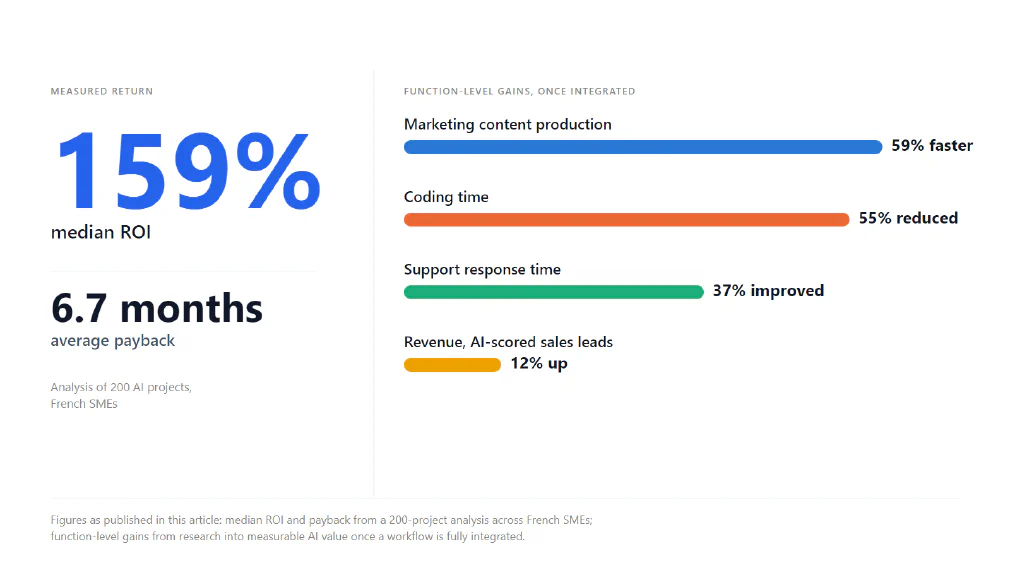
A single, properly scoped AI workflow delivers a measured, specific return, not a vague productivity story. The confusion in most reporting on this comes from lumping that result in with broad, unscoped AI rollouts, which behave completely differently.
This article sets out what the return actually looks like when a workflow is well-scoped and fully integrated, where the biggest gains have already been measured, and what separates that result from a pilot that never pays for itself.
Key Takeaways
- Analysis of 200 AI projects across French SMEs found a median ROI of 159%, with payback arriving in an average of 6.7 months.
- Function-level gains, once a workflow is properly integrated, include a 55% reduction in coding time, a 37% improvement in support response time, and 59% faster marketing content production.
- Independent research measured average time savings of 5.4% of work hours, roughly 2.2 hours a week, across regular AI users.
- Organisations that fully integrate AI into a specific function see a 3 to 5% revenue lift or a 10 to 15% cost reduction in that function, according to research into measurable AI value.
- Returns of 3.70 to 10.30 in value per 1 invested have been recorded for well-implemented projects, with value typically arriving within around 13 months.
- Early adopters of agentic AI report 15.2% average cost savings and 22.6% average productivity improvements, ahead of broader adoption figures.
- 66% of organisations report productivity and efficiency improvements as their most commonly realised benefit from AI adoption.
- The gains concentrate where a workflow is narrow and well-scoped. Broad, loosely-defined rollouts are where the return goes missing.
Where the Real Numbers Show Up
Analysis of 200 AI projects across French SMEs found a median return on investment of 159%, with payback arriving in an average of 6.7 months. That figure sits well above the vague, aggregate adoption statistics that dominate most coverage of AI in business, and the difference comes down to scope. A defined, single-purpose workflow produces a number that can be measured. A general AI rollout across an organisation usually does not.
Independent research measured average time savings of 5.4% of work hours among regular AI users, which works out to roughly 2.2 hours a week, close to a full working day reclaimed each month. That figure is an average across a wide range of use cases, and it understates what a genuinely well-scoped workflow can return.
Separate research into enterprise AI spending found a return of 3.70 to 10.30 in value for every 1 invested, with well-implemented projects reaching that value in around 13 months on average. The size of that range is itself informative: it is not a single expected outcome, it is a spread that depends heavily on how tightly the workflow was scoped going in.
What “Well-Scoped” Actually Looks Like in Practice
The clearest gains show up at the function level, once a workflow moves past general use and into a specific, integrated process. Measured gains include a 55% reduction in coding time, a 37% improvement in support response time, 59% faster marketing content production, and a 12% revenue uplift where AI is used to score and prioritise sales leads.
Each of those is a single, well-defined workflow, not a general AI capability sitting across an entire department. That distinction is the difference between a number that shows up in a spreadsheet and a tool nobody can point to a clear result from.
Early, Focused Adoption Outperforms Broad Rollout
The pattern holds at the adoption-strategy level too. Organisations that moved early and specifically into agentic AI, rather than deploying it broadly and generally, report an average of 15.2% in cost savings and 22.6% in productivity improvements, ahead of what broader, less-targeted adoption typically returns.
That aligns with the wider picture: in 2026 enterprise research, 66% of surveyed organisations named productivity and efficiency improvements as their most commonly realised benefit from AI, ahead of every other category measured. The organisations seeing that result are consistently the ones that started with a defined process rather than a department-wide initiative.
What follows
Start with one process, not a department-wide rollout, and pick the one with the clearest input, output, and review point. Measure it against a real baseline before building anything, since the return only shows up clearly when there is something specific to compare it against. Treat scope as the decision that determines the result, since the same underlying technology produces a measured 159% median return in one case and a markedly smaller one in another, depending entirely on how narrowly it was applied.
FAQ
Questions we get asked
What counts as a well-scoped AI workflow?
A well-scoped AI workflow is one built around a single, specific process, with a clear input, a clear output, and a defined point where a person reviews the result. It is fully integrated into how that process actually runs, rather than sitting alongside it as an optional extra tool.
How quickly does an AI workflow typically pay for itself?
Analysis of 200 AI projects across French SMEs found a median return on investment of 159%, with payback arriving in an average of 6.7 months. Payback speed depends heavily on how narrowly the workflow is scoped: a single, well-defined process pays back faster than a broad, loosely-defined rollout.
What kind of return can I expect per pound or dollar invested?
Research into enterprise AI spending found returns ranging from 3.70 to 10.30 in value for every 1 invested, with an average time to value of around 13 months for well-implemented projects. The wide range reflects how much scope and integration quality affect the outcome, which is exactly why narrow, well-defined workflows tend to land at the stronger end of that range.
Do early adopters see stronger results than general AI users?
Yes. Organisations adopting agentic AI early report an average of 15.2% in cost savings and 22.6% in productivity improvements, noticeably ahead of the broader averages seen across general-purpose AI use. Early, focused adoption of a specific workflow consistently outperforms broad, general rollout.
Is productivity improvement actually the most common benefit organisations report?
Yes. In 2026 enterprise research, 66% of surveyed organisations reported productivity and efficiency improvements, making it the single most commonly realised benefit of AI adoption, ahead of cost reduction, revenue growth, or any other category measured.
Ready to put this to work?
Tell us where your team is with AI and we will tell you honestly what would make the biggest difference.