What happens when nobody owns the AI you've rolled out
Nobody owns the AI you have already rolled out, and it shows months later. Here is what goes wrong and how to name an owner in 30 days.
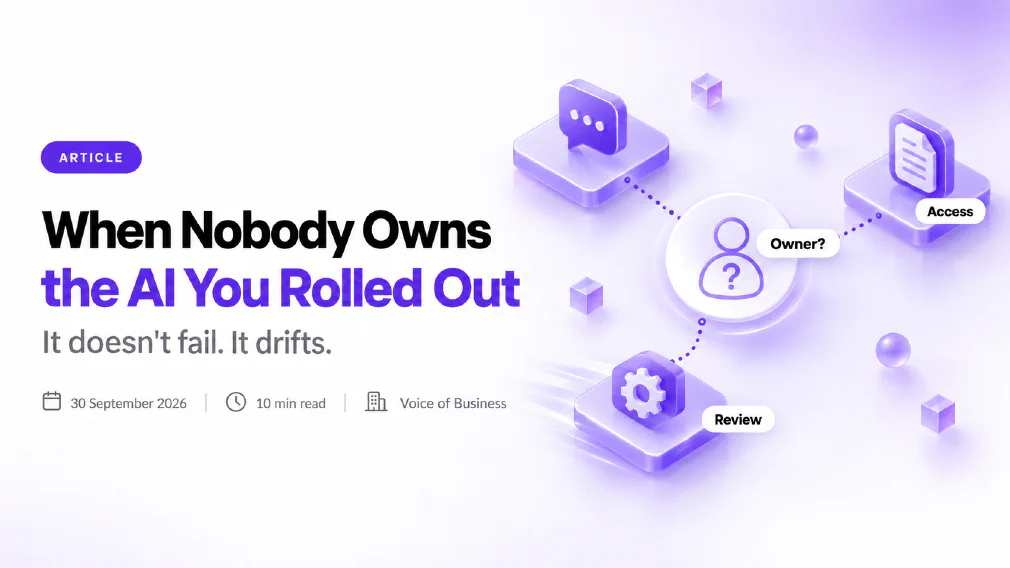
An AI tool that nobody owns does not fail on the day it goes live. It fails months later and quietly, when its outputs drift, its access widens, its written rules go stale and the person who set it up has moved on. Rolling out AI is a project with an end date. Owning it is a job with none, and most businesses only plan for the first.
This article explains what happens in the gap between the two, why that gap is so common, and how a small business can close it in about thirty days by naming one accountable person for every AI tool in use.
Key takeaways
- Buying or rolling out an AI tool and owning it are separate jobs. The first ends at launch, the second does not.
- Shared ownership is the usual failure. When IT, a department and the managing director each hold a slice, nobody holds the whole.
- Unowned AI rarely fails loudly. It drifts: output quality slips, access widens, rules go stale and incidents have no reporting route.
- Under the EU AI Act, deployers of high-risk systems must assign competent people to oversee them, so an owner has to exist before the duty applies.
- An owner is one named person per tool who can answer four questions: what it is for, who uses it, what it can reach, and when it was last checked.
- Thirty days is enough to list every tool, name an owner for each, write a one-page record and set a review date.
Unowned AI is the Normal state, not the exception
Most businesses that have rolled out AI can say who signed off the purchase. Far fewer can say who is responsible today for whether it is working. Those are different questions, and the gap between them is where the trouble starts.
The evidence is thin but consistent. One 2026 survey of 60 senior data and AI leaders found that 40% split ownership of AI strategy across several executives, and 17% said no one clearly owned it at all. Sixty people is a small sample and these are larger organisations with data teams, so read the figures as a signal about the pattern, not as a measurement of your sector.
A separate June 2026 survey of 2,000 senior technology executives is larger and points the same way. It found that 77% said AI adoption was already outpacing their governance, and 70% said teams across the business were deploying technology faster than IT could track. Two-thirds said they were held accountable for AI systems they did not fully control.
Put those side by side and the pattern is clear. If organisations with a dedicated IT function struggle to say who owns AI, a 30-person business with no such function is unlikely to be better placed. In a small business the tools arrive through individuals. Someone starts using an assistant to summarise client calls. A manager buys a licence for the team. A department connects a tool to a shared drive. Each decision is sensible on its own, and nobody adds them up.
This is also why banning tools does not solve the problem. A ban removes the visible use and leaves the invisible use, and the invisible use is exactly the part nobody owns.
In this article, “owner” has a narrow meaning. An owner is the one named person who can answer four questions about a given AI tool: what it is used for, who can use it, what data it can reach, and when it was last checked. They do not have to do the technical work. They have to be the person the question goes to.
Buying an AI Tool and owning it are Different jobs
A rollout is a project. It has a start, a budget, a champion and a date on which it is declared finished. Owning the result is operational work with no end date, and projects do not turn into it on their own.
Three things happen when a rollout closes. The project team disbands, so the person who understood how the tool was configured returns to their day job. The enthusiasm that carried the launch fades, because the tool is now simply part of the furniture. And responsibility spreads out, because an AI tool touches several functions at once. IT holds the account, the department holds the use, the managing director or legal holds the risk, and HR holds the training. Each has a genuine claim to a slice. Nobody holds the whole, and each slice-holder reasonably assumes that someone else is watching the rest.
That is why “who owns AI in a company” rarely has a clean answer, even in businesses that take the question seriously. Ownership by committee is ownership by nobody. A group can advise and agree principles, but a group cannot be the person who gets the call because the tool did something odd.
The second reason is that AI does not stay as it was installed. A conventional piece of software does what it did on the day it was set up until somebody changes it. An AI tool keeps moving. The vendor updates the model behind it, sometimes without an announcement that reaches the people using it. The documents it draws on change. New features switch on. Staff discover uses that nobody planned. Any of these can change what the tool does, and a review carried out at launch then describes a tool that no longer exists in quite that form. The checking has to keep moving because the tool does.
The third reason is that the missing owner is replaced by the users. When nobody sets the rules, people set their own. That is how a sanctioned assistant ends up alongside personal accounts and browser extensions the business never chose. It is also why governance work on AI so often begins with an inventory. You cannot own what you cannot list, and you cannot list what nobody is responsible for finding.
The named owner is one of the traits that separates AI projects that reach production from those that stall. The point extends past the pilot. An owner matters more after launch than before it, because that is when the attention has gone elsewhere.
What goes wrong after launch when nobody is Accountable
The costs of an unowned tool are slow and spread out, which is why they go unnoticed. Five turn up repeatedly.
Quality drifts. Nobody is sampling the outputs, so a summary tool that was accurate at launch becomes slightly less so, or starts to be used on a kind of document it was never tested on. Staff learn to trust it because it usually works, which is the moment a hallucination does the most damage, because nobody is expecting one.
Access widens. Permissions granted for a pilot stay in place. A tool connected to one folder gets connected to three. When a member of staff leaves, their account and its connections outlive them.
Policy goes stale. A rule written at launch does not mention the new features, the new tools or the new team. It sits on the intranet and nobody is responsible for reading it against reality.
Incidents have no route. Suppose an assistant sends wrong information to a client, or surfaces something it should not. Who is told first? Who decides whether it is reportable? In an unowned system that conversation starts from nothing, under pressure, while the clock runs.
The business cannot show its work. Customers, auditors and insurers increasingly ask which AI is in use, on what data and under whose supervision. “We think it is fine” is not an answer.
The legal position sharpens the last two. Under the EU AI Act, an organisation that deploys a high-risk AI system, as opposed to building one, has duties of its own. It must monitor the system for anomalies, dysfunctions and unexpected performance. It must keep the system’s logs for at least six months. It must assign competent people to oversee it. And it must inform the provider and the authorities if there is a serious incident.
The compliance deadline for stand-alone high-risk systems has moved to 2 December 2027, as the governance article reports, so this is not an urgent duty for everyone. Most everyday tools are not high-risk, and the Act does not ask every business to appoint someone for every chat assistant. But look at what each duty presumes. Monitoring needs someone monitoring. Oversight needs someone assigned. A business that has not decided who that is will find the deadline arriving without an answer. The same is true of data protection duties under GDPR, which attach to what a tool does with personal data, whoever bought it.
Here is an illustration, not a real client. A 40-person professional services business rolls out an AI assistant after a successful pilot run by an enthusiastic operations manager. Six months on, that manager has moved to another project. The assistant has since been connected to the shared drive, which includes a folder of HR documents that was never meant to be searchable. An employee asks it a routine question about the team and it returns text drawn from that folder. Nobody notices for weeks, because nobody’s job is to look. There was no attack and no fault in the tool. There was only a gap where an owner should have been.
How to give every AI Tool an owner in 30 days
The fix is not a committee, a new department or a large document. It is a short sequence that a small business can finish in a month, and it starts with a list.
Week one: list what is in use. Ask people rather than scanning accounts, and make it plain that the aim is to understand use, not to punish it. Include the tools staff pay for themselves and the AI features switched on inside software the business already has. The result is a single page: tool, who uses it, what it is used for. This is the inventory that the governance article describes, and it is usually the first time anyone has seen the whole picture.
Week two: name one owner per tool. Choose a person, not a team. Pick someone who feels the consequences when the tool goes wrong, which is often the head of the function that uses it and not automatically IT. They must have the authority to pause the tool, because responsibility without that power is only a title. If nobody can be found who is willing to be accountable for a tool, that is a finding in itself, and a reason to reconsider whether the tool should be in use.
Ownership works best when each question has one answer, even if several people contribute to it:
| The question | Who should hold it |
|---|---|
| Is the tool doing what it was bought to do? | The head of the function that uses it |
| Who can use it, and what can it reach? | Whoever administers the accounts |
| Is the data it touches allowed? | Whoever holds data protection |
| Are staff using it within the rules? | Line managers |
| What happens when it goes wrong? | The named owner, escalating to the managing director |
Week three: write the one-page record. For each tool, record its purpose, its users, the data it can reach and the date of its next review. Keep it short enough that it will be read. This is also the moment to be honest about which uses are automating a decision and not merely a task, because a tool that decides needs closer supervision than one that drafts. A rule that says “a person should check the output” is a hope, not a control. The record has to say who checks, and how often.
Week four: set the rhythm and the route. Put a quarterly review in the calendar for each tool, and a second trigger for whenever the vendor announces a change. Agree who is told, and in what order, if something goes wrong, before it does. Then make sure the owners can do the job. An owner does not need to be technical, but they do need enough AI literacy to ask good questions, and the people around them need to brief the team on what the owner is responsible for. Training in responsible and compliant use gives owners the vocabulary for it.
None of this is complicated, which is the point. The hard part is not the method but deciding that ownership is a job and giving it to someone by name. If you would rather have the whole estate mapped by someone outside the business, that is what an audit does: it lists every tool in use, checks what each one handles, and gives each one an owner and a review date. The five areas it examines are set out in what an AI audit checks. Whichever route you take, start with one name against one tool this week.
Sources
- Survey of 60 senior data and AI leaders on who owns AI strategy: 2026 industry report finding that 40% of organisations split ownership of AI strategy across several executives and 17% report no clear owner. The sample is small, which the article says.
- Survey of 2,000 senior technology executives on AI control and governance: June 2026 study finding that 77% say AI adoption is outpacing their governance, 70% say teams deploy technology faster than IT can track, and two-thirds of CIOs and CTOs are held accountable for AI systems they do not fully control.
- EU AI Act: obligations for deployers of high-risk AI systems: law-firm summary of the duties on deployers to monitor the system, keep its logs for at least six months, assign competent people to oversee it, and notify providers and authorities of serious incidents.
FAQ
Questions we get asked
Who should own AI in a company?
One named person for each AI tool, chosen because they feel the consequences when it goes wrong, not because they sit in IT by default. Ownership does not mean doing the technical work. It means being the person who can say what the tool is used for, who can use it, what data it can reach and when it was last checked. In a small business this is often an operations lead or a department head, with the managing director as the person they escalate to.
What is the AI accountability Gap?
It is the state in which several people each own part of an AI tool and nobody owns the whole of it. IT holds the account, a department holds the use, and legal or the managing director holds the risk, so each assumes another is watching. In a June 2026 survey of 2,000 senior technology executives, 77% said AI adoption was already outpacing their governance. The gap is organisational, not technical.
Does a Small Business really need an AI owner?
Yes, and arguably more than a large one, because a small business has no IT function that notices when a tool is added. AI usually arrives through individuals: one person starts using an assistant, a manager buys a team licence, a department connects a tool to a shared drive. Without an owner nobody adds those decisions up. In a 2026 survey of 60 senior data and AI leaders, 17% said no one clearly owned AI strategy, and those were mostly larger organisations.
What does an AI owner actually do?
Four things. They keep a one-page record of what the tool is for, who uses it and what data it reaches. They sample its outputs on a regular schedule. They check its permissions and settings after any change from the vendor. And they know who to tell, and in what order, if something goes wrong. They also have the authority to pause the tool, because responsibility without that power is only a title.
What happens if nobody monitors an AI Tool after rollout?
Usually nothing dramatic at first, which is the danger. Output quality drifts, permissions granted for a pilot stay in place, the written rules go out of date, and staff start using personal accounts to fill the gaps. When something does go wrong, there is no agreed route for reporting it and no record showing what the tool was doing. A survey of senior technology executives found 70% said teams were deploying technology faster than IT could track.
Do the EU AI Act Deployer duties apply to every AI Tool?
No. The monitoring, log-keeping and human oversight duties apply to deployers of high-risk AI systems, and most everyday business tools are not in that category. The compliance deadline for stand-alone high-risk systems has moved to 2 December 2027. Where the duties do apply, they require a competent person to be assigned to oversee the system and logs to be kept for at least six months, so the owner has to be decided before the deadline arrives.
How often should a deployed AI Tool be reviewed?
At least once a quarter, and again whenever the vendor announces a change to the model, the features or the terms. A quarterly review checks a sample of real outputs, the list of who has access, what data the tool can reach and whether the written rules still match how people use it. Put the next review date on the one-page record so that it does not depend on anyone remembering.
Ready to Put This to Work?
Tell us where your team is with AI and we will tell you honestly what would make the biggest difference.