ChatGPT vs Copilot: Which fits your Business?
Copilot and ChatGPT solve the same underlying problem from opposite directions: one lives inside the tools staff already use, the other is a separate destination. What that actually changes, with the data handling each provider states in its own documentation.
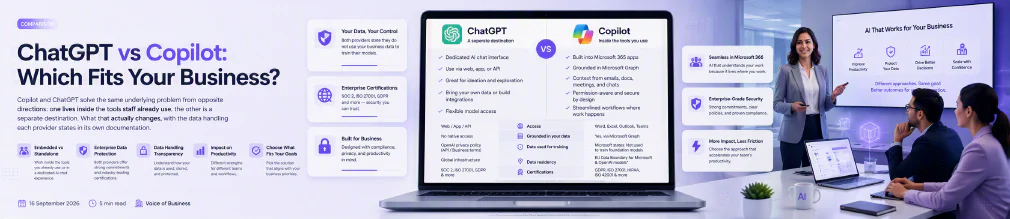
Copilot and ChatGPT get compared as if they are two answers to the same question. They are not. Copilot’s whole design is to sit inside the tools staff already have open (Word, Excel, Outlook, Teams) and answer using content those staff already have permission to see. ChatGPT is a separate destination, reached directly or built into something else through the API. That difference decides more of the real-world outcome than either provider’s raw capability does.
Key takeaways
- Copilot works by grounding responses in an organisation’s own Microsoft Graph content (emails, documents, chats, meetings), restricted to whatever the individual user already has permission to see.
- Microsoft states plainly that prompts, responses and Graph data are not used to train the foundation models behind Copilot.
- OpenAI states that data sent to its API is not used to train or improve its models unless an organisation opts in, a policy running since March 2023; ChatGPT’s own business tiers sit on a separate agreement worth checking directly.
- Microsoft’s EU Data Boundary covers its own and OpenAI’s models inside Copilot, but explicitly excludes Anthropic-supplied models from that boundary, a real, specific gap worth knowing before assuming “EU data stays in the EU” applies uniformly.
- Both providers hold real, named compliance certifications (SOC 2, ISO 27001 and related standards, GDPR), so the deciding factor for most organisations is workflow fit, not a security gap between them.
Where each one actually lives
Copilot is reached from inside the applications a business already runs its day on. It reads Microsoft Graph, the same permission-scoped index that already governs SharePoint and Teams access, so it can answer “what did we agree with this client last month” using the actual email thread, without a separate step to feed it that context. ChatGPT, by contrast, is its own interface: a chat window, or an integration a business builds itself against the API. It has no native awareness of an organisation’s own documents unless something is built to connect it to them.
Microsoft Copilot
Lives inside Word, Excel, Outlook, Teams
Reads Microsoft Graph, permission-scoped
Answers grounded in your own data
ChatGPT
A separate interface or API integration
No native awareness of your documents
Needs a connection built to see your data
Neither approach is better in the abstract. A business already running on Microsoft 365 gets Copilot’s grounding built into the tools people already use, with no separate integration step to set it up. A business that wants a general-purpose assistant, or one building a specific product on top of a model’s raw capability, gets more flexibility from the API route ChatGPT and its business tiers are built around: the kind of custom AI Automation work that starts once a tool is chosen, not before.
What each provider actually states about your Data
Microsoft’s own documentation is direct: prompts, responses, and any data Copilot accesses through Microsoft Graph “aren’t used to train foundation LLMs, including those used by Microsoft Copilot,” a commitment that covers the third-party OpenAI and Anthropic models Copilot can also call on, not only Microsoft’s own.
OpenAI’s equivalent commitment, as stated in its API documentation, is that data sent to the API is not used to train or improve its models unless an organisation explicitly opts in, in place since March 2023. That is the API’s own documented terms. ChatGPT’s business tiers run on a separate customer agreement, and the honest answer for anyone deciding between them is to check that agreement’s exact wording for the tier being bought, rather than assume the API policy carries over unchanged. That kind of check is exactly what a proper AI audit walks through before a tool gets adopted, not something a comparison article alone can settle.
The EU Data detail that’s easy to miss
For an EU-based organisation weighing GDPR obligations this is worth reading closely rather than assumed: Microsoft states that Copilot’s EU Data Boundary keeps EU traffic for its own and OpenAI’s models inside the EU. It also states, in the same documentation, that models supplied by Anthropic as a subprocessor are currently excluded from that EU Data Boundary. An organisation choosing which underlying model Copilot uses for a given task is choosing whether that specific commitment applies; it is not automatic across every model option inside the same product.
Comparison at a glance
| Aspect | Microsoft Copilot | ChatGPT (business tiers) |
|---|---|---|
| Where it’s reached from | Inside Word, Excel, Outlook, Teams and other Microsoft 365 apps | A separate interface, or built into something else via the API |
| Grounded in your own data by default | Yes, via Microsoft Graph, permission-scoped to the user | No, unless something is built to connect it |
| Training on your data | Stated not to happen, across Copilot’s own and third-party models it uses | Stated not to happen for the API, since March 2023; check the specific business-tier agreement |
| EU data boundary | Applies to Microsoft’s and OpenAI’s models; explicitly does not apply to Anthropic-supplied models within Copilot | Governed by OpenAI’s own data residency terms for the product tier in use |
| Named certifications | GDPR, ISO 27001, HIPAA, ISO 42001 | SOC 2 Type 2, ISO 27001/27017/27018/27701, PCI DSS, GDPR, ISO 42001 |
| Best fit | An organisation already running on Microsoft 365, wanting AI embedded in existing tools | An organisation building its own product or workflow on top of a model directly |
Which fits your organisation
The honest starting point is what the organisation already runs on, and what the workflow actually needs it to do: grounded in existing documents, or built into something new. That is exactly the question an audit’s Identify step is built to answer, weighed against what a candidate process actually handles rather than decided in the abstract. Once a tool is chosen, a core AI course on it is what turns the decision into something the people using it day to day actually know how to do.
FAQ
Questions we get asked
Does Microsoft Copilot train on our organisation's Data?
No. Microsoft states directly that prompts, responses, and data accessed through Microsoft Graph are not used to train the foundation models behind Copilot, including models supplied by third parties such as OpenAI and Anthropic.
Does ChatGPT train on Data sent to it?
For the API specifically, OpenAI states that data sent is not used to train or improve its models unless an organisation explicitly opts in, a policy in effect since March 2023. That is the API's documented policy; ChatGPT's business tiers (Team, Enterprise) sit on their own customer agreement, which is worth checking directly against the tier actually being bought rather than assumed from the API terms.
Is Copilot's EU Data handling the same for every Model it uses?
No, and this is worth knowing before assuming EU data stays in the EU by default across the board. Microsoft states that EU traffic for its own and OpenAI's models stays within the EU Data Boundary, but that models supplied by Anthropic as a subprocessor are currently excluded from that EU Data Boundary.
Which one is more Secure?
Both providers publish real, checkable compliance certifications rather than marketing claims alone: Copilot is built on Microsoft's existing GDPR, ISO 27001, HIPAA and ISO 42001 commitments; OpenAI's business products are covered by a SOC 2 Type 2 report and ISO 27001, 27017, 27018, 27701 and 42001 certifications. Neither publishes a claim that the other doesn't also make in some form, so the deciding factor is usually integration and workflow fit, not one being unambiguously more secure.
Ready to put this to work?
Tell us where your team is with AI and we will tell you honestly what would make the biggest difference.