SEO vs GEO: What changes and what doesn't
Google says optimising for AI answers is still SEO. Where SEO and GEO overlap, where they split, and what a business should do first, with sources.
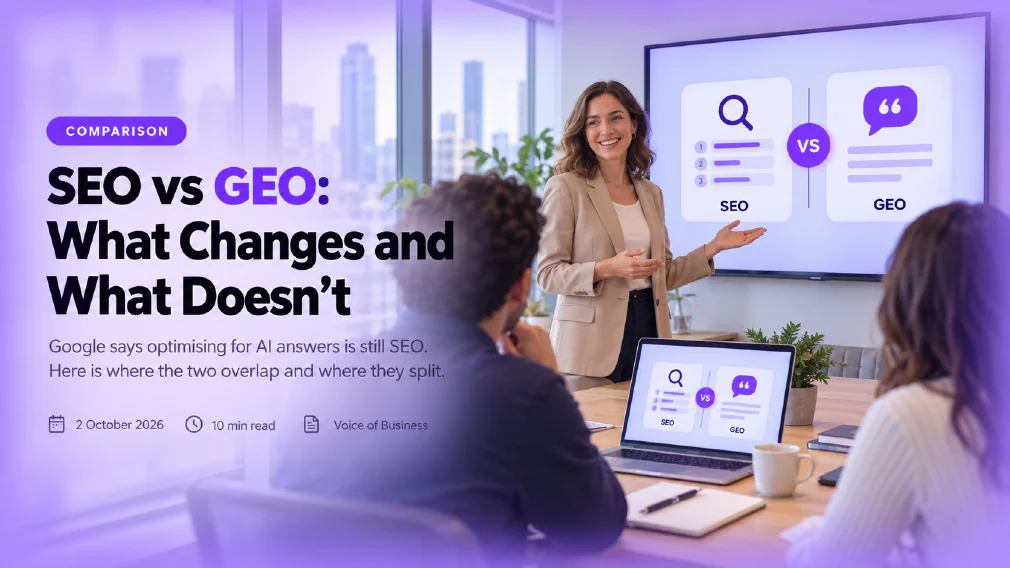
SEO and GEO are mostly the same work with a different finish line. Both reward pages that can be crawled, that say something original and that come from a source people have reason to trust. What differs is what you are trying to win: a position in a list of links, or a place inside an answer that may never send anyone to your site.
This review sets out what each discipline is, what Google itself says about the overlap, where the two genuinely split, what the evidence shows about how AI answers choose sources, and which one a business should put first.
Key takeaways
- SEO aims to rank a page in a results list. GEO, generative engine optimisation, aims to have content retrieved and cited inside an AI-generated answer.
- Google’s published guidance says optimising for its AI features is still SEO and that no special markup, AI text file or content chunking is needed. That guidance covers Google only.
- Outside Google the overlap is looser: on average only 12% of AI-assistant citations came from Google’s top 10 in a 15,000-query study.
- Ordinary search still sends far more traffic than AI platforms, so SEO foundations come first.
- A citation can be won without a click, so GEO needs its own measurement: whether you are cited, how often and for which questions.
- The sensible plan for most businesses is sequential: fix the SEO base, then add the low-cost habits that make content easy to quote.
What each one is, and what Google says about the overlap
SEO is the long-established practice of making a site easy for search engines to find, understand and rank. The unit of success is a page, the reward is a click and the measure is a position and the traffic that follows. GEO is the newer name for making content easy for an AI system to retrieve and use when it writes an answer. The unit is closer to a passage than a page, the reward is a mention or a citation, and the measure is how often and how prominently you appear in the answer.
The term was formalised in an academic paper presented at a major data-mining conference in 2024, which defined generative engine optimisation as a way for content creators to improve their visibility in generative engine responses. Since then it has become a marketing category of its own, with agencies and software tools selling it as a separate service.
Google has now answered whether it is separate. Its published guide to generative AI features in Search, last updated in July 2026, states that optimising for generative AI search is optimising for the search experience, and so is still SEO. It goes further and names tactics it says you can skip: you do not need new machine-readable files, AI text files, special markup or Markdown, there is no special schema.org markup to add for AI features, you do not need to split pages into small chunks, and manufactured brand mentions are not as useful as they might seem. What it recommends instead is unusual, non-commodity content with first-hand expertise, a sound technical foundation, and accurate business data.
That is a strong position, and it should be read for what it covers. It describes Google’s own AI features, such as the AI Overviews written by its Gemini models, which sit on top of Google’s ranking systems. A trade-press report on the guide makes the same caveat: signals for other assistants may differ. ChatGPT, Perplexity and Claude run their own retrieval and make their own choices about what to cite. So the accurate version of the claim is that for Google, GEO is SEO, and for everything else the overlap is large but not guaranteed.
Where the two genuinely diverge
Once the shared foundations are accounted for, three real differences remain. The first is the path from question to answer. In classic search, a person types a query, the engine ranks pages for that query, and the person chooses one. In an AI answer, the system typically breaks the question into several related searches, gathers passages from many pages and has a large language model write a single response. Your page is competing to be one of the sources behind an answer, not to be the top result for one phrase.
SEO path
A person types a query into the search box
The engine ranks pages for that query
The person clicks a result and lands on your site
Success is measured in position, clicks and conversions
GEO path
A person asks a full question in conversation
The system runs several related searches behind the scenes
It pulls passages from many pages and writes one answer
Success is measured in citations, mentions and share of answers
The second difference is the unit of content. A page that wanders through five topics can still rank. A passage is more likely to be quoted when it answers one question completely, in plain words, with the fact and its source close together. That is not a licence to fragment pages, which Google says is unnecessary, but it is a reason to write each section so it makes sense if lifted out on its own.
The third difference is measurement, and it is the one most businesses underestimate. SEO has mature instruments: rank trackers, click data and conversion reports. For generative answers, Google now provides a generative AI performance report in Search Console, which covers its own AI features. For other assistants there is no equivalent first-party report, so the practical method is to ask a fixed set of real customer questions at regular intervals and record whether and how your brand is cited. It is slower and noisier than rank tracking, and it is the honest cost of working in a channel that does not report to you.
A final point is about what stops mattering. Because generative systems understand synonyms and intent, rewriting copy to chase exact keyword variants, which was always a weak tactic, becomes a worse one. The effort moves from phrasing to substance: original facts, named expertise and clear sourcing.
What the Evidence shows
The numbers matter most here, so they are gathered in one place. On overlap, a study of 15,000 long-tail queries run in July 2025 found that on average 12% of the pages cited by four AI assistants also ranked in Google’s top 10. Individual assistants sat near 8%, apart from Perplexity at 28.6%. The authors’ reading is that assistants run many query variations and fuse the results, so citations come from pages that rank well across related searches, not necessarily the original question. That is why a page that ranks for the broad topic can be cited for a question it never targeted, and why a top-10 position for one phrase does not guarantee a mention.
On behaviour, a Pew Research analysis of 68,879 Google searches by 900 US adults in March 2025 found that people clicked a traditional result in 8% of visits when an AI summary appeared and in 15% when it did not. Citations in a summary are not a substitute for traffic, but the click is no longer the whole prize. On scale, a June 2025 Similarweb comparison of the top 1,000 sites, reported by an SEO publication, put Google at about 191 billion monthly referrals against 1.1 billion for all AI platforms combined, roughly 170 to one.
On technique, the 2024 generative engine optimisation paper reported that its methods could raise visibility in generative engine responses by up to 40%, and that the effect varied by subject area. That is a result from a research benchmark, not a promise for your site, and it is best read as evidence that how content is written changes how often it is used, not as a figure to plan around.
Taken together, the evidence supports a measured conclusion. Ranking still matters because it puts a page into the pool assistants draw from and because most traffic still arrives through ordinary search. But rank alone is no longer a reliable proxy for being quoted, which is the argument made in why ranking on Google isn’t enough, and the content techniques that raise visibility are covered in what earns a citation.
What to do, in order
The order of work matters more than the label on it. Start with the foundations Google names, because they serve both disciplines: pages that are crawlable and indexed, load properly and carry content that cannot be found elsewhere in the same form. A page that is not indexed cannot be retrieved by anything.
Fix the base
crawlable, indexed, fast
Publish original content
first-hand facts, named expertise
Make answers self-contained
one question, one clear passage
Source every figure
the fact and its origin together
Track citations
a fixed set of real questions
Then make each section quotable. Put the direct answer first, state it in plain words, and place the evidence and its source beside it. Visible question-and-answer blocks work for the same reason: each answer stands alone. Keep figures sourced, because an assistant can only repeat a number with confidence if the page shows where it came from, and a reader checking it needs the same. Assistants are built to give answers that are grounded in sources they can point to, so a page that shows its sources plainly is easier for them to use and safer for them to repeat.
On markup, the position is straightforward. Google says it is not required for its AI features, so there is no case for treating it as a ranking lever for them. It still earns rich results in ordinary search and costs little to keep accurate, so it is worth maintaining on its own merits. Whether other assistants read such files or markup is not documented in the way Google’s guidance is, so any claim of guaranteed benefit should be treated with suspicion. The same goes for pitches that present GEO as a secret method with a fixed price of entry. The research is young, the results vary by subject area, and the one authority that has published detailed guidance describes the work as ordinary search optimisation done well. A supplier worth hiring will say which parts are established practice, which are experimental, and how they will show you the difference in your own numbers.
Finally, measure. Choose twenty to thirty questions a real customer would ask, run them on a regular schedule across the assistants your market uses, and record whether you are named, whether you are linked and what is said. The trend over months is the signal. A single run proves little because answers vary from one attempt to the next.
Comparison at a glance
| Aspect | SEO | GEO |
|---|---|---|
| Goal | Rank a page in a list of results | Be retrieved and cited inside a generated answer |
| Unit of content | The page | The passage that answers one question |
| Reward | A click to your site | A mention or citation, with or without a click |
| How the system works | Ranks pages for the typed query | Runs several related searches and fuses the passages |
| Measurement | Rank, clicks, conversions | Citation rate, brand mentions, a Search Console AI report for Google’s features |
| What Google says | The core discipline | Still SEO for Google’s features; no special markup needed |
| Traffic today | The dominant source | Small but growing, and often zero-click |
| Shared foundations | Crawlable, original, trustworthy content | The same |
When SEO-first fits
SEO-first fits almost every business that is not yet ranking for the questions its customers ask. If key pages are not indexed, load slowly or repeat what a dozen competitors already say, GEO tactics are premature because assistants cannot cite what they cannot find. It also fits any business whose leads arrive mainly through ordinary search, where the traffic gap described above means the larger prize is still the click.
When to add GEO
Add deliberate GEO work once the foundations are sound and the buying journey in your market visibly involves assistants: long, advisory questions, comparisons, and research done before anyone contacts a supplier. It fits businesses whose expertise is the product, such as consultancies, specialist services and technical suppliers, because original knowledge is exactly what assistants quote. It also fits any organisation that wants to know what AI systems currently say about it, which is a reputation question as much as a traffic one.
Which fits your Business
For most businesses the honest answer is both, in sequence, with one budget and one team. The practical split is simple: spend first on the shared foundations, then on the writing habits and tracking that make content easy to cite. A business unsure of its starting point can have an AI audit map where its content stands today, and a discovery call is the quickest way to find out whether the gap is in the foundations or in how the content is written.
Sources
- Google’s guide to optimising for generative AI features in Search: Google’s own position, updated July 2026, that this work is still SEO, with the list of tactics it says are unnecessary and the note on the Search Console AI report.
- Search Engine Journal on Google’s AI search guide: a May 2026 trade-press summary of the guide, including the caveat that it applies to Google Search and not to other assistants.
- The KDD 2024 paper that introduced generative engine optimisation (arXiv): the academic paper that defined the term and reported visibility gains of up to 40% on its benchmark, varying by domain.
- AI citation overlap with search results (Ahrefs): a July 2025 study of 15,000 long-tail queries finding that on average 12% of AI-assistant citations ranked in Google’s top 10, with Perplexity highest at 28.6%.
- Google users are less likely to click on links when an AI summary appears (Pew Research): 68,879 searches by 900 US adults in March 2025, with clicks on a traditional result in 8% of visits with an AI summary and 15% without.
- AI impact on Google search traffic, 2026 data (Digitaleer): a compilation that reports the June 2025 comparison of Google and AI-platform referrals across the top 1,000 sites, at roughly 170 to one.
FAQ
Questions we get asked
What is the difference between SEO and GEO?
SEO aims to rank a page in a list of search results so people click through to it. GEO, generative engine optimisation, aims to have your content retrieved, quoted and cited inside an AI-generated answer. The two share most of their foundations: crawlable pages, original content and clear authority. They split on what success looks like, since a citation can be won without a click.
Is GEO just SEO under a New name?
For Google's own AI features, largely yes. Google's guidance says that optimising for generative AI search is optimising for the search experience, and so is still SEO. That guidance covers Google only. Other assistants retrieve and cite differently, and a 15,000-query study found that on average only 12% of AI citations came from pages in Google's top 10.
Do I need to rank on Google to be cited by AI Assistants?
Ranking matters but does not decide it. In a July 2025 study of 15,000 long-tail queries, on average 12% of the pages cited by ChatGPT, Gemini, Copilot and Perplexity ranked in Google's top 10 for the same query. One assistant, Perplexity, reached 28.6%. Assistants tend to cite pages that rank well across many related searches, not only the exact question asked.
Does GEO need special markup or an llms.txt file?
Not for Google. Its guidance says you do not need new machine-readable files, AI text files, markup or Markdown to appear in its AI features, and that no special schema.org markup is required. Structured data still earns rich results in ordinary search, so keeping it is sensible. Whether other assistants read such files is not documented in the same way.
Should a Small Business invest in GEO or stick with SEO?
Fix the SEO foundations first, because AI answers draw on them and most traffic still arrives through ordinary search. A June 2025 comparison of the top 1,000 sites put Google at about 170 referrals for every one from all AI platforms combined. Then add the GEO habits that cost little: original sourced facts, self-contained answers and tracking whether you are cited.
Ready to Put This to Work?
Tell us where your team is with AI and we will tell you honestly what would make the biggest difference.