What Makes AI Training Actually Stick
Formal AI training produces a measurably faster, stronger return than letting staff teach themselves. Here is what the strongest programmes have in common.
Formal AI training produces a measurably faster and stronger return than letting staff teach themselves, and the factors that make a programme work are well understood rather than guesswork. Most organisations still default to letting individual staff work AI out on their own time, treating training as a cost to defer rather than a return to capture, and the numbers below are a direct answer to why that default is the more expensive choice.
We see the same pattern from inside the programmes we run: teams trained on their own workflows close the adoption gap in months, and teams left to self-teach are still closing it a year later, often having settled on habits that a structured programme would have corrected in the first session. This article sets out what the data says about formal training compared with self-directed learning, which specific factors drive the biggest gains, and what that means for building or improving a programme now.
Key Takeaways
- Organisations with formal AI training programmes achieve 2.3 times faster AI adoption and 67% higher AI ROI than organisations without one.
- 70% of AI success comes from people, process, and change management, not from algorithms or infrastructure, which is exactly what training addresses.
- Digital training applied to real workflows is 93.7% more effective than generic, traditional training methods.
- Adaptive learning produces 58% higher knowledge retention than static, one-size-fits-all content.
- Structured AI training correlates with a 40% improvement in measured employee productivity.
- Only 19% of workers have been through a formal AI training programme, leaving a clear opening for organisations that build one properly now.
The gap between formal training and self-teaching
Organisations with formal AI training programmes achieve 2.3 times faster AI adoption than organisations without one, and see 67% higher AI ROI on top of that faster adoption. That is not a marginal difference, it is the gap between a workforce that uses AI confidently within a defined process and one where individual staff each work out their own approach at their own pace.
The explanation sits in where AI success actually comes from. Research into what separates strong AI adopters from weak ones found that 70% of AI success is attributable to people, process, and change management, with the remaining 30% down to the technology itself. Training is the mechanism that addresses the larger share of that equation, not the smaller one.
What the strongest programmes have in common
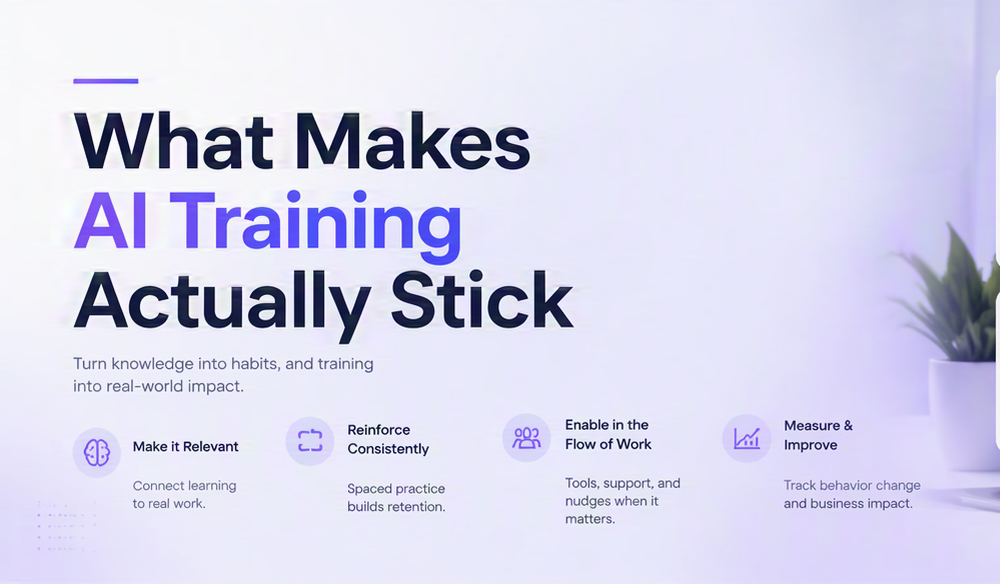
Two factors show up consistently in the data on what makes training actually work. First, relevance: digital training applied directly to real workflows is 93.7% more effective at moving staff towards organisational expectations than generic, traditional training delivered in the abstract. Staff retain what they practise on their own tasks far better than what they are told in a session unconnected to their day-to-day work.
Second, personalisation: adaptive learning, where the content adjusts to how an individual is actually progressing, produces 58% higher knowledge retention than a fixed curriculum delivered identically to everyone. Retention is the figure worth tracking, since completing a course and being able to use what it covered are not the same thing.
Put together, these factors translate into a real operational outcome. Organisations investing in structured AI training report a 40% improvement in measured employee productivity, which is what turns training from a cost into a business case with a traceable return.
The opportunity sitting in the gap
Fewer than one in five workers, 19%, have currently been through a formal AI training programme. Most staff using AI today are doing so through self-directed experimentation rather than any structured programme.
That is not a shortfall to dwell on, it is the size of the opportunity available to an organisation that builds a proper programme now. Every one of the figures above, the faster adoption, the higher ROI, the stronger retention, the measured productivity gain, was recorded against a backdrop where most competitors have not yet done this.
What follows
Build training around the specific workflows staff already do, rather than generic AI literacy content, since that relevance is where the largest effectiveness gain comes from. Choose or design a programme that adapts to individual progress rather than delivering identical content to everyone, and measure retention over time rather than course completion alone. Treat the programme as ongoing rather than a single event, since the tools and the tasks worth applying them to will keep changing faster than a one-off session can account for. If you want a second opinion on where your own programme stands against these numbers, book a 30-minute discovery meeting and we will go through it together.
FAQ
Questions we get asked
Does formal AI training actually produce a better result than letting staff teach themselves?
Yes, and by a wide margin. Organisations with formal AI training programmes achieve 2.3 times faster AI adoption and 67% higher AI ROI compared to organisations without one. Self-directed learning still produces some skill, but it is markedly slower and less consistent across a team.
Is technology or people the bigger factor in successful AI adoption?
People and process, according to research covering what separates successful AI adopters from unsuccessful ones: 70% of AI success comes from people, process, and change management, not from the underlying algorithms or infrastructure. A well-run training programme addresses the 70%, not the 30%.
Why does training applied to real workflows work better than generic training?
Digital training applied directly to real workflows is 93.7% more effective at moving employees towards organisational expectations than traditional, generic training methods. The difference comes from relevance: staff retain and apply what they practise on their actual tasks far better than what they hear described in the abstract.
What training format produces the best knowledge retention?
Adaptive learning, where the training adjusts to how an individual is progressing rather than delivering the same fixed content to everyone, produces 58% higher knowledge retention than static, one-size-fits-all training. Retention, not completion, is the meaningful measure of whether training actually worked.
Does AI training improve measurable productivity, not just confidence?
Yes. Organisations investing in structured AI training report a 40% improvement in employee productivity, a measurable operational outcome rather than a self-reported sentiment score. That figure is what turns a training budget into a business case.
How common is formal AI training right now, and what does that mean for organisations that invest in it properly?
Fewer than one in five workers, 19%, have been through a formal AI training programme, with most staff instead experimenting on their own. That gap is exactly where the return described above gets captured: an organisation that builds a proper programme now is competing against a workforce that is still mostly self-taught.
Should AI training happen once, or on an ongoing basis?
Ongoing. AI tools and the tasks worth applying them to change faster than a single training event can account for, and the productivity and retention gains above were measured in organisations treating AI training as a continuing programme rather than a one-off session.
Ready to put this to work?
Tell us where your team is with AI and we will tell you honestly what would make the biggest difference.