
Bespoke / In-House Training
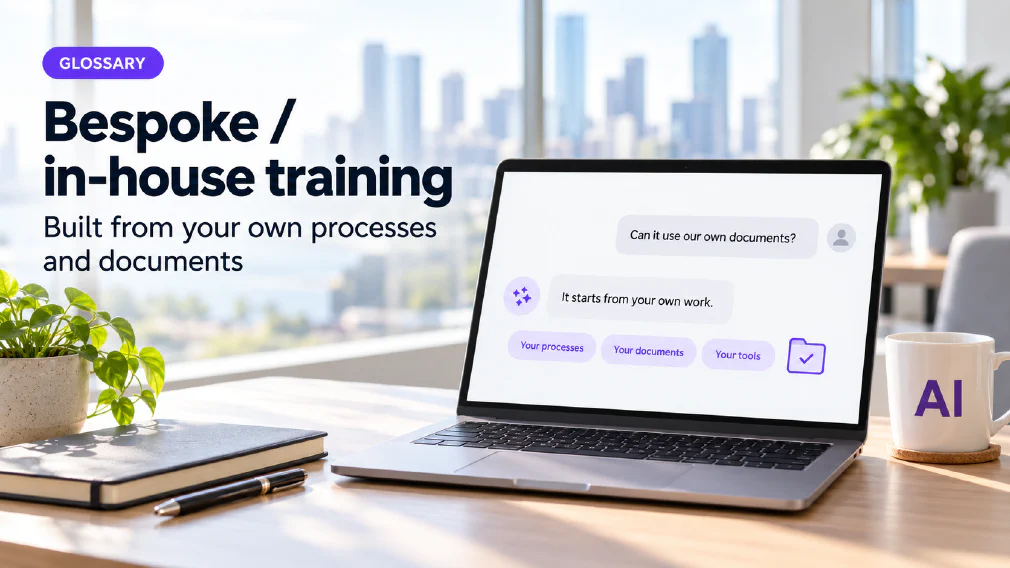
A training programme built from an organisation's own processes and documents, rather than a published outline, scoped in a conversation.
What Bespoke Training is
Bespoke training, also called in-house training on this site, is a programme built from an organisation’s own processes and documents and not from a published outline. It is scoped in a conversation. Nothing in it is demonstrated on invented material. The examples are the organisation’s own work.
The site puts the difference from a course in one sentence. A core AI course teaches a subject. A bespoke programme takes the work your teams already repeat and rebuilds it in front of them, using their own documents, their own systems and their own vocabulary.
Core Course or Bespoke
The two formats start from opposite directions. A core AI course runs to a published outline, so what it covers can be read before anyone is contacted. A bespoke programme has no standard shape to publish, because the shape follows what a discovery conversation turns up.
The site’s review says the real decision is whether a team needs a proven session on a known subject, or needs its own processes worked through first. A core course is the entry point for a team that knows roughly what subject it needs. Where the choice is genuinely unclear, an audit is what settles it before either format is booked.
Built from your own material
Building from the organisation’s own processes and documents is the whole idea. The training article gives the reason it works. Digital training applied directly to real workflows is far more effective than generic training, because staff retain and apply what they practise on their own tasks better than what they hear described in the abstract. That relevance is where the largest gain comes from.
It is also why the bespoke page’s comparison table sets what it delivers against generic AI awareness and content with no context. The table claims practical capability that is usable on Monday morning. This page repeats that claim as the site states it and adds none of its own.
Scoped in a Conversation only
The site is firm that bespoke and in-house work is scoped through direct conversation only. Duration, session count and content are all set during scoping, so none of them is published in advance. Scope is decided in conversation and not on a page.
This page follows the same rule. It states no length, no number of sessions and no price for any programme, because none is published. The discovery call page explains what that first step settles: which processes are in scope, who needs to be in the room and whether training is the right instrument at all.
How a Programme is put together
The bespoke page describes the pattern in five steps. It opens with a discovery call, then an AI audit where one is warranted, then automation and agent implementation for whatever the audit finds. The fourth step is training and ongoing support for the people who will run it. The fifth, where it is asked for, is white-label delivery.
White-label means an organisation delivers the training to its own clients under its own brand. The site is careful about it. It is an arrangement on top of the three services and not a fourth service. The page’s motto for the whole thing is short: start small, scale fast, and each phase justifies the next.
Who goes first
The recommended entry sequence is a leadership briefing first and then all-staff foundations. The reason given is that top-down commitment and bottom-up capability then arrive together, so the people deciding and the people doing the work reach the same starting point at the same time.
The leadership masterclass is the first step. It is recommended for leaders before staff training begins, and its outcomes are to make informed decisions about generative AI, guide adoption responsibly and align strategy with business goals. Its governance section covers the organisation’s own approved tools and not a generic list.
Session shapes in the Catalogue
The catalogue describes several sessions of this kind, each with a published summary that says it is tuned to the organisation. The all-staff briefing spends half its time on risks, compliance and regulation. A session for finance and data teams runs on the organisation’s own kind of material and on freely available tools, so nothing depends on a paid rollout.
A hackathon is not a taught session: every participant builds their own use case on their own work with a trainer in the room. A programme for editors and authors keeps editorial control and applies the house style. A build day is built around one team’s own documents and problems, using real work and not examples. A rules-first briefing suits staff receiving a deliberately limited Copilot rollout. These are starting shapes and not fixed products.
Who it suits
The bespoke page says it suits process-heavy organisations with structured teams in support, operations, admin and sales, already running a CRM, Microsoft 365 or Google Workspace, and with no structured AI strategy yet. It serves both SMEs and Enterprises.
Core courses suit a team that already knows the subject it needs, at any level, without a scoping step first. A bespoke programme suits a team whose strategy needs building around its own processes first. Both can sit in the same organisation, and the review says the choice is about fit and not about one being better.
Governance is built in
The bespoke page says EU AI Act and GDPR content is built into every foundational programme and not bolted on at the end, and it sets that against providers with no compliance or governance content. The all-staff briefing and the leadership masterclass show what that looks like in practice.
The AI governance page covers the rules a programme teaches, and the EU AI Act page covers the regulation. The site is careful about the limit. Training teaches the subject, and no training substitutes for advice from a qualified lawyer.
Preparing a team
The briefing article says people arrive at training with nothing to try it on, and that is a decision somebody made by not making it. The fix is one hour, about a week before, run by the manager, naming the tasks in scope and asking each person to bring a real example.
For bespoke work the article says this matters arguably more. A core course arrives with its own examples if a team turns up empty-handed. A bespoke programme is built from what a team brings, so a session run without a briefing has nothing of its own to build from, and the trainer ends up improvising a generic session at bespoke cost.
After the Session
The training article gives two tests for whether training worked. Retention over time is the meaningful measure and not course completion alone, and the training should be ongoing and not a single event, because the tools and the tasks worth applying them to change faster than a one-off session can account for.
That is why the pathway in the comparison table runs from leadership to staff to advanced work to agents, and not as one event. The AI literacy page covers what the working understanding is. The business outcomes page covers what the whole sequence is meant to leave behind.
A worked example
This is an illustration, not a real client. A small firm has a mixed team of support and operations staff and no AI strategy. The managing director books a discovery call, and nothing is quoted or scheduled on the call. It settles that the firm should start with its leaders and then its staff, and that one process, the shared support inbox, is the natural material.
The programme is scoped from there. The managers attend a leadership briefing. A week before the staff sessions, each manager runs the one-hour briefing and everyone picks a real inbox task to bring. The sessions run on the firm’s own tools and its own documents. Nothing is demonstrated on invented material, and the firm decides afterwards whether an audit is warranted.
Mix-ups worth avoiding
Four confusions come up often enough to name. The first is treating bespoke as meaning more expensive or bigger. It means built from your own material. The second is treating it as a fixed package with a published length, when duration, session count and content are set in scoping.
The third is treating it as the same as an audit or as the only way to get training. The core courses can be requested directly. The fourth is treating the first call as a sales call with a quote, when nothing is quoted or scheduled in it.
Where it goes wrong
The commonest failure is turning up with nothing to work on, so the programme has nothing of its own to build from. A second is skipping the leaders, so staff learn something their managers have not agreed to. A third is choosing bespoke when a proven session on a known subject is what the team needs.
A fourth is treating the programme as one event and not measuring retention. A fifth is treating a programme as a substitute for the rules. The site says a rule people understand gets followed in cases it did not anticipate, and that is what training is for.
Where it appears on the site
The bespoke training page describes the format, and the review of core courses against bespoke training sets out how to choose. The training catalogue lists every session.
Every bespoke programme starts with a discovery call, which is where scope is set. For the alternative, see the core AI course page.
FAQ
Questions about Bespoke / In-House Training
What is Bespoke or In-House AI Training?
A training programme built from an organisation's own processes and documents, and not from a published outline, scoped in a conversation. Nothing is demonstrated on invented material. The examples are the organisation's own work.
How is it Different from a Core AI Course?
A core course teaches a subject to a fixed outline, chosen from six. A bespoke programme has no fixed outline and takes the work a team already repeats and rebuilds it in front of them, using their own documents, systems and vocabulary. A core course suits a team that knows what subject it needs and wants a proven session first.
Core AI CourseCore AI Courses vs Bespoke Training: Which fits your team?
Why is there no published length, Session count or Content?
Because the shape follows what the discovery turns up. Duration, session count and content are all set during scoping, so none of them is published in advance. Bespoke and in-house work is scoped through direct conversation only.
How does a Bespoke Programme start?
With a discovery call. It runs thirty minutes, nothing is quoted or scheduled during it, and nothing is committed on either side. It establishes which processes are in scope and who needs to be in the room.
Who should be trained first?
The recommended entry sequence is a leadership briefing first and then all-staff foundations, so top-down commitment and bottom-up capability arrive together. The leadership masterclass is recommended for leaders before staff training begins.
Masterclass AI for leaders and managers: Vision, impact & Strategy
Does Bespoke Training include the EU AI Act and GDPR?
Yes. EU AI Act and GDPR content is built into every foundational programme and not bolted on at the end. The all-staff briefing spends half its time on risks, compliance and regulation, and the leadership masterclass opens on a governance-first section covering the organisation's own approved tools.
Is Bespoke Training the same as an Audit?
No. The published pattern has five steps: a discovery call, an AI audit where one is warranted, automation and agent implementation, training and ongoing support, and white-label delivery where it is asked for. Training is one of the three services, and the audit is a separate diagnostic that may or may not be needed first.
How should a team prepare?
With a one-hour briefing about a week before, run by the manager. The site says this matters arguably more for bespoke work, because a bespoke programme is built from what a team brings, so a session run without a briefing has nothing of its own to build from.
What it means for a Business
It is built from an organisation's own processes and documents rather than a published outline, which is why it is scoped in a conversation instead of being picked off a catalogue page.
Ready to Put This to Work?
Tell us where your team is with AI and we will tell you honestly what would make the biggest difference.