
Prompt
The instruction a person gives an AI system to produce a result. Writing effective prompts is one of the practical skills every core AI course teaches.
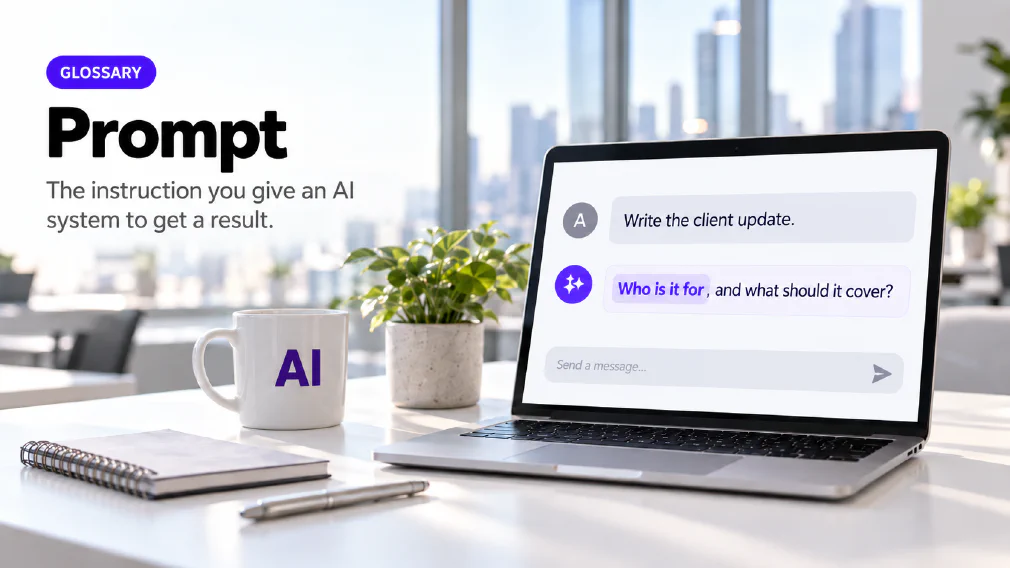
What a Prompt is
A prompt is the instruction you give an AI system to get a result. It can be a single question, a paragraph of background followed by a task, or a document with a request attached. Whatever its length, it is the only thing the tool has to go on. The model cannot see your inbox, your last meeting or the way your team likes a report set out unless the prompt, or a feature that feeds the prompt, supplies it.
That makes the prompt the one part of an AI tool a person controls directly on every request. The model underneath is fixed by the vendor. The interface is fixed by the product. What you type is yours. This is why writing prompts is one of the practical skills every core AI course on this site teaches, and why the foundational courses treat it as a skill to practise rather than as theory.
What the Tool does with a Prompt
A large language model reads the prompt, predicts the most likely next token, adds it to what has been written so far and predicts the one after that. It repeats the step until the answer is complete. It does not look the answer up. It completes a pattern that your prompt started.
Two things follow from that. First, everything in the prompt shapes the pattern. A vague request starts a vague pattern and gets a generic reply. A request that names the reader, the format and the source material starts a narrower pattern, so the reply lands closer to what you needed. Second, the model works only with what is in view. The prompt, any attached document and the model’s own growing answer share one context window, so a longer prompt leaves less room for everything else.
This applies to every tool built on a language model, which is why the same skill carries from one product to the next. The wider category is generative AI, and a prompt is how a person steers any of it.
The four parts of a Prompt
The prompting workshop on this site starts from one reliable method, the four essential parts of a prompt: goal, context, source and expectations.
The goal is what you want done and what the result is for. The context is the background a newcomer to the task would need, including who will read the result. The source is the material the answer should draw on, such as a document you attach, rather than whatever the model happens to remember. The expectations describe what good looks like: the format, the length, the tone and what to avoid.
Take a bare instruction such as “Write the client update.” A new hire given only that line would guess, and so would an AI tool. Now write the same request with all four parts. The goal is a short update on this month’s progress. The context is who reads it and what last month’s version looked like. The source is the meeting notes you attach. The expectations are the length, the tone and a request to flag anything that slipped. The task is identical. The result is not, because nothing has been left for the tool to guess.
Context matters more than wording
The instinct with AI tools is to fix a poor result by rewording the prompt: sharper verbs, more specific phrasing, a cleverer instruction. Our article on briefing an AI tool like a new hire argues that this treats the problem as one of language when it is one of missing context. The study it cites linked most of the extra rounds of editing to incomplete context, not to poor wording.
That article sets out six things a good brief covers: the job the tool is doing right now, the deliverable and its reader, the background a newcomer would need, what to avoid, one example of a result you have accepted before, and how the output will be judged. The four parts above and the six things are two views of the same idea. Both say the sentence you type is the smallest part of a good prompt, and the paragraph nobody wrote before it is the largest.
Techniques worth knowing
Once the four parts are in place, a set of techniques changes what the tool does with them. The prompting workshop covers these in order.
Personas give the tool a role, so it answers as a specific kind of expert or in a specific house style. One-shot and few-shot prompting show the tool one or several examples of the output you want, which is often quicker than describing it. Output format control fixes the shape of the reply, and asking for sources and citations makes the answer easier to check.
Question and answer prompting reverses the usual direction. You ask the tool to interview you before it answers, so it collects the missing context itself. A version of the same idea grounds the questions in a document you attach, with a fallback so that when the document does not say, the tool replies “not specified in the document” instead of inventing something. Chain of thought and tree of thought ask the tool to work through a problem in steps or branches rather than jumping to a conclusion. Prompt chaining splits a large task into a sequence in which each output feeds the next. These techniques are collected under prompt engineering.
From one Prompt to a Reusable Tool
A prompt that works once is worth keeping. The move from writing prompts to reusing reliable ones is the subject of the prompt library: a kept set of prompts already shown to work, reused rather than rewritten. A prompt template is the same idea one step smaller, a fixed structure with gaps you fill in for each task. Meta prompting goes the other way and uses the AI to write and improve your prompts for you.
Some prompts stop being prompts at all. A scheduled prompt runs on its own at set times, and the workshop’s example is a weekly AI news digest. An AI agent goes further and takes several steps with less oversight at each one. The workshop closes on a decision framework for choosing between a prompt, a template, a scheduled prompt and an agent, because the right answer depends on how often the task repeats and how much judgement it needs.
Standing rules sit alongside all of this. Custom instructions are set once and applied to every request, so you stop restating the same context each time. A prompt then only has to carry what is specific to the task in front of you.
Where Prompts go wrong
A prompt cannot turn a language model into a fact checker. The model predicts plausible text, so a wrong statement reads exactly like a right one. A better prompt reduces the room for an invented answer, because a real example, a named reader and a clear standard give the tool something concrete to match. It does not remove the problem. That failure has a name, hallucination, and the answer still needs a human to check it before it goes out. The workshop treats humans in the loop, and why verification matters, as part of the method rather than an afterthought.
Prompts also fail for ordinary reasons, and the workshop teaches prompt debugging for those: why prompts fail, and five questions that fix them. Working through a failed prompt is a faster way to improve than starting again with a new phrasing.
The last risk is what goes into the prompt. Everything you type is data, and staff put internal emails, client information and contracts into personal AI accounts where no clear rule exists, as our article on why banning AI at work backfires sets out. The fix in that article is a short rule drawn by kind of data, not by tool, together with an approved tool that is good enough for daily work. Vendors state that business content typed into their tools is not used to train their models by default. That is a policy each vendor publishes, and a business should read it for itself.
Where it is taught and where it shows up in an Audit
Prompting is part of every core AI course on this site. The set courses teach it as a practical skill on the tools a business already has. The Art of Prompting workshop, over two half days, goes deepest. It is a follow-along session in which participants write their own prompts, send them into the chat and are coached on improving them live. Participants leave with a repeatable method rather than a list of tricks, and with a hints and tips book of every prompt used in the session written out in full.
An audit meets prompts from the other side. Repeated prompts are a signal. When a team keeps rewriting the same prompt, the task behind it is a candidate for a template, a scheduled prompt or an agent, and that is the kind of workflow an audit identifies. It also separates the work that suits a language model from the work that needs a fixed rule, which is what automation provides. Knowing what a prompt is, and what one can and cannot do, is what makes that judgement possible.
FAQ
Questions about Prompt
What is a Prompt in AI?
A prompt is the instruction a person gives an AI system to produce a result. It can be one question, a paragraph of background and a task, or a document with a request attached. It is the only thing the tool has to go on, so the result can only be as good as what the prompt supplies.
What is the difference between a Prompt and Prompt Engineering?
A prompt is the instruction itself. Prompt engineering is the practice of structuring that instruction deliberately, rather than typing the first phrasing that comes to mind, so the result is closer to what is actually needed. Everyone who uses an AI tool writes prompts. Prompt engineering is the skill of writing them well, and it is taught as a practical skill in the foundational courses, not as theory.
What makes a Good Prompt?
A good prompt carries four things: a goal, the context around it, the source material the answer should draw on, and your expectations for the result. These are the four essential parts taught in the prompting workshop. A prompt that names only the task leaves the tool to guess the other three, and a guess reads as a generic answer.
Does the exact wording of a Prompt matter?
Less than the context around it. Bad AI output is usually a missing-context problem, not a wording problem, so rewording a bare instruction with sharper verbs rarely fixes it. Adding the reader, the format, the background and an example of a result you have accepted before does. A plainly worded prompt with the right context usually beats a cleverly worded one without it.
Why does the same Prompt give Different Answers in Different Tools?
Because the model is only part of the product. Each vendor trains its own model, tunes it differently and wraps it in different features, so two tools built on large language models can produce noticeably different answers to the same prompt. Prompting skill carries across tools, though. The prompting workshop is not tied to one tool and runs on whichever chatbot an organisation uses.
Can a better Prompt stop an AI Tool making things up?
It reduces the chance but does not remove it. A vague prompt with no context is exactly the condition an invented answer thrives in, because the tool has nothing concrete to match against. A prompt with a real example, a named reader and a clear standard gives it less room to invent. The answer still needs a human check before it goes out under a business's name.
When should a Prompt become a Template or an Agent?
When the same task keeps coming back. A prompt you write once for a one-off job stays a prompt. One you rewrite every week is a candidate for a saved template, a scheduled prompt or an AI agent, depending on how much of the work needs judgement each time. The prompting workshop closes on exactly this decision, and an audit looks for the same signal across a whole business.
Is it Safe to put company Information into a Prompt?
It depends on the data and on the tool. Client information, contracts and HR records should not go into any AI tool unless a rule says they may, and personal accounts sit outside anything the business can see. Major vendors state that business content typed into their tools is not used to train their models by default, but that is a policy each vendor publishes and a business should read for itself.
What it means for a Business
Writing effective prompts is one of the practical skills every core AI course teaches, and the foundational courses treat it as a skill to practise rather than as theory.
Ready to Put This to Work?
Tell us where your team is with AI and we will tell you honestly what would make the biggest difference.