
Prompt Library
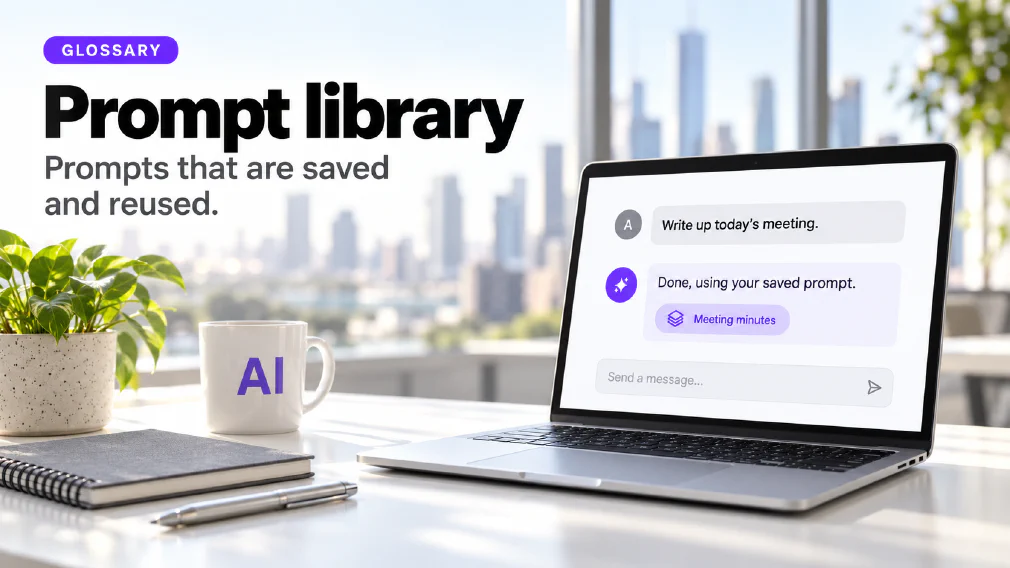
A kept set of prompts that have already been shown to work, reused instead of rewritten each time. It is the move from writing prompts to reusing reliable tools, and it is how a repeated task costs less the second time.
What a Prompt Library is
A prompt library is a kept set of prompts that have already been shown to work, reused instead of rewritten each time. The idea is small, and the courses treat it as a stated takeaway and not as a topic covered in passing. The prompting workshop names it as the move from writing prompts to reusing reliable tools.
The reason is cost. A prompt that took some effort to get right the first time should not need the same effort the second time. A repeated task costs less when the working version is already to hand.
A Prompt that works once is worth keeping
The prompt and prompt engineering pages make the same point in the same words. A prompt that works once is worth keeping. That is the step from a person who writes good prompts to a team that has a set of them, and the two are different outcomes.
The briefing article puts it through a comparison. A new hire gets a written induction once and does not have it repeated from memory every morning. Writing six lines into every request gets tedious for the same reason. A library of briefs that already cleared the bar, reused rather than rewritten, turns the skill into a resource someone can open.
What goes into one
A prompt earns its place in a library by being complete. The prompting workshop teaches four essential parts of a prompt, which are goal, context, source and expectations. A saved prompt that carries all four gives the same reliable result each time, because nothing has been left for the tool to guess.
The briefing article sets out six things a good brief covers. They are the job the tool is doing right now, the deliverable and its reader, the background a newcomer would need, what to avoid, one example of a result you have accepted before, and how the output will be judged. Read together, the two lists describe what a kept prompt should hold. Where a prompt has a part that changes each time, such as the meeting notes or the name of the client, that part is a gap to fill in.
Templates, and the Library around them
A prompt template is a fixed structure with gaps you fill in for each task. It is the same idea one step smaller than a library, and the two are taught together. A library is the kept set, and templates are often what it holds.
The editors and authors workshop treats the pair as a way to tackle repeated tasks. Its editorial workflows block covers prompt libraries, template filling, and templates and structured reports, with meeting minutes from a transcript as an example. The prompting workshop adds meta prompting, which uses the AI to write and improve your prompts, and prompt debugging, which gives a poor result a diagnosis instead of a guess at new wording. Both are ways to bring a prompt up to the standard where it is worth keeping.
A worked example
The ChatGPT Enterprise course gives a plain picture. Participants build custom GPTs for recurring work, among them an AI prompter, an HR assistant and expense categorisation. Each of those is a task that recurs and follows rules, so the working prompt is worth more each time it is reused.
Take meeting minutes. The first version is written with care, with a goal, the context of who reads the minutes, the transcript as the source, and the format expected. It is tested, corrected and kept. From then on, someone opens the saved prompt, pastes in the new transcript and gets minutes in the same shape. The effort went in once.
From a Library to a Prompt Library Agent
A library can also live in a database. The Excel and databases session builds a project and prompt library agent live, with version history so the library compounds. It teaches building the database first, before you build the agent, and it covers how agents work with databases and where they struggle.
The Copilot advanced workshops include a prompt library agent in their agents block, and the advanced generative AI course lists a prompt library agent and advanced prompt library ideas under agents with memory. The spreadsheet agent in the real use cases course carries a prompt library and a rules sheet the agent reads.
The distinction underneath is the one the memory page draws. A fixed set of prompts is a snapshot. A library held in a database the agent can read and write can grow as people use it, and version history keeps the earlier versions.
Choosing between a Prompt, a Template, a scheduled Prompt and an Agent
The prompting workshop closes on a decision framework for choosing between these four, and the answer depends on how often the task repeats and how much judgement it needs. A task that recurs and follows rules suits a template or a scheduled prompt. One that needs several steps, a source and a tool suits an AI agent.
A prompt library sits at the first of those steps. It is the lightest way to stop repeating yourself, and the framework asks for the lightest option that does the job. The advanced course asks where a saved prompt is enough, and does not treat a custom GPT as the answer to every repeated task.
Standing Rules and saved Prompts
A saved prompt does not have to carry everything. Custom instructions are standing rules set once and applied to every request, so each prompt only has to supply what is specific to the task. Your role and the tone you want belong in the standing set. The goal, the source and the expectations for this piece of work belong in the prompt.
The split also decides what a library needs to hold. A library of prompts that each restate your role and your house style is longer than it needs to be, and every copy has to be updated when either changes. Keeping the stable parts in one place and the task parts in the library is the same judgement the personalisation session teaches for custom instructions and memory.
Keeping it Useful
A library only compounds if it stays current. The databases session builds version history in for that reason. It is worth deciding who is allowed to add to a shared library and what a prompt has to show before it goes in. That is advice built on the material above and not a claim the courses make in those words. A prompt that has not cleared the bar is a draft, and a library full of drafts is the same as no library.
What not to put in
Everything you type into an AI tool is data, and that includes the example inside a saved prompt. The briefing article recommends one example of a result you have accepted before. If that example is a real client letter, it now sits in the prompt, and it is copied wherever the prompt goes. The site’s article on why banning AI at work backfires argues for a rule drawn by kind of data and not by tool.
Client information, contracts and HR records should not go in unless a rule says they may. The personalisation course closes on using public AI safely, with public, anonymised, generic or invented content only. An invented example does the same job in a saved prompt and carries no risk.
Mix-ups worth avoiding
Four confusions come up often enough to name. The first is treating a prompt library as the same thing as a library in the Mistral workshop. There, libraries are knowledge bases for grounded answers, which hold documents. A prompt library holds prompts. The second is treating it as a custom GPT, which holds a role and rules for one job.
The third is assuming a prompt that worked before will keep working without a check. The same prompt can give a different answer on a different day, and it still needs reading. The fourth is treating the library as a substitute for context. A saved prompt has gaps for a reason, and the missing context for this task still has to go in.
Where it goes wrong
A saved prompt does not check facts. It can produce a reply that reads well and is wrong, which is hallucination, and it is a property of how generative AI works, not a fault in the library. Reuse makes the risk easier to forget, because a prompt that has worked ten times feels settled.
The working habit does not change. Ask for the source, open the source and treat the first reply as a draft. The person who sends the result on is responsible for what it says.
Where it is taught and where it appears in an Audit
The art of prompting course is where the move from writing prompts to reusing reliable tools is made, alongside templates, meta prompting and scheduled prompting. ChatGPT Enterprise Essentials builds an AI prompter as a custom GPT, and the editors and authors workshop tackles repeated tasks with one. The Excel and databases session builds a prompt library agent live, the Copilot advanced workshops and the advanced generative AI course include one, and the real use cases course carries a library inside an agent. Six of the courses are the core AI courses, and the rest sit in the wider training catalogue.
An audit meets a prompt library as a sign of repetition. Where people in a team rewrite the same prompt for the same task, the work repeats, and the prompting workshop’s decision framework sorts it by how often it repeats and how much judgement it needs. A task that recurs and follows rules is a candidate for a template or a scheduled prompt, and the audit weighs that against what the process handles.
FAQ
Questions about Prompt Library
What is a Prompt Library?
A prompt library is a kept set of prompts that have already been shown to work, reused instead of rewritten each time. It is the move from writing prompts to reusing reliable tools. It is how a repeated task costs less the second time.
What should go into a Prompt Library?
Prompts that have already cleared the bar. The site's briefing article sets out what a good one covers, including the job, the deliverable and its reader, the background, what to avoid, one accepted example and how the result will be judged. A prompt that only worked once, with no idea why, is not yet ready to be kept.
What is the difference between a Prompt Library and a Prompt Template?
A template is a fixed structure with gaps you fill in for each task. A library is the kept set of prompts, and templates are often what it holds. The prompting workshop teaches them together, in the block on the move from writing prompts to reusing reliable tools.
Is a Prompt Library the same as a Custom GPT?
No. A prompt library is a kept set of prompts you choose from. A custom GPT is an assistant that holds a role and a set of rules for one job, so whoever uses it does not write the brief each time. The advanced course asks where a saved prompt is enough, and does not treat a custom GPT as the answer to every repeated task.
What is a Prompt Library Agent?
It is an agent built around a library, so the prompts live in a database it can read and write and grow as people use it. The databases session builds a project and prompt library agent live, with version history so the library compounds, and teaches building the database first, before the agent. The Copilot advanced workshops and the advanced generative AI course include one too.
Can I put client Information into a saved Prompt?
Treat everything you type into an AI tool as data, because it is, and that includes the example inside a saved prompt. The site's rule is drawn by kind of data and not by tool. Client information, contracts and HR records should not go in unless a rule says they may. The personalisation course closes on public, anonymised, generic or invented content only.
Why banning AI at work backfires, and what to doAI Agents & Personalisation
Does a saved Prompt guarantee a correct Answer?
No. A prompt that worked before still produces an answer that can read well and be wrong, which is hallucination. Reusing a prompt saves the writing. It does not check a fact. The answer is a draft, and the person who sends it on is responsible for it.
What it means for a Business
It is a stated takeaway rather than a subject: the ChatGPT Enterprise course builds custom GPTs for recurring tasks, an AI prompter among them, and the advanced sessions build a prompt library agent live, with version history so the library compounds.
Ready to Put This to Work?
Tell us where your team is with AI and we will tell you honestly what would make the biggest difference.