Core AI Courses vs Bespoke Training: Which fits your team?
A core AI course teaches a subject to a fixed shape. A bespoke programme rebuilds the work a team already repeats, in their own documents and systems. What actually decides which one a team needs.
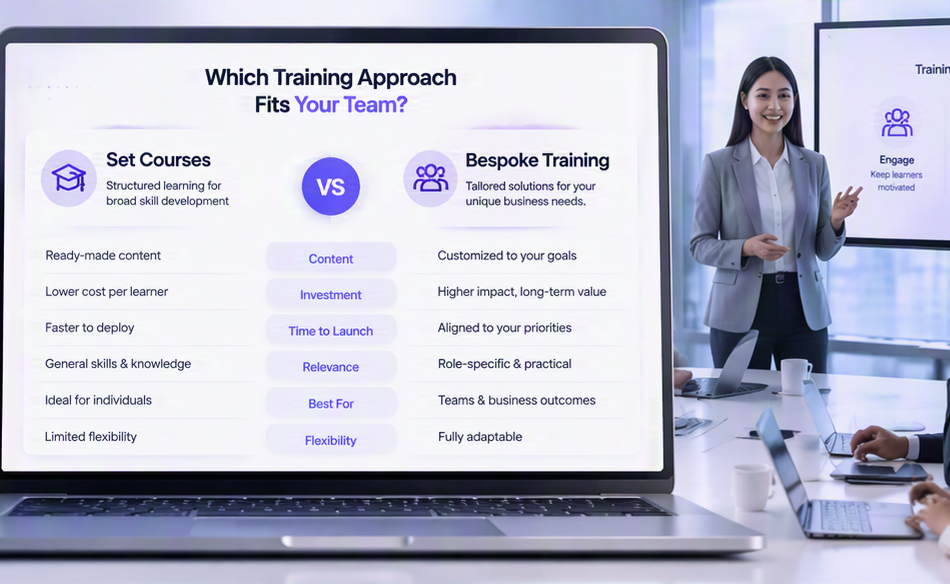
Six sessions run to a fixed shape. Everything else is scoped in a conversation and built around whatever an organisation actually runs on. That is the real difference between core AI courses and bespoke / in-house training, and it decides more about which one fits a given team than price or subject matter does.
Key takeaways
- Core AI courses are six fixed sessions, from a general foundation through to one-to-one work, run to a published outline.
- Bespoke programmes have no fixed outline. Scope is decided in conversation and built from the organisation’s own documents, systems and vocabulary.
- Bespoke work follows a five-step pattern: a no-commitment discovery call, an AI audit if warranted, automation and agent implementation, training and ongoing support, and, where it is asked for, white-label delivery on top of those three services.
- Every course in the catalogue publishes the same group rate, and bespoke work is priced through the discovery call.
- Both formats build EU AI Act and GDPR content into the session itself, not as an add-on.
What a Core AI Course actually is
A core AI course is the fixed end of the catalogue: six sessions, each with a published outline, running from Generative Artificial Intelligence: The Basics & Beyond through function-specific sessions for HR and admin teams, into agents, and finishing at 1-2-1 Personal AI Training for a single senior person with no syllabus at all. A core AI course is the entry point for a team that knows roughly what subject it needs covered and wants a proven session rather than a discovery call first.
What Bespoke Training actually is
A bespoke programme starts from the opposite direction. There is no standard shape to publish, because the shape follows what a discovery conversation turns up. The published pattern has five steps: a discovery call with no commitment attached, an AI audit where one is actually warranted, automation and agent implementation for whatever the audit surfaces, training and ongoing support for the people who will run it, and, for organisations that want to deliver AI services under their own name, white-label delivery. That last one is an arrangement on top of the three services rather than a fourth service. Nothing in a bespoke programme is demonstrated on invented material; the examples are the organisation’s own work.
Discovery
call
No commitment
AI
Audit
Where warranted
Automation &
agent build
What the audit finds
Training &
support
For who runs it
White-label
delivery
Where asked for
Who each one suits
Core AI courses suit a team that already knows the subject it needs, at any level from a first introduction to advanced agent work, without a scoping step first. Bespoke work suits process-heavy organisations, SME and Enterprise, already running structured teams on a CRM, Microsoft 365 or Google Workspace, without a structured AI strategy in place yet. The recommended way into bespoke work is a leadership briefing first, then all-staff foundations, so the people deciding and the people doing the work arrive at the same starting point together.
Comparison at a glance
| Aspect | Core AI courses | Bespoke / in-house training |
|---|---|---|
| Shape | Six fixed sessions, published outline | No fixed shape; scoped in conversation |
| Built on | A standard curriculum | The organisation’s own documents, systems and vocabulary |
| Tools taught on | ChatGPT, Microsoft 365 Copilot and Mistral Le Chat have courses of their own; the ChatGPT and Copilot sessions compare those against Gemini, Claude, Perplexity and DeepSeek | Whatever the organisation already has, on its own files |
| Entry point | Request a course directly | A discovery call, no commitment |
| Compliance content | Built into the sessions that need it (e.g. AI Agents & Personalisation) | Built into every foundational programme |
| Pricing | Every course publishes the same group rate | Scoped and priced through conversation |
| Best fit | A team that knows the subject it needs | A team whose AI strategy needs building around its own processes first |
Which one to start with
Both formats come out of the same team: 5,000+ professionals trained across European organisations, with 20+ years in automation, optimisation and IT operations, not just teaching about them. The real decision is whether a team needs a proven session on a known subject, or needs its own processes worked through first. Where that is genuinely unclear, an AI audit is what settles it before either training format gets booked.
FAQ
Questions we get asked
What's the Actual difference between a Core AI Course and Bespoke Training?
A core AI course teaches a subject to a fixed outline, chosen from six sessions covering a beginner foundation through to one-to-one work. Bespoke training has no fixed outline at all; the content is scoped in conversation and built from the organisation's own documents, systems and vocabulary.
How much does each option cost?
Every course in the catalogue, the core courses included, publishes the same rate, priced per group in two bands by group size rather than per person. Bespoke work is scoped and priced through direct conversation, since duration and content both depend on what the scoping turns up. The published figures are on the pricing page.
Do both formats cover EU AI Act and GDPR Compliance?
Both include real governance content, not as an afterthought. Bespoke programmes build EU AI Act and GDPR material into every foundational programme, and core courses such as AI Agents & Personalisation and Copilot Essentials carry their own governance and safe-use content as part of the session, not a bolt-on.
Can a team start with a Core AI Course and move to Bespoke work later?
Ask when scoping. Which order suits a team depends on what it already knows, and bespoke work is scoped in conversation rather than run to a fixed outline. The one order that is set out is the one within bespoke work itself: a leadership briefing first, then all-staff foundations, so top-down commitment and bottom-up capability arrive together.
Ready to Put This to Work?
Tell us where your team is with AI and we will tell you honestly what would make the biggest difference.