Gemini vs ChatGPT: Which fits your Business?
Gemini lives inside Google Workspace. ChatGPT is its own destination. What each provider's own documentation states about pricing, data and EU residency.
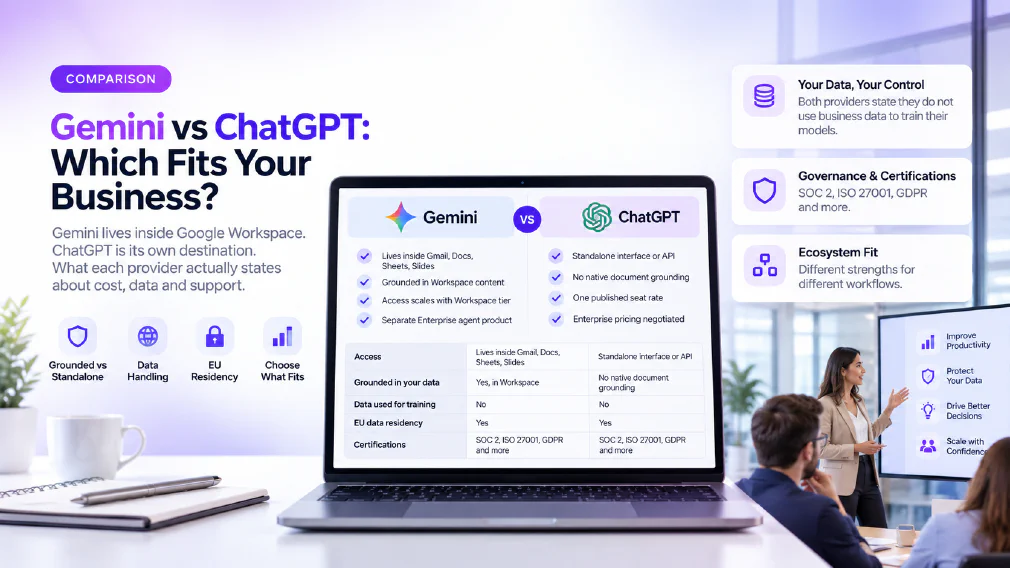
Gemini and ChatGPT get compared as if picking one settles the question. It does not, because they are not competing on the same axis. Gemini’s whole design is to sit inside Google Workspace, answering from documents and messages a user already has open. ChatGPT is a separate destination, reached directly or through the API, with no Workspace-style grounding built in by default. That difference decides more of the real-world outcome than either model’s raw capability does, and it is the one most comparisons skip past to argue about benchmarks instead.
This review sets out what each product actually is, since two names cover more than one product on the Google side, what each one costs once the plan tiers are read properly, what each provider states in its own documentation about training data and EU residency, and which one a given organisation should actually pick.
Key takeaways
- Gemini’s main business use is Google Workspace, bundled into Business and Enterprise plans since March 2025, with full access across Gmail, Docs, Sheets, Slides, Meet and Chat starting at the Business Plus tier.
- Gemini Enterprise is a separate Google Cloud product, an AI agent platform formerly called Agentspace, priced and sold apart from Gemini inside Workspace. Confusing the two is an easy, avoidable mistake.
- ChatGPT Business is billed per seat on a published, annual-or-monthly rate, with a higher-capacity seat type available for heavier usage. ChatGPT Enterprise pricing is not published and is negotiated directly with OpenAI.
- Both providers state that Business and Enterprise data is not used to train their models by default, and both now offer EU-region data residency for regulated workloads.
- Google’s certifications (SOC 1/2/3, ISO 27001 and its related family, FedRAMP High, HIPAA) and OpenAI’s (SOC 2 Type 2, ISO 27001 and its related family) cover largely the same ground, so the deciding factor is rarely security written down on paper.
- The workable question is which ecosystem a business already runs on, not which model tests marginally better on a benchmark neither business will ever run itself.
What “Gemini” and “ChatGPT” actually cover
Google sells generative AI for business under two names that are easy to conflate. Gemini inside Google Workspace is the assistant built into Gmail, Docs, Sheets, Slides, Meet and Chat, bundled into a Workspace subscription rather than sold on its own. Gemini Enterprise is a different product, a standalone Google Cloud platform for building and running AI agents, previously called Agentspace, priced and bought separately from a Workspace plan. A business asking what Gemini costs needs to know which of the two it means before a number means anything.
ChatGPT has one name and covers roughly one shape: a standalone interface at chatgpt.com, or the same models called through OpenAI’s API and built into something else. Team, Business and Enterprise are tiers of the same product line, not separate platforms, which is simpler to reason about even where it is less deeply wired into a business’s existing documents by default.
Gemini (Google Workspace)
Lives inside Gmail, Docs, Sheets, Slides, Meet, Chat
Grounded in Workspace content the user already has
Full access needs Business Plus or Enterprise
Gemini Enterprise is a separate product, bought apart
ChatGPT
A separate interface, or an API integration
No native grounding in your own documents
One published price up to the Business tier
Enterprise pricing is negotiated, not listed
What each one costs, seat by seat
Gemini’s cost sits inside a Workspace subscription rather than standing on its own. Google prices Workspace in rising tiers, Business Starter, Standard and Plus, with Enterprise quoted directly, and Gemini’s own reach rises alongside it rather than being switched on across the board: Starter carries Gemini in Gmail and Vids only, Standard extends it across Gmail, Docs and Meet, and full access across every app, Gmail, Docs, Sheets, Slides, Drive, Meet and Chat, needs Business Plus or above. A business reading only the entry-level Workspace rate is not necessarily reading a rate that includes full Gemini access at all.
ChatGPT’s business pricing is published rather than negotiated, at least up to the Business tier. It is billed per seat, with an annual commitment priced below the equivalent monthly one, a low seat minimum, and a separate, higher-capacity seat type for users who need more usage than the standard seat allows. Enterprise carries no published rate. OpenAI negotiates it directly with each buyer, which is worth knowing before a business assumes the Business-tier rate simply scales up.
What each provider states about your Data
Google states directly that Workspace, including whatever Gemini processes inside it, is not used to train its generative AI models without the customer’s explicit permission, and that content is not reviewed by human reviewers for that purpose either. Administrators can choose to keep Gemini’s Workspace integration data inside the EU specifically, through Google’s data-region controls, an option that covers Gemini’s Workspace integrations and not the separate consumer Gemini app.
OpenAI’s equivalent commitment covers ChatGPT Business, Enterprise and the API. None of them use submitted data to train or improve OpenAI’s models by default, and an organisation stays opted out unless it deliberately opts in. OpenAI now offers data residency in the EEA and Switzerland, alongside the UK, the US, Canada and several other regions, for Enterprise, Edu and API customers, so data can be stored, and for some customers processed, at rest inside the EU rather than assumed to sit there by default.
Both sides carry real, checkable certifications rather than marketing claims. Google’s Workspace and Gemini stack holds SOC 1/2/3, ISO 27001 and its related family (27017, 27018, 27701), ISO 42001, FedRAMP High and HIPAA support with a signed agreement. OpenAI’s business products hold SOC 2 Type 2 and ISO 27001 and related certifications. Neither publishes a certification the other lacks in some comparable form, so the deciding factor for most organisations is not which one looks more secure on paper.
Where the Ecosystem argument actually cuts
The recurring claim in most comparisons, that “ecosystem” decides the choice, is true, but it is worth being specific about what that actually means rather than repeating it as received wisdom. An organisation already running Google Workspace gets Gemini answering from documents, emails and meeting notes it already has open, with no separate integration project to reach that state. An organisation running Microsoft 365 gets the equivalent from Copilot, not from Gemini, whichever model is technically stronger, which is worth reading alongside ChatGPT vs Copilot if Microsoft, not Google, is the platform actually in use.
ChatGPT has no default equivalent to that grounding. It answers from what is in the conversation, from documents deliberately uploaded to it, or from whatever an organisation’s own integration connects it to through the API. That is a real limitation for a business that wants AI to already know its own content, and a real advantage for a business that wants one general-purpose assistant regardless of which cloud platform the rest of the organisation runs on, or one that would rather build a specific product on the API than adopt a chat interface shaped for someone else’s average use case. Building that product is AI Automation work in its own right, not a feature of picking a chat tool.
Comparison at a glance
| Aspect | Gemini (Google Workspace) | ChatGPT (Business/Enterprise) |
|---|---|---|
| Where it’s reached from | Inside Gmail, Docs, Sheets, Slides, Drive, Meet and Chat, once the plan tier includes it | A separate interface, or built into something else via the API |
| Published pricing | Bundled into a Workspace subscription; access rises with the tier, full access needs Business Plus or above | Business: published per-seat rate, billed annually or monthly, low seat minimum; Enterprise not published |
| A separate, easily confused product | Gemini Enterprise, Google Cloud’s agent platform, sold and priced apart from Workspace | No equivalent naming overlap; Team, Business and Enterprise are one product line |
| Training on your data | Stated not to happen without explicit permission | Stated not to happen by default for Business, Enterprise and the API |
| EU data residency | Choosable for Gemini’s Workspace integrations; not offered for the separate consumer Gemini app | Available in the EEA and Switzerland, alongside other regions, for Enterprise, Edu and the API |
| Named certifications | SOC 1/2/3, ISO 27001/27017/27018/27701, ISO 42001, FedRAMP High, HIPAA with agreement | SOC 2 Type 2, ISO 27001 and related certifications |
| Best fit | An organisation already running Google Workspace, wanting AI grounded in existing documents | An organisation without a Workspace dependency, or building its own product on the API |
When Gemini fits better
Gemini fits an organisation that already runs its day on Google Workspace and wants the assistant answering from documents, email threads and meeting notes it already has permission to see, with no separate connector to build. It fits a business willing to check its Workspace tier carefully, since full Gemini access across every app needs Business Plus or Enterprise rather than the cheaper Starter or Standard plans. It fits an organisation that also wants to build its own AI agents beyond the chat assistant, provided it treats Gemini Enterprise as the separate purchase it actually is rather than assuming a Workspace subscription already covers it.
When ChatGPT fits better
ChatGPT fits an organisation not running Google Workspace, where Gemini’s main advantage, grounding in documents already open, never applies anyway. It fits a business that wants one general-purpose assistant independent of which cloud platform sits underneath the rest of the organisation, or one building a specific product on the API rather than using a chat interface day to day. It fits a team that would rather read one published price for its plan than start from a sales conversation, at least up to the Business tier. Enterprise buyers on either side end up in the same negotiated-price conversation regardless.
Which fits your organisation
Neither is the default correct answer. The honest starting point is what the organisation already runs on. A business already inside Google Workspace gets a genuinely different, faster-to-stand-up result from Gemini than the same business would get from ChatGPT, and a business outside that ecosystem loses Gemini’s main advantage before the comparison even starts. That is exactly the question an audit’s Identify step is built to answer, checked against what a candidate process actually handles rather than decided from a features page. Once a tool is chosen, a core AI course on it is what turns the decision into something the people using it day to day actually know how to do.
FAQ
Questions we get asked
Does Gemini train on our Google Workspace Data?
Google states that Workspace, including whatever Gemini processes inside it, is not used to train its generative AI models without the customer's explicit permission, and that content is not reviewed by human reviewers for that purpose either. That applies to Gemini inside Workspace apps. A personal Google account sharing data with the separate consumer Gemini app is a different setting, governed by different terms.
Does ChatGPT train on Data sent through Business or Enterprise plans?
No, by default. OpenAI states that ChatGPT Business, Enterprise, Edu and the API platform are all excluded from model training unless an organisation explicitly opts in, and that this applies to both the requests sent and the responses returned.
Is Gemini Enterprise the same product as Gemini inside Google Workspace?
No, and the shared name causes real confusion. Gemini inside Workspace is the assistant bundled into Gmail, Docs, Sheets, Slides, Meet and Chat as part of a Workspace subscription. Gemini Enterprise is a separate Google Cloud product, an AI agent platform formerly called Agentspace, sold and priced on its own. A business budgeting for Gemini needs to know which one it actually means.
Can EU Data stay in the EU with either provider?
Both offer a version of this, with different scope. Google lets an administrator choose the EU as the data region for Gemini's Workspace integrations specifically. OpenAI offers data residency in the EEA and Switzerland for ChatGPT Enterprise, Edu and the API. Neither covers every product tier automatically, so the specific plan in question is worth checking rather than assumed.
Which one costs less for a Small team?
ChatGPT Business publishes a straightforward per-seat rate up to its own tier, which makes it the easier of the two to compare on cost alone. Gemini has no standalone business price at all. Its cost is whatever Workspace tier a team is already paying for, or would need to move to for full access. That makes a direct price comparison the wrong question. The right one is what a team's existing or planned Workspace tier already includes, set against what a published ChatGPT seat rate would add on top.
Ready to Put This to Work?
Tell us where your team is with AI and we will tell you honestly what would make the biggest difference.