
AI governance for small and mid-sized businesses
68% of small businesses now use AI, but 77% run it with no written policy. Here is the gap and how to close it, without a compliance department.
11 min readBy Somangsu Mukherjee
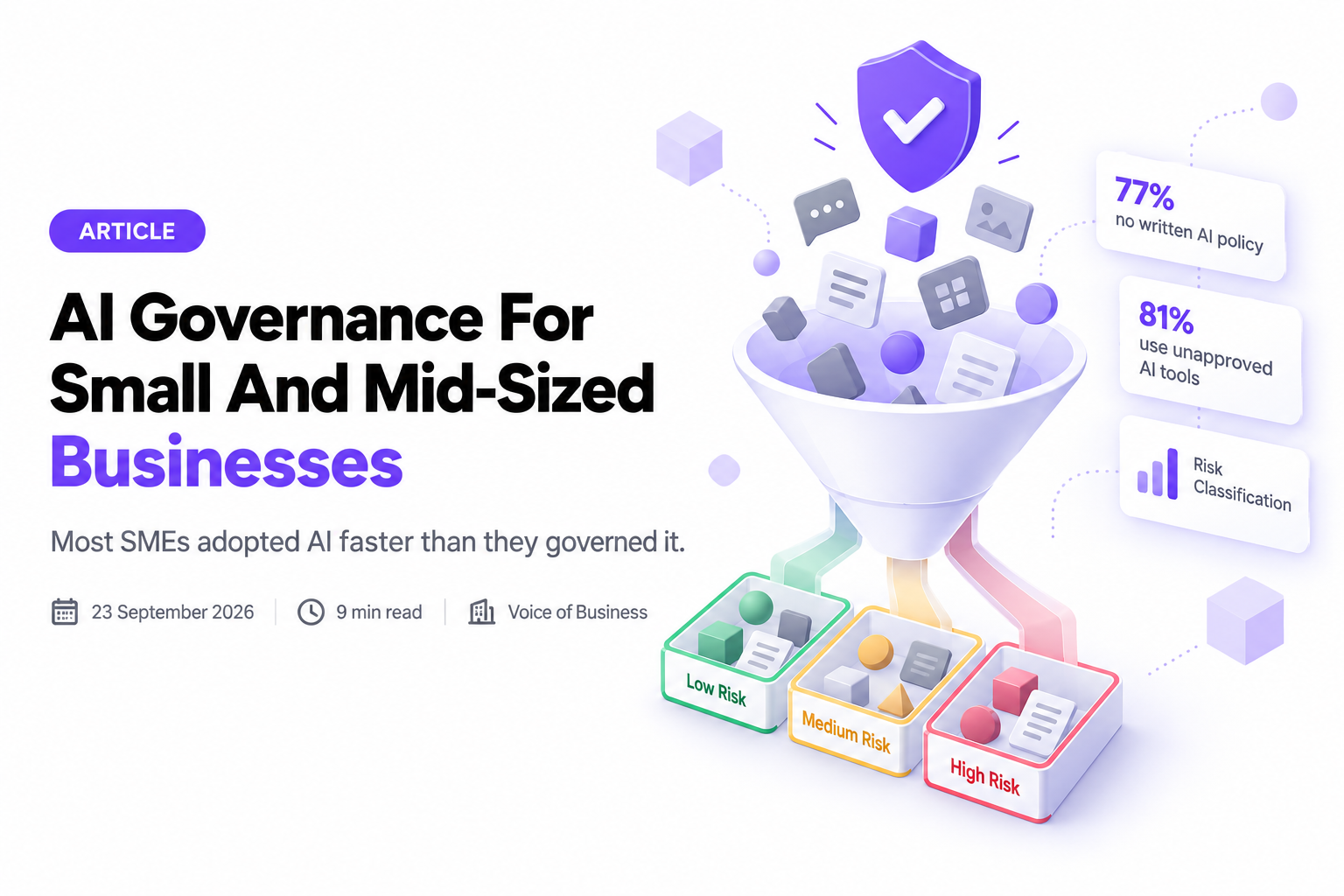
AI governance at a small or mid-sized organisation fails for a specific, avoidable reason: the policy gets written before anyone checks what staff are actually using. 68% of small businesses now use AI in some part of their operation, and 77% of them run it with no written policy at all, which means most governance documents, when they finally get written, are built against a guess about usage rather than a record of it. A document built on a guess does not survive contact with the shadow AI already running underneath it.
This article sets out what AI governance means at SME scale, the sequence that actually works, and where the EU AI Act touches an organisation that has never had a compliance function.
Key Takeaways
- 68% of small businesses now use AI, but 77% of them have no written AI policy, and only 2% of small organisations have a comprehensive AI governance framework, against 8% globally.
- Shadow AI, the tools staff adopt without approval, is usually a bigger exposure than the tools the organisation bought on purpose: 81% of employees and 88% of security leaders report using unapproved AI tools at work.
- Governance starts with an inventory of what AI is actually in use, not with a policy written against an assumption.
- Not every AI use case carries the same obligation. Risk classification, not a blanket rule, is what makes a policy proportionate rather than paralysing, and only around 22% of UK businesses have given staff any AI-specific governance training.
- A rule with nobody responsible for enforcing it is a document, not a control. Organisations with a high level of shadow AI averaged 670,000 US dollars more per data breach than those with little or none.
- The EU AI Act applies by use case, not by company size, and its 2 December 2027 high-risk deadline and simplified route for small mid-cap firms change the timeline, not the underlying obligation.
Small and Mid-Sized Businesses Have Adopted AI Faster Than They Have Governed It
Among companies with 10 to 100 employees, AI adoption jumped from 47% to 68% in a single year, a pace of uptake most other business tools never manage. Governance has not moved anywhere close to the same pace. Only 8% of organisations globally report a comprehensive AI governance framework, and that figure drops to 2% among small firms specifically. The gap between the two curves, fast adoption against almost no governance, is where most of the actual risk in SME AI use concentrates.
That gap shows up directly in the numbers on written policy. An estimated 77% of small businesses using AI have no written AI policy at all: no guidelines on what data staff can share with a model, no review step before an AI-generated output goes out, no approved tool list, and no one formally responsible for an AI-related decision when something goes wrong. The concern is not abstract to the businesses themselves either. 65% of small businesses say they are worried new AI regulation could harm their operations, up 11 percentage points on the year before, and 95% expect compliance challenges from AI laws already on the way, with uncertainty about what actually applies to them cited as the main source of friction.
None of that uncertainty is solved by writing a policy faster. It is solved by writing it against an accurate picture of what is happening, which is the step most organisations skip. A short, direct question put to every team, what AI tools do you actually use, for what, and on what kind of data, usually returns an answer longer and more varied than leadership expects, and it is the only foundation a policy can actually be built on rather than guessed at.
Shadow AI Is the Exposure Most Policies Never See
Even where a policy exists, it typically covers only the tools the organisation approved on purpose, and that is a shrinking share of what staff are actually using. 81% of employees and 88% of security leaders report using unapproved AI tools at work, a gap wide enough that the people responsible for enforcing a policy are, by their own account, breaking it themselves. A separate survey of 302 cybersecurity leaders found that 69% of organisations suspect or have evidence that employees are using prohibited public generative AI tools, and 60% said they lacked confidence they could even identify the unapproved tools already running inside their own environment. The same research predicted that more than 40% of enterprises will experience a security or compliance incident tied specifically to unauthorised shadow AI by 2030.
That blind spot is measurable, not theoretical. One widely cited breach study found that organisations with a high level of shadow AI averaged 4.74 million US dollars per breach, against 4.07 million for organisations with little or none, a gap of 670,000 US dollars attributable to exactly the exposure a written policy is meant to close. Training has not kept pace with any of this either. Only around 22% of UK businesses have given staff involved in AI deployment any AI-specific governance training at all, which means the gap between policy and practice is not just about missing rules, it is about nobody having explained the rules that do exist to the people using the tools every day.
An inventory is what turns this from an open-ended worry into a specific, closeable list. It does not need software to run, and it does not need to be exhaustive on the first pass. It needs to ask every team the same plain question and record the answer honestly, including the tool a manager would rather not have mentioned. Where a process only runs because one person knows something nobody else has ever had to explain, that is a key-person dependency, and it is worth logging during this same pass rather than discovering it the day that person is unavailable. A policy written after that conversation names the actual exposure. A policy written before it is a guess wearing the shape of a control.
Risk Classification Turns a Blanket Policy Into a Workable One
Once the inventory exists, the temptation is to write one rule that covers everything it turned up, either approving all of it or blocking all of it. Both produce a policy nobody actually follows, because it is either too permissive to mean anything or too restrictive for the work that genuinely needs the tool. Risk classification asks a narrower question of each use case: what happens if this goes wrong, who is affected, and does it touch personal data, a regulated decision, or a client-facing output that nobody checks before it goes out.
A tool used to draft an internal summary carries a different exposure to one used to screen a job application or generate content a client will see unreviewed. Sorting by that distinction is what turns a governance policy from a blanket restriction into a set of proportionate rules that match the real exposure of each use case, rather than treating a drafting assistant and a decision-making system as the same problem.
An internal draft or summary. Moves fast with a light review, no named checkpoint required.
Content a client sees, or output shared outside the team, unreviewed. Needs a checked step before it goes out.
A hiring decision, a regulated communication, or a client deliverable. Needs a named human checkpoint, actually staffed.
Classification only does useful work if it is attached to a specific person and a specific checkpoint. A rule that says “a person should check the output” is not a control, it is a hope. Oversight has to name who checks it, at what stage, against what standard, before the result reaches a client, a decision, or a public output. Part of what makes that checkpoint effective is basic literacy rather than technical depth: knowing that a large language model can produce a confident hallucination with exactly the same tone as a correct answer is what lets a reviewer catch a wrong result rather than approve it on confidence alone. This matters most for the use cases the classification flagged as highest exposure. A low-risk internal draft can reasonably move fast with a light review. A use case that touches a hiring decision, a regulated communication, or a client deliverable needs a defined human checkpoint that is actually staffed and actually used under deadline pressure, not one that exists only on paper. The same oversight question gets harder once an AI agent is running unattended rather than answering one prompt at a time, which is why a checkpoint has to extend past chatbots to anything acting on an organisation’s systems without a person in the loop. The checkpoint is only as real as the person accountable for running it, which is precisely the ownership gap the 77% figure above describes at the policy level, and it repeats at the level of every individual use case if it is not named explicitly.
The EU AI Act Applies by Use Case, Not by Company Size
A common assumption at SME scale is that the EU AI Act is written for large enterprises with dedicated compliance teams, and that a smaller organisation sits outside its reach because of its size. The Act does not draw its line there. It draws it at what the AI is used for. A small organisation deploying AI for a use case the Act classifies as high-risk carries the same core obligations as a large one running the identical use case, regardless of headcount or turnover.
The timeline around that obligation has recently moved, and it is worth understanding precisely rather than as a vague sense of relief. Under the Digital Omnibus agreement, the compliance deadline for stand-alone high-risk systems under Annex III was pushed from 2 August 2026 to 2 December 2027, a sixteen-month extension. Product-embedded high-risk systems under Annex I were given a separate extension to August 2028. Alongside the delay, a simplified compliance framework was extended to qualifying small mid-cap companies, defined as organisations with fewer than 750 employees and either 150 million euro or less in annual turnover or 129 million euro or less in total assets, easing the documentation burden for firms in that band. What did not change is the substance of the obligation itself: the extension buys time and eases paperwork, it does not remove the requirement to classify a use case correctly and manage the risk it carries.
Most day-to-day SME use, drafting, summarising, internal search, sits outside the high-risk category altogether. But the only way to know which use case is which is to classify each one against the Act specifically, alongside the general risk sort described above, rather than assuming small size is itself a form of exemption. This is also where data protection sits alongside the Act rather than apart from it: any use case touching personal data carries GDPR and EU AI Act obligations at once, checked at the same point in the process rather than as a separate review bolted on afterwards. The heaviest obligations, a full risk management system run across a product’s lifecycle, representative training data, built-in logging, generally sit with the vendor developing a high-risk system rather than the SME deploying an existing one, but “the vendor handles compliance” is not itself a defensible answer, because a deployer still carries oversight duties of its own.
Most published AI governance advice stops at the policy: write the rules, publish them, move on. The organisations that keep their governance current do not treat it that way. They run it as a process that gets rerun as usage changes, the same way an operational audit gets rerun rather than filed once and forgotten. That process moves in the same sequence as any other operating audit: map what is actually happening, document it precisely enough to act on, identify and classify the risk in each use case against real regulatory exposure, test a proposed rule against how the highest-risk use case actually behaves before rolling it out everywhere, then build the oversight and ownership that keeps it working as new tools arrive. It is the same five-step audit methodology, Map, Document, Identify, Test/Prototype, Build & Scale, applied to governance rather than to a single automated workflow, and it is why governance built on a scoped audit tends to hold where a policy written in isolation, against a guess, does not.
None of this holds if the people running the checkpoints do not understand why they matter, which is why the classification a governance review produces belongs inside a foundational training programme rather than a memo nobody reads twice, whether that runs as a set course across a whole team or as bespoke training built around one function’s own workflows.
Inventory what AI is actually in use before writing a rule about it, including the tools nobody approved, because a policy built on a guess gets rewritten within a month. Classify each use case by real exposure rather than applying one rule to everything, and name a specific person and checkpoint for the use cases that carry the most risk. Check every use case against the EU AI Act and GDPR by what it does, not by the size of the organisation running it. Every audit here starts with a scoping conversation: get an audit and that inventory, classification and oversight design gets built properly, in the same five steps, rather than guessed at from a template.
Sources
- Small Business AI Adoption: 68% Use It, Most Wing It
- AI Governance Statistics 2026: Key Data & Insights
- Small business AI adoption statistics for 2026
- The State of Shadow AI - Trends, Insights & Statistics
- Gartner Identifies Critical GenAI Blind Spots That CIOs Must Urgently Address
- Top 50 Shadow AI Statistics 2026: Who Uses It and What It Costs
- AI Adoption for UK SMBs in 2026: Stats, Barriers and Playbook
- EU AI Act High-Risk Deadline Pushed to December 2027
FAQ
Questions we get asked
What is AI governance for a small or mid-sized business?
It is the set of rules an organisation puts around how staff use AI: which tools are approved, where a third-party tool's terms stop being acceptable, who stays accountable for a result, and how that result gets checked before it reaches a client or a decision. At SME scale it does not need a compliance department to run it, it needs an owner, a short written policy, and a review point built into how work already gets done.
What is shadow AI and why does it matter for a small business?
Shadow AI is any AI tool staff are already using that was never approved, reviewed or logged, from a free chatbot pasting in client data to a browser extension nobody in IT signed off. 81% of employees and 88% of security leaders report using unapproved AI tools at work, so governance built around only the tools a business bought misses most of what is actually happening.
Does the EU AI Act apply to a small or mid-sized organisation?
It applies by what the AI is used for, not by headcount or turnover, so a small organisation using AI for a use case the Act treats as high-risk carries the same core obligations as a large one. The Digital Omnibus agreement pushed the high-risk compliance deadline from 2 August 2026 to 2 December 2027 and gave qualifying small mid-cap companies a simplified documentation route, but it did not remove the underlying obligation. The only way to know which use case is which is to classify each one, not to assume small size means the Act does not apply.
Where should a small or mid-sized business start with AI governance?
Start with an inventory of what is actually being used, including the tools nobody approved, before writing a single policy. A rule written against a guess about usage gets rewritten within a month; a rule written against an accurate list of what staff actually touch tends to hold. Only 2% of small organisations currently have a comprehensive AI governance framework, so most businesses starting this process are not behind an unusual curve, they are the normal starting point.
Is AI governance only a data protection issue?
No. Data protection under GDPR is one part of it, but governance also covers accountability (who is responsible when an AI-assisted decision is wrong), verification (how a result gets checked before it is used), and regulatory classification under the EU AI Act. A policy that only addresses data handling and says nothing about who checks an output, or who owns a workflow once it goes live, is covering roughly half the actual exposure.
How much does AI governance cost to set up at SME scale?
For an organisation that deploys AI rather than builds it, which is most SMEs, governance is mainly a matter of time and process rather than a large budget: an inventory, a short written policy, a risk classification pass, and a named owner. It is the compliance cost of building and certifying a high-risk AI system from scratch that runs into six figures per product, and that obligation sits with the vendor developing the system, not with most SMEs that are only deploying an existing tool.