
AI training for HR teams: what should it cover?
Most HR AI training covers the tools and skips bias and compliance, the two subjects the evidence says create the real risk.
10 min readBy Somangsu Mukherjee
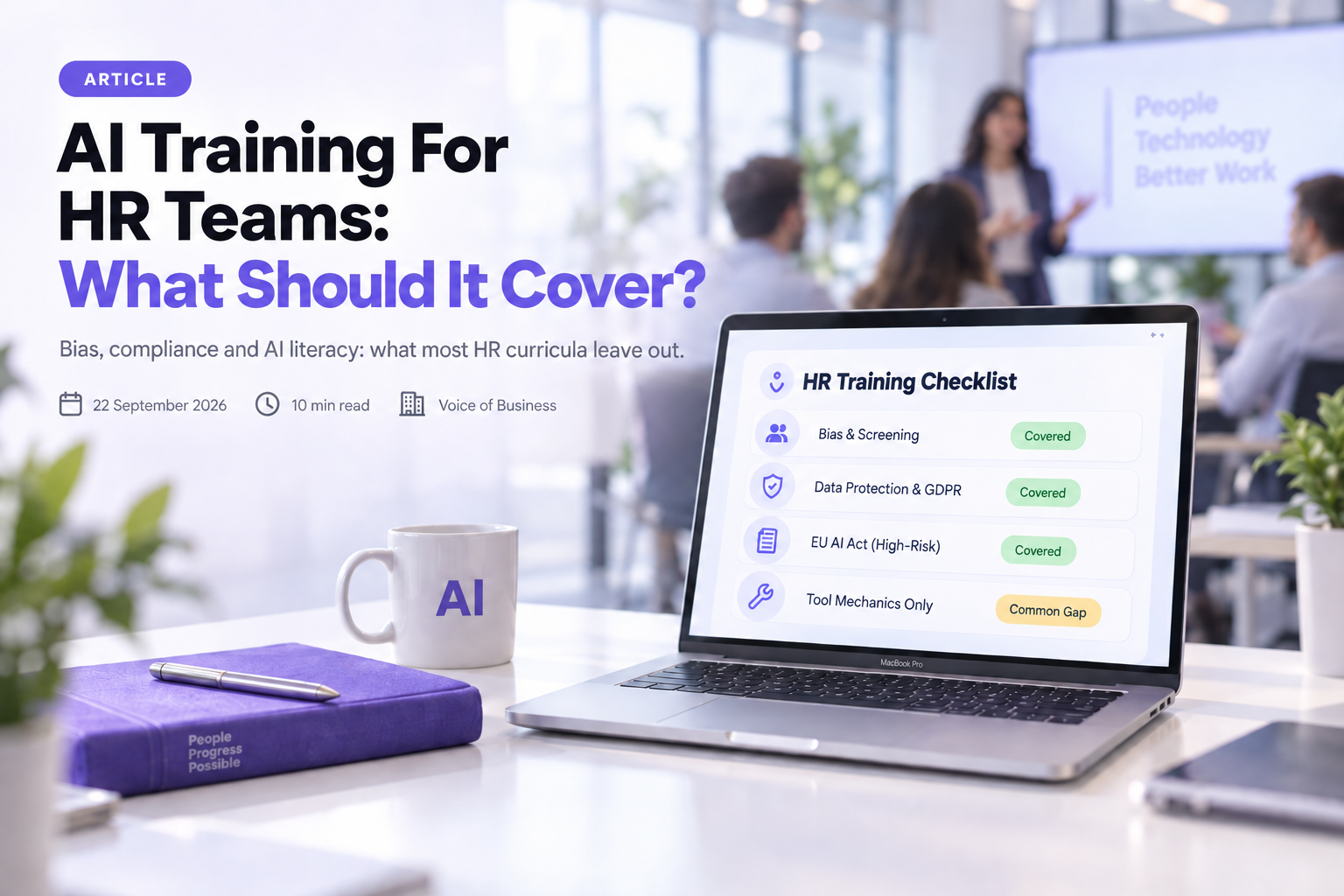
Most AI training built for HR teams teaches the tools and stops there, leaving out the two subjects that actually cause damage when they are missing: bias in AI-assisted decisions, and the compliance obligations specific to HR data.
This piece sets out what the evidence says a properly scoped programme has to include alongside tool mechanics, and why treating bias and compliance as an afterthought is the more expensive choice for a team already using AI anywhere in recruitment, screening or case management. It also covers a third pressure most curricula miss entirely: candidates are now using AI to write applications, and HR is expected to handle the volume that produces without any training in how.
Key Takeaways
- Half of companies cite AI introducing bias as a top hiring concern, and 57% cite it screening out qualified candidates, yet 80% of HR professionals still believe AI reduces unconscious bias in early screening.
- 49% of organisations have a policy governing staff AI use, and only a quarter of those believe it is future-proof.
- 57% of HR professionals working under a state-level workforce AI regulation do not know it applies to them.
- Of the HR professionals who do know a regulation applies to their work, only 12% have taken a step to comply with it.
- Recruitment and candidate-evaluation AI is classified as high-risk under the EU AI Act, which carries a documentation and risk-management obligation regardless of which platform runs it.
- 67% of HR leaders say reviewing AI-generated job applications has slowed the hiring process, and 84% report their teams carrying a heavier workload as a result.
- None of these gaps close with tool training alone: bias, policy and regulation are subjects a curriculum has to name directly, not assume are covered by teaching the software.
The bias training usually assumes is already handled
Half of companies now cite AI introducing bias as a top concern in hiring, and 57% cite AI screening out qualified candidates as a separate top concern. Set against that: 80% of HR professionals still believe AI reduces unconscious bias at the early screening stage. Both things are true at once inside the same organisations, and a training session that teaches the screening tool without naming that contradiction leaves the belief in place and the concern unaddressed. The defensible position is that filtering candidates against published criteria is an arguable use of the technology and ranking them by an opaque score is not, and a curriculum has to leave people able to tell the two apart rather than treating “the tool does bias-aware screening” as the end of the conversation. This is one of the seven use cases the AI Essentials for HR programme runs end to end rather than describing in the abstract.

The screening question does not stop at the AI a company chooses to run itself. 67% of HR leaders say reviewing AI-generated job applications has slowed the hiring process, and one in five report delays running past two weeks. 65% of hiring managers separately report that a surge in applications, many enhanced or generated by AI, has made it harder to verify what a candidate can actually do, and 84% say their teams are carrying a heavier workload because of it. The responses so far are mostly manual and reactive rather than trained: more time spent re-reading each application, more interview rounds added to compensate, job descriptions rewritten specifically to discourage a generic AI-written reply. None of that is a repeatable process, and none of it is something a tool-mechanics session teaches, because it is not about the HR team’s own AI use at all. A curriculum that only covers the side of the desk the company controls is answering half the question a screening team actually faces.
The compliance gap nobody is training for
Governance is the second subject most programmes skip, and the numbers show why that is expensive. 49% of organisations have a policy in place governing how staff use AI, but only a quarter of the organisations that have one believe it will still hold up as the technology and the regulation around it keep moving. The gap is sharper at the level of the individual HR professional: 57% working under a state-level workforce AI regulation do not know the rule applies to them at all, and of the smaller group who do know, only 12% have taken any step towards compliance. A training session cannot write an AI governance policy, but it can be the point where a team learns which regulation actually touches their own hiring and case-management work, rather than leaving that discovery to the point a decision gets challenged.
For HR specifically, this is not a hypothetical risk sitting somewhere in the future. The EU AI Act classifies recruitment and candidate-evaluation systems as high-risk, covering job-advert targeting, CV filtering and candidate scoring, alongside decisions on promotion, termination and performance monitoring once someone is already employed. A system in that high-risk category under the EU AI Act carries a documentation and risk-management obligation whichever platform runs it, and the same HR data that triggers that classification is also personal data under GDPR , so a curriculum that treats the two as separate topics is only describing half the picture.
Most of that obligation is heavier on the company that built the system than on the one using it: a risk management system run across the tool’s lifecycle, training data that is representative and as error-free as can be managed, logging built in to catch a risk to health, safety or fundamental rights, and instructions that let the people running it apply human oversight properly. A deployer, the HR team actually running the system day to day rather than the vendor that built it, carries fewer duties under the Act than the provider does, but fewer is not the same as none, and “the vendor handles compliance” is not itself the defensible answer a training session should let a team walk out believing. Knowing where the line between provider and deployer actually sits is part of the same session, not a separate legal briefing.
HR’s own AI literacy comes before anyone else’s training
A programme can name bias and compliance as sessions and still fail if the people running it have not built their own AI literacy first. HR is generally the function expected to lead AI upskilling for the rest of the organisation, and doing that credibly depends on understanding what generative AI can and cannot reliably do, not just which button opens the tool. That grounding does not need to be deep or technical: knowing why a large language model can produce a confident hallucination with the same tone as a correct answer is enough to make the rest of the curriculum land. It is what turns a policy from a document nobody reads into something a trainer can actually defend when a member of staff asks why a particular use is allowed and another is not, and it is the reason a curriculum built for HR specifically has to run before HR is asked to run one for anybody else.
None of this requires HR to become a technical function. The literacy that makes a training session credible is closer to knowing what a spreadsheet formula can and cannot be trusted to do than to understanding how one is implemented: enough to recognise that a chatbot’s confidence is not evidence, that a prompt’s phrasing changes its output more than most people expect, and that a tool trained on one organisation’s data will not automatically behave the same way on another’s. A generalist HR team can reach that level in a single session properly built around their own work, which is a different claim to making them AI specialists, and a curriculum that quietly asks for the second while promising the first is setting the session up to under-deliver before it starts.
A programme built on named sessions, not a tool demo
Put together, the evidence argues for a programme that treats bias and compliance as named sessions rather than a caveat slide before the tool demo starts: a defensible answer on screening, a data protection session covering anonymisation and local hosting rather than assuming staff already know the difference, and the exact point at which a person, not the model, has to make the final call. Whether that sits inside a broader set course or a fully bespoke training session built around one team’s own workflows, those are the subjects that turn attendance into something that holds up when a decision gets challenged.
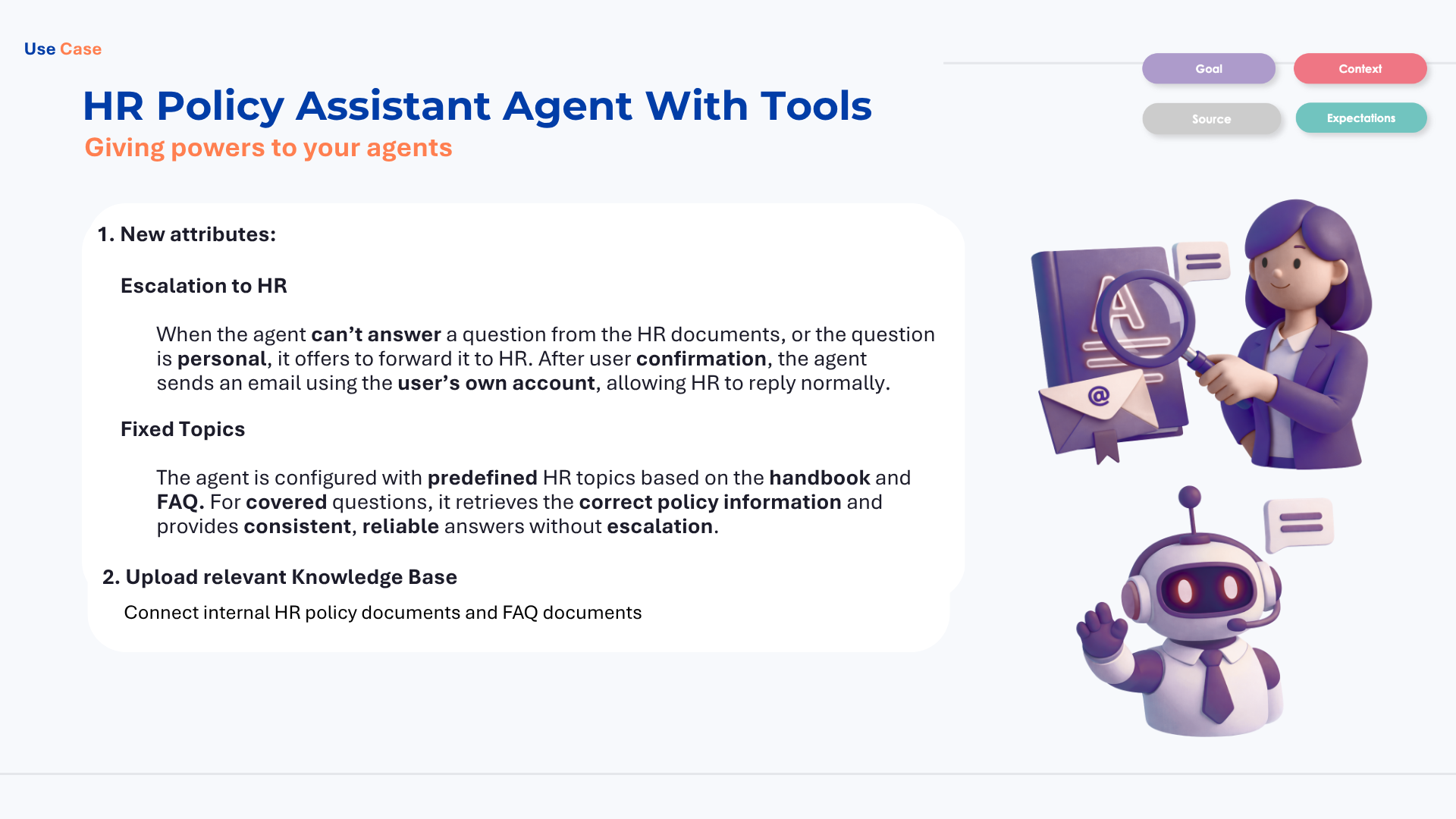
In practice that means a specific shape, not a general one. Foundations first: what generative AI is actually good at, where it fails, and the ethics of applying it to people rather than documents, covered honestly rather than skipped past on the way to the demo. Pattern recognition next, on real HR tasks, writing a job description against a previous notice with an assumptions list attached, generating interview questions anchored to a library of previous sets so they stop repeating themselves session after session. Personalisation after that: one vacancy written for four different audiences, candidate correspondence drafted from templates loaded once rather than retyped, development recommendations grounded in an organisation’s own learning catalogue rather than generic advice. Then the harder material: which tools suit which job, what an agent actually is and where the three levels of building one stop being worth the effort, and finally the session that closes on the honest answer rather than a comfortable one, cloud versus local hosting, anonymisation done live, and where responsibility for a screening decision actually sits under the regulation.
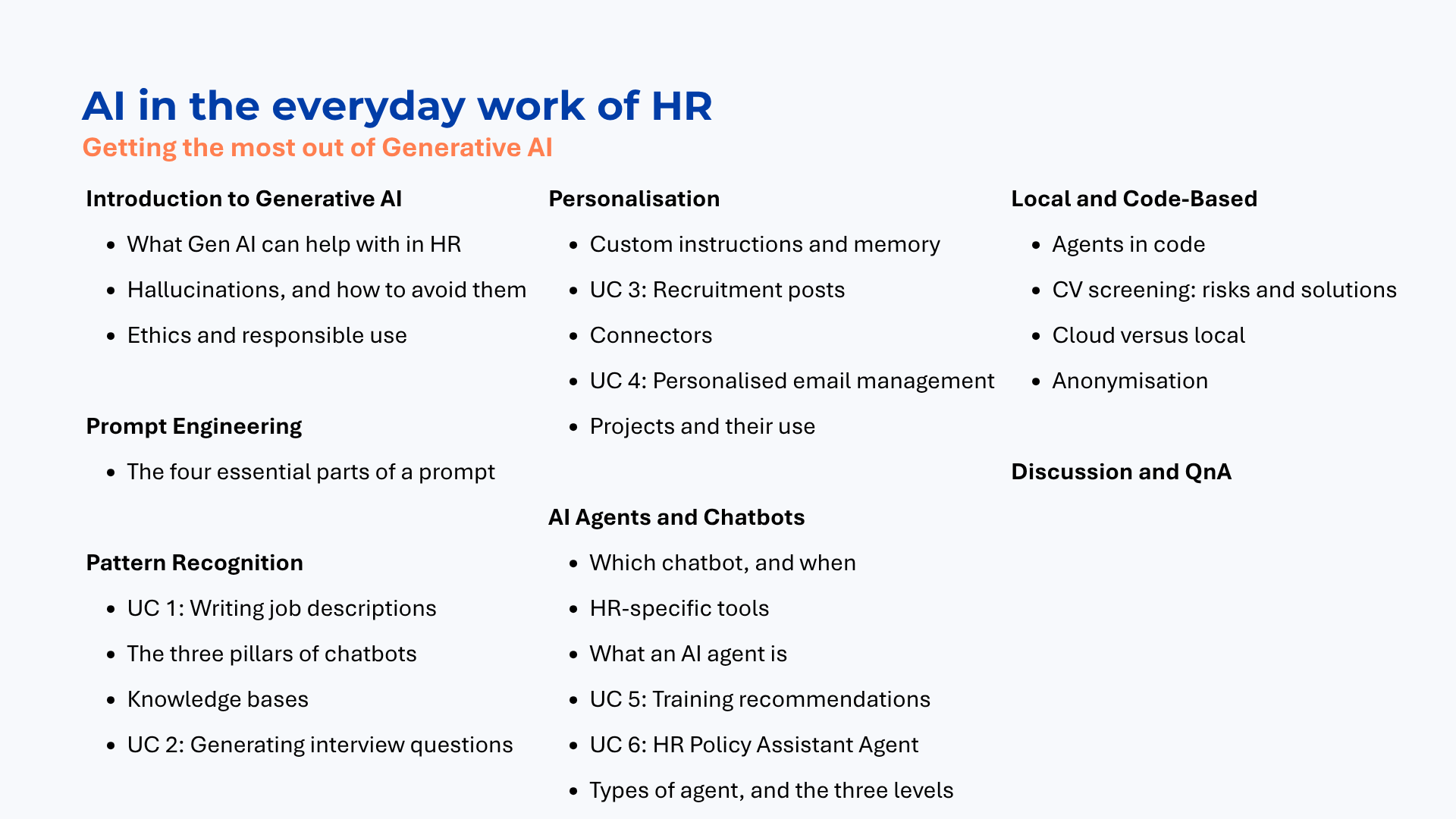
One of the use cases on that agenda is worth a closer look, since it is the one that turns a chatbot into something with a defined job: an HR policy assistant agent, configured with fixed topics from the organisation’s own handbook and FAQ, that answers what it can from the source it was given and escalates anything personal or out of scope to a person rather than guessing.
Cadence and audience matter as much as content. A single all-staff session does not fit HR the way it fits a department using AI for drafting and summarising, because HR’s own data is the sensitive material the rest of the organisation is only asked to handle carefully around. The people in the room need to be the ones actually running recruitment, case management and reporting, at a level built for people already comfortable with the basics rather than a first introduction to AI, and the session needs revisiting on a cycle shorter than most training calendars assume, because the tools on the market and the regulation around them are both still moving. A programme booked once and never repeated is answering a question that changes underneath it.
Whether it worked is a separate question from whether it happened, and the two get conflated more often than either gets checked properly. Attendance and a completion certificate say nothing about whether a screening decision made six weeks later actually applies what the session covered. The more useful check is behavioural: can the people who sat through it explain, in their own words and without notes, why a given AI-assisted decision is or is not defensible, and can they point to the specific safeguard, human oversight, anonymisation, a published criterion, that makes it so. A programme that cannot survive that question when asked cold was not really training in the first place, whatever the attendance sheet says.
Before booking HR training built around a single tool, check whether bias and compliance are named sessions on the agenda or an assumed footnote. If they are missing, that gap is worth closing before the rest of the curriculum is built. Book a 30-minute discovery meeting and we will go through what a properly scoped programme covers for your team specifically.