
How to Brief an AI Tool Like You'd Brief a New Hire
Bad AI output is usually a missing-context problem, not a wording problem. Brief it like a new hire and the gap closes.
10 min readBy Somangsu Mukherjee
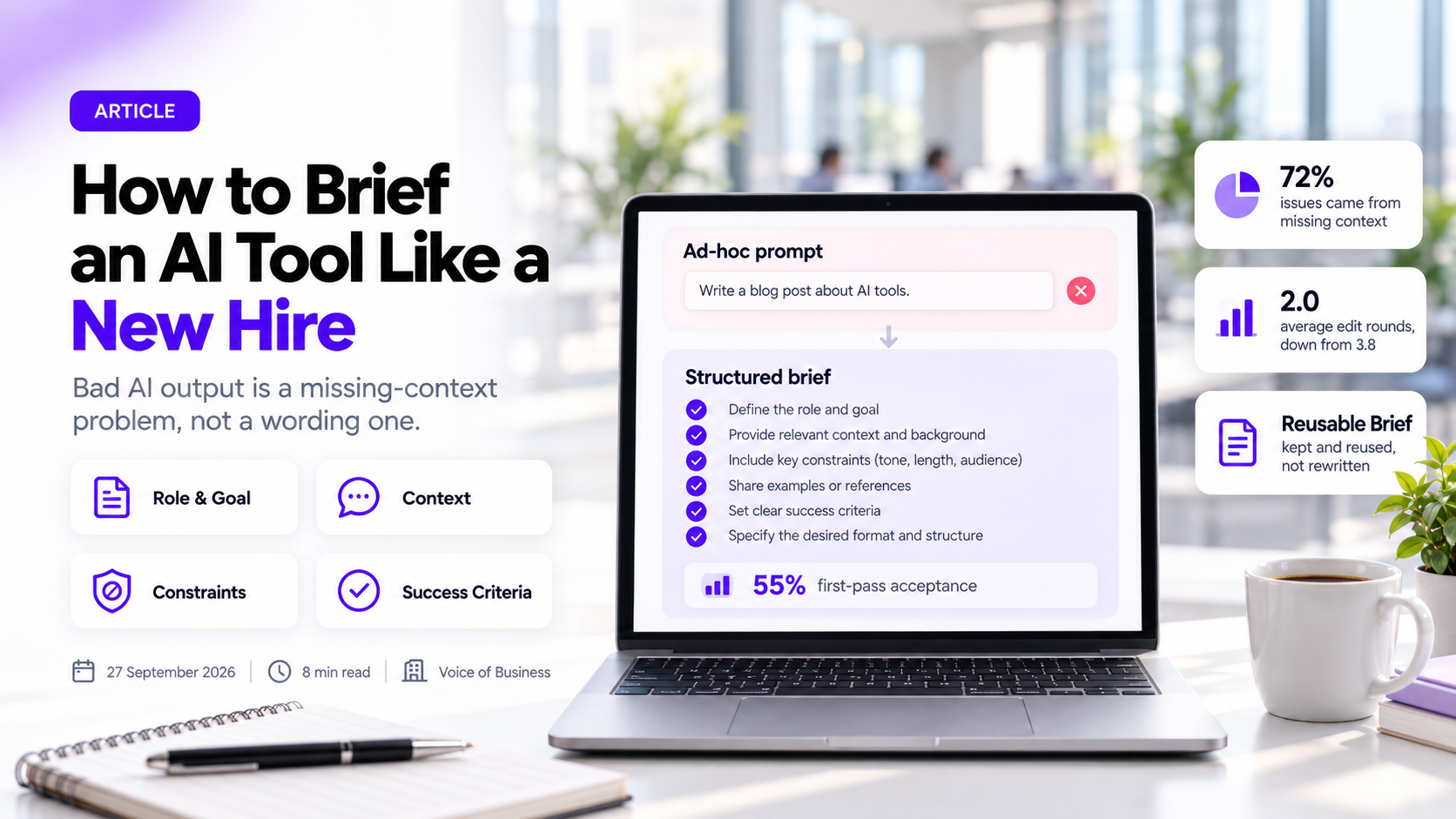
Bad AI output is rarely a wording problem. It is a missing-context problem, and the fix looks exactly like the one you would reach for with a new hire: brief it, don’t just instruct it.
This article sets out why that new-hire comparison holds up under the numbers, what a proper brief actually contains, how to build one section at a time, and why a team that treats this as a habit rather than a wording trick keeps getting the benefit after the tool underneath has changed twice.
Key Takeaways
- A one-line prompt and a one-line instruction to a new hire fail for the same reason: neither carries the context a stranger to the task would need.
- A study of 200 AI interactions across four tools found first-pass acceptance rose from 32% to 55%, and average iteration cycles fell from 3.8 to 2.0, once users assembled structured context before prompting.
- Incomplete context, not poor wording, was linked to 72% of the iteration cycles in that same dataset.
- Six things cover most of what a brief needs: the role the AI is doing right now, the actual deliverable and its reader, the background a newcomer would need, what to avoid, one example of accepted output, and how the result gets judged.
- Treating this as a wording skill produces a team that re-learns the same lesson on every new tool. Treating it as a briefing habit produces one that keeps the standard when the tool changes.
- A small, reused set of briefs beats writing a fresh one from memory every time, for the same reason a new hire gets a written induction rather than a verbal one repeated weekly.
The new hire gets a brief. The AI usually gets a sentence.
Nobody hands a new hire one line (“write the client update”) and expects a usable draft back. They get told who reads it, roughly how long it should run, what last month’s version looked like, and what the boss hates seeing in it. None of that is generosity. It is the minimum a stranger to the task needs to do it without guessing, and a new hire who was given only the one line would produce exactly the generic, slightly-wrong draft that a bare prompt produces from an AI tool.
The instinct with AI tools has been to fix this by rewording the prompt, with sharper verbs, more specific phrasing, a cleverer instruction. That treats the problem as one of language. It is not, and the size of the gap is worth putting a number on rather than taking on faith.
A study of 200 documented AI interactions across four tools, run by researcher Elias Calboreanu, found that when people assembled structured context before prompting rather than after a bad first attempt, first-pass acceptance rose from 32% to 55%, and the average number of iteration cycles needed to get a usable result fell from 3.8 to 2.0. Incomplete context, not poor wording, was linked to 72% of the iteration cycles in that data. The wording was rarely the thing that needed fixing, and the people in that dataset who improved their results did so by changing what surrounded the request, not the request itself.
That distinction has picked up a name in its own right, context engineering, sitting alongside prompt engineering rather than replacing it. Prompt engineering is still real and still useful, in the same way that phrasing an instruction to a new hire clearly still matters. But a beautifully worded instruction with nothing else attached still leaves a stranger to the task guessing at the parts that were never said out loud, and a plainly worded one with the right material attached usually does not.
Why the wording was never the real problem
The reason a bare prompt fails is not that the model cannot parse the sentence. It is that the sentence, on its own, does not contain enough of the decision the requester already made in their own head before typing it. A person asking for “the client update” already knows which client, what tone that client expects, roughly how long the last one ran, and what a version that got rejected looked like. None of that reaches the model unless it is written down, and a model with no access to what is inside someone’s head can only produce the statistically likely answer to the words it was actually given.
A hallucinated or generic answer is what that gap looks like from the outside. It is not the model inventing nonsense at random; it is the model filling in, plausibly, exactly the part nobody specified. Ask a new hire to “write the client update” with nothing else and they will produce something too, filled in with their own best guess at tone, length and audience. Sometimes that guess is close enough. Often it is not, and the person who asked ends up doing a second pass that amounts to writing the brief they should have given in the first place, after the fact rather than before it.
This is also why rewording rarely fixes it on its own. A sharper verb changes how the instruction reads, not what the model knows about the audience, the history, or the standard the result will be judged against. Two people can type functionally the same clear sentence into the same tool and get very different results, because one of them has spent months building the surrounding habits, whether that is custom instructions that carry standing context automatically, or a prompt library of briefs that already cleared the bar once and get reused rather than rewritten from scratch. The other person is starting from a blank line every time, which is the equivalent of a new hire who never got an induction and has to reconstruct the house style from nothing on every single task.
The six things a new hire’s brief covers, and a prompt usually skips
Six things do most of the work, and each one has a direct new-hire equivalent. Building a request from this list takes longer to type than a bare sentence, and returns something usable on the first pass far more often, which is the trade the numbers above describe.
- Role. What job is this AI doing right now: drafting, summarising, analysing? The same as telling a new hire whether they are producing a first draft or a final one, since the two are held to different standards and take a different amount of care.
- Goal. The actual deliverable, who reads it, and roughly how long it should be. The same brief you would give before someone wrote the first client email, because “write something” and “write a three-paragraph update for a client who reads on their phone” produce different drafts even from the same person.
- Context. What a new hire would need on day one that nobody thinks to say out loud: the audience, the history, the constraint everyone already in the room knows. This is the section most prompts skip entirely, because it feels obvious to the person who already has it in their head.
- Constraints. What to avoid, the same way a new hire is told about house style, tone, or a client that hates being sold to. A constraint stated once in the brief is cheaper than the same mistake corrected on every draft.
- Examples. One reference piece of “good,” exactly like showing a new starter a strong past example rather than describing one in the abstract. A description of quality is always vaguer than a real instance of it.
- Success criteria. How the output gets judged, stated before the work starts rather than decided afterwards when the draft already exists. Deciding the bar after seeing the result is how a perfectly reasonable first draft gets rejected for a reason nobody mentioned in advance.
Miss any one of the six and the pattern is usually recognisable: a role with no goal produces confident work aimed at the wrong reader; a goal with no constraints produces something usable that still needs a tone pass; constraints with no example produces something that technically obeys every rule and still doesn’t read right, because “no jargon” and “here is what it should sound like” are not the same instruction.
Building the habit into how a team actually works
Writing six lines into every request gets tedious fast, which is exactly why a new hire’s induction gets written down once rather than repeated from memory every morning. The same move works here. A prompt library of briefs that already cleared the bar, reused rather than rewritten, turns this from a skill someone has to remember into a resource someone can just open. The advanced end of this looks like custom instructions or a personalised setup that carries the standing half of the context automatically, so a person only has to brief the part that is genuinely new each time, the way a well-run team’s onboarding covers house style once and never makes a returning employee re-explain it.
This is also where treating it as an individual wording skill and treating it as a team habit start to produce different outcomes. A person who has personally learned to write good prompts carries that skill to their next tool and their next job; the rest of the team does not automatically inherit it, and the same missing-context problem shows up again with the next hire, the next AI tool the business adopts, or the next task nobody has briefed properly yet. A team that has instead been trained to assemble a brief, and handed a shared starting set of ones that already work, keeps the standard even when the underlying model changes, because the habit was never really about that one tool. Courses built around the art of prompting and around setting up personalisation so context doesn’t have to be retyped exist for exactly this reason: the skill that survives a tool change is the briefing habit, not the specific phrasing that happened to work last month. Editorial and writing teams working from a fixed house style see this most clearly, which is why a bespoke session built around exactly that spends most of its time on the brief a document needs before anyone touches wording.
The same logic applies at the team level that this piece has been describing at the level of a single request. How to brief a team on AI before training covers the version of this that happens once, before a training day, so people arrive with a real task rather than nothing to try the tool on. What makes AI training actually stick covers what keeps the habit alive afterwards, once the novelty of the first session has worn off. Briefing an individual request well is the smallest unit of the same discipline; a business that only ever teaches the smallest unit, and never builds the habit into how the team works day to day, ends up with one or two people who write good prompts and everyone else quietly guessing, which tends to surface first in whichever process an AI audit looks at closely.
What follows
Stop treating a disappointing answer as proof the tool needs better wording, and start treating it as a sign the request was missing something a stranger to the task would have needed. Write the next request as a six-part brief rather than a sentence, keep the ones that work rather than starting fresh each time, and notice whether the gap closes on the first attempt rather than the third. If the honest answer is that nobody on the team briefs AI tools this way yet, that is worth fixing as a habit rather than as one person’s skill, and it is exactly what the training catalogue is built to close, or book a 30-minute discovery conversation if you would rather talk through where your own team’s gap actually is first.
FAQ
Questions we get asked
Why does AI give bad answers even when the prompt seems clear?
Because the prompt usually is clear, and the missing part is everything around it: who reads the result, what the last version of it looked like, and what would make it wrong. A new hire given that same one-line instruction with no other context would produce the same guess. The fix is not a better sentence, it is the paragraph nobody wrote before the sentence.
How much context does AI actually need?
Enough that a person who has never seen the task before could do it from what you wrote. That is the same bar a new hire's written brief has to clear, and most prompts fall well short of it: they name the task and skip the audience, the format, the example of good, and the line that says what to avoid.
What information should I give an AI tool before asking it to do something?
Six things cover most work: what job it is doing right now, the actual deliverable and who reads it, the background a newcomer would need on day one, what to avoid, one example of a result you have accepted before, and how the output will be judged. Missing any one of the six is usually where a generic answer comes from.
How do I write a good AI prompt for work tasks specifically?
Write it as a brief, not an instruction. Name the deliverable and its reader before the task itself, attach one example of output you have already accepted, and say what would make the result wrong. That ordering is the difference between a prompt and a brief, and it is the brief that a business task actually needs.
Is this just prompt engineering with a different name?
It is closer to context engineering, which is the same idea prompt engineering pointed at before it had a name: the wording of the request matters far less than what surrounds it. A well-worded prompt with no context still guesses. A plainly-worded prompt with the right context usually does not.
How do you train a team to brief AI properly rather than just prompt it?
By treating the brief as a habit, not a one-off skill taught once. A team that only learns wording repeats the same missing-context problem on every new tool and every new task. A team taught to assemble a brief, and given a shared set of ones that already work, keeps the standard even when the tool underneath changes. That is the difference between training on a tool and training on how the team works with any tool.
What is the difference between custom instructions and briefing an AI tool each time?
Custom instructions are the standing half: the rules that apply to every request, set once. A brief is the task-specific half: what this particular deliverable needs that the standing rules cannot know in advance, such as who reads it this time or what last week's version looked like. A team that sets good custom instructions still needs to brief the one-off task properly; the two do different jobs.
Does a better-briefed prompt reduce hallucination as well as improve quality?
Indirectly, yes. A model given a real example, a named audience and a clear success criterion has far less room to invent an answer that merely sounds plausible, because the brief gives it something concrete to match against. It is not a hallucination fix on its own, but a vague, context-free prompt is exactly the condition an invented answer thrives in.