
What an AI Audit Actually Checks
An AI audit checks five things: data, tools, workflows, people and risk, and a genuine one is willing to conclude AI is not the answer.
10 min readBy Hugo Lewis Plant
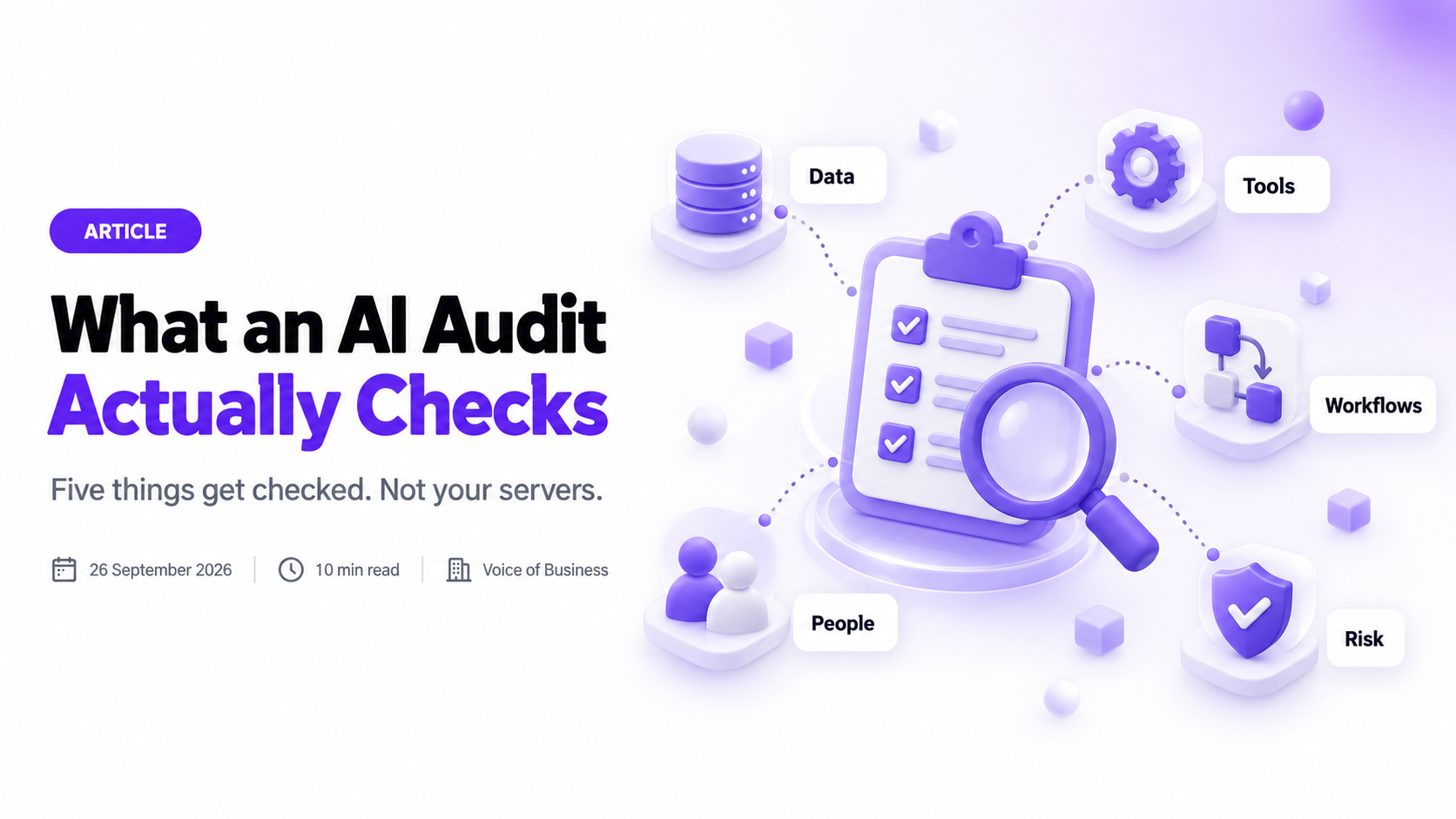
An AI audit is not a scan of your servers for security holes. For a small or mid-sized business, done properly, it is a review of how work actually gets done, and a genuine one is willing to conclude that AI is not what the business needs yet.
That split matters because most of what gets published on this topic is written for a different reader entirely: enterprise pieces that frame an audit as model security, data governance at scale, and regulatory certification. An SME running a handful of core processes does not need that review. It needs a plainer one, aimed at five things: data, tools, workflows, people and risk.
Key Takeaways
- An AI audit for a small or mid-sized business checks data, tools, workflows, people and risk, not model security or infrastructure.
- Data is checked for where it actually lives and whether a tool could reach it, not for how much of it there is.
- Tools are checked against what is already paid for and unused before anything new is recommended.
- Workflows are mapped as they actually run, exceptions included, not as the tidy version written up for the audit.
- Findings are ranked through opportunity identification, so the business gets a short list, not a scan of everything that is technically possible.
- A genuine audit is prepared to say AI is not the answer, and it hands back a short, ranked list rather than a long report.
What five things actually get checked
Illustrative. A genuine audit checks these five areas in turn, on every engagement, rather than scanning a model's internals once.
The first question is not how much data a business holds. It is where that data actually sits and whether the tool under consideration could reach it at all. A process that runs on scattered spreadsheets, a shared inbox and one person’s memory has a data problem no model fixes, and an audit names that rather than recommending a tool on top of it. That means tracing where each input actually comes from: a lead captured in one system and re-typed into another, a contract signed over email and never logged anywhere else, a report built by hand from three exports every Friday morning. None of that shows up if the audit only asks how much data the business holds. It shows up once the audit asks where a specific piece of information physically sits, and who or what is able to open it. Where a tool would touch personal data, the audit checks that under data protection rules before the tool is recommended, not after it is already in use, because a data protection problem found after roll-out costs far more to unwind than one flagged at the scoping stage.
The second question is what the business is already paying for. Most businesses run more licensed capability than anyone in the building is using: a CRM with an automation module nobody switched on, a productivity suite with a summarising feature buried three menus deep, a ticketing tool that already tags and routes requests once someone configures the rules. An audit checks that unused capacity before it recommends anything new, because the fastest and cheapest gain is often switching something on rather than buying something else. A tool that duplicates a feature already sitting idle in an existing licence is not a finding worth putting on the roadmap; it is a licence the business should read properly before it spends again. Where a genuinely new tool is the right call, the audit says so, but only once the existing stack has been checked and ruled out, not skipped past because a new subscription is more interesting to recommend than a settings change.
Why the mapped process matters more than the tidy version
A workflow written up for an audit describes the process as it is supposed to run, and that tidy version is not the process being audited. Ask most process owners to describe their own workflow and they will describe the happy path: the case where the form arrives complete, the customer answers on the first call, the approval comes back the same day. That happy path is real, but it is rarely most of the work. The value sits in the exceptions: what happens when the input is wrong, who gets asked when a rule does not cover the case in front of them, where the work actually queues while someone waits for an answer. A process gets automated against its exceptions, not its ideal path, because a tool built only for the happy path breaks on the first case that was not, and then someone has to do the work by hand anyway, on top of running the tool. Mapping those exceptions is the start of workflow design: redrawing the process around what AI can actually do, rather than describing a tool bolted onto the process that was already there.
A recommendation that fits the process but not the people who run it goes unused, whatever it demonstrated on the day it was pitched. An audit checks skill and appetite alongside the process itself, not as an afterthought once the technical case is made. That means sitting with the people who do the work, watching how they actually do it rather than how the process document says they do it, and asking directly whether they would use the tool being proposed or quietly route around it within a month. Whoever runs the audit tests candidate work against those people, not against a demo audience who will never touch the result. A tool the team will not open in three months is not a result, no matter how well it performed in the room where it was shown.
That test looks different depending on who is being asked. A team that already uses AI tools day to day mainly needs the new step to fit inside what they already do, without adding an extra login or an extra copy-paste between two systems that do not talk to each other. A team with no prior AI use needs something plainer: a plausible reason the change makes their own week easier, not a slide explaining what the model can theoretically do. An audit that skips this distinction and pitches the same demo to both groups gets the same answer from neither, because a confident team wants to see the edge cases handled and a hesitant one wants to see that nothing breaks if they get it wrong the first time. Building that answer into the recommendation, rather than treating adoption as a training problem to solve after the tool is bought, is what separates a workflow that gets used from one that sits in a folder marked “pilot” a year later.
Risk, kept proportionate to the business
Data protection and safe tool use belong in every audit, but the shape of that check should match the business, not a template built for a different one. For a small or mid-sized business that means checking what the EU AI Act and GDPR actually require of the processes in scope: which of those processes touch personal data, which ones feed a decision about a person such as a hiring shortlist or a credit check, and which ones never go near either. A process that never touches personal data or a regulated decision carries a short risk section, because there is little to check beyond ordinary good practice. One that does gets a longer section, sized to what it actually does rather than to a certification exercise built for an enterprise running its own infrastructure at a scale this business does not operate at.
In practice this comes down to sorting the processes in scope into a small number of bands rather than treating every one of them as a compliance project. A process that only speeds up drafting or summarising, with a person reading the output before it goes anywhere, sits at one end: the check is light, because a mistake gets caught before it reaches anyone. A process that talks directly to a customer, or that feeds into a decision about a person such as a shortlisting step or a pricing offer, sits further along, because a wrong or biased output can reach someone before anyone reviews it. The EU AI Act’s own risk tiers run on the same logic, from minimal risk through to the uses it treats as high-risk or bans outright, and an audit maps the processes in scope against that same scale rather than inventing its own. GDPR sits alongside it, asking the more familiar questions: what the lawful basis is for processing the data involved, what the third-party tool’s own terms say about where that data goes and who can see it, and whether a person can still get an explanation and a correction when an AI-assisted decision affects them. Proportionate does not mean lighter for its own sake. It means the depth of the check is set by what the process actually touches, checked against the real rule rather than assumed from the size of the company doing the checking, and it means a business running two or three customer-facing processes gets a risk section built around those two or three, not a generic policy copied from a template built for a business ten times its size.
From a ranked list to a working result
Mapping the areas above produces a list of candidate changes, not a recommendation on its own. Turning that list into something a business can act on is opportunity identification: scoring each candidate against the effort it needs, the data it depends on, and the value it would return if the team actually adopted it, then ordering the list on that basis rather than presenting everything as equally worth doing. A change that scores well on paper but fails the people test from the previous section sits lower on the list, not off it, because it may still be worth doing once a simpler item has built confidence in the process. An audit that recommends everything is not a prioritised audit; the useful output is a prioritised roadmap of opportunities, each carrying the reason it sits where it does, with the ones that are technically possible but not worth doing named and set aside rather than left in. That includes the finding, when it is true, that the process examined is not an AI problem at all: a pricing issue, a communication gap, a sales process losing leads before any tool would ever touch them. No audit fixes that by recommending software.
The output of an audit is a plan, not a finished workflow. Building a well-scoped AI workflow from one of the ranked opportunities is separate work, with its own scope, its own guardrails and its own measure of the return it produces. Likewise, an audit can flag that a business has no written rule for which AI tools staff may use, but closing that gap is its own piece of work: AI governance, covering which tools are approved, who stays accountable for a result, and how that result gets checked before it reaches a client. Both follow from the audit. Neither is the audit itself, and treating either as automatically included is how a short, useful piece of work turns into a long one nobody asked for.
What an AI audit actually checks, in short, is whether AI fits a specific, mapped process, not whether the business owns enough of it in the abstract. Data, tools, workflows, people and risk are the same five things whether the process in scope is a sales pipeline, a hiring shortlist or a customer support queue, and a genuine audit is willing to name the one that is not worth touching alongside the ones that are. It is one methodology applied to whatever is in scope, not five separate ones stitched together, and it starts with a scoping conversation, not a quote. Ask to see the ranked list before you commit to a tool, and treat an audit that hands you one without being willing to say no to anything as the warning sign it is.
FAQ
Questions we get asked
What does an AI audit actually check?
Five things: where your data actually lives and whether a tool could reach it, what you have already paid for and are not using versus what genuinely needs adding, the real step-by-step sequence of the work rather than the idealised version of it, whether your team can and will use what gets recommended, and the data protection and safe-use questions a proportionate review needs to ask. It is a review of the business, not a scan of the technology.
Can an AI audit conclude that AI is not the right answer?
Yes, and a genuine one is prepared to say so. Sometimes the process an audit maps turns out to be broken for reasons no tool addresses: pricing, a communication gap, a sales process that loses leads before AI ever touches them. Naming that and stopping there is a more useful outcome than recommending a tool against a problem it cannot fix.
Does an AI audit produce a long report?
It should not. A prioritised, short list of ranked opportunities is more useful to act on than a sprawling document nobody finishes reading, and each recommendation should carry the reason it sits where it does rather than a list that says yes to everything.
Is an AI audit mainly about compliance and security?
For a small or mid-sized business, no. Security and model-integrity reviews matter for organisations running their own infrastructure at scale, but for most businesses the audit that matters is a process review: which workflows are worth automating, whether the data behind them is usable, and whether the team is ready. Compliance sits inside that review, kept proportionate to the business, rather than replacing it.
How does an AI audit check whether a team will actually use a recommendation?
By testing candidate work against the people who would use it, not against a demo audience. That means sitting with the team, watching how they actually do the work rather than how the process document describes it, and asking directly whether they would use the tool being proposed or quietly route around it within a month. A team already using AI day to day needs a new step to fit inside what they already do; a team with no prior AI use needs a plainer, low-risk reason the change makes their own week easier. A recommendation that skips that distinction and pitches the same case to both groups tends to go unused by either.
What does 'proportionate' mean for the risk section of an AI audit?
It means the depth of the check is set by what each process in scope actually touches, not by a template built for a much larger business. A process that only speeds up drafting, with a person checking the output before it goes anywhere, needs a light check. A process that talks to a customer directly, or feeds into a decision about a person such as a hiring shortlist or a pricing offer, needs a fuller one, assessed against the EU AI Act's own risk tiers and GDPR's rules on lawful basis and data access rather than a generic policy. A business running two or three customer-facing processes gets a risk section built around those two or three, not a policy copied from elsewhere.