
Why Ranking on Google Isn't Enough Anymore
Google's own AI Overview cited top-10 pages 76% of the time in 2025. By 2026 that fell to 38%, and standalone assistants were already down at 12%.
11 min readBy Somangsu Mukherjee
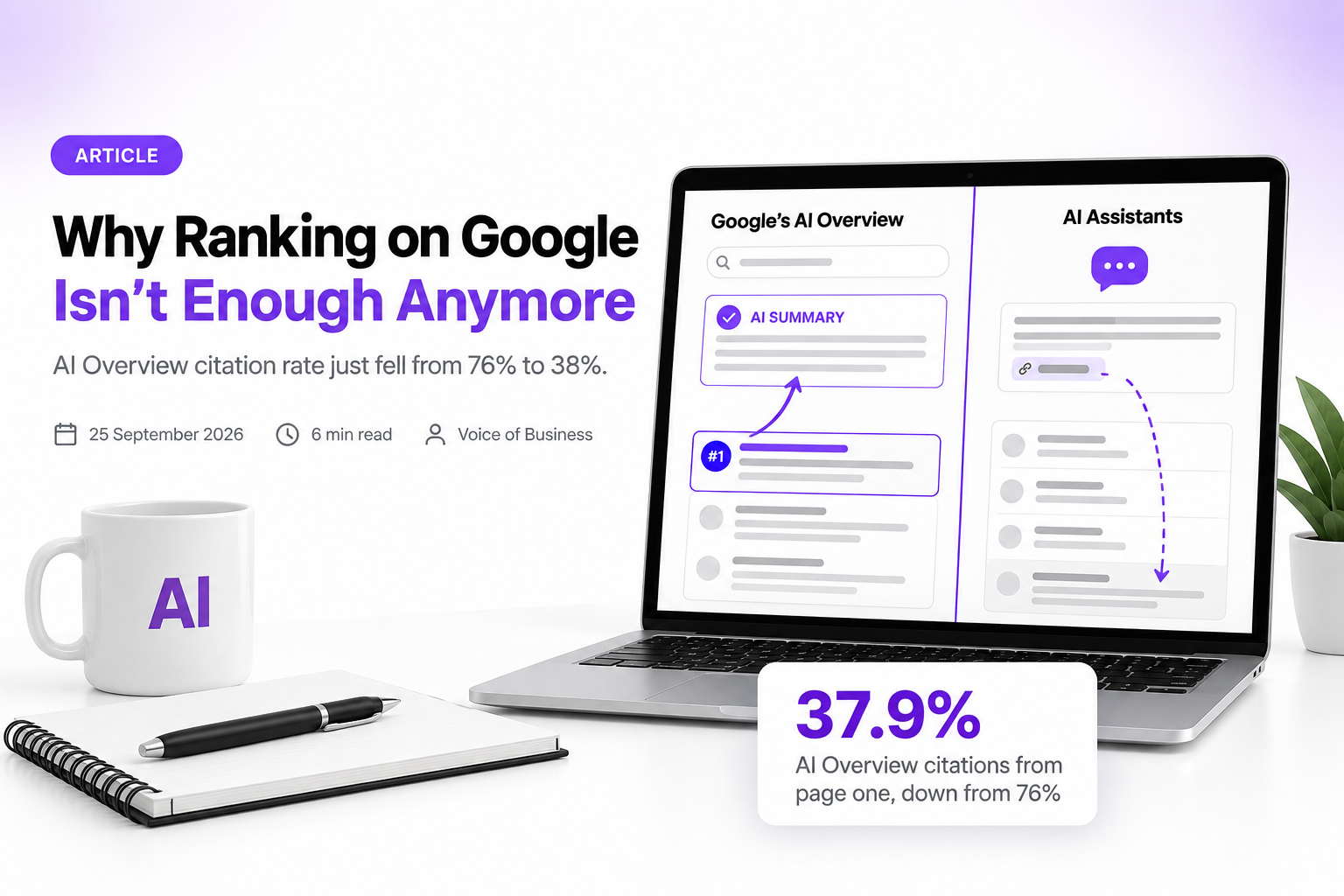
Page one used to be the finish line. For a while, Google’s own AI Overview kept that promise better than anything else in AI search: in 2025, three out of four of its citations still came from a page already sitting in the top 10. A year later, that number is 38%. For ChatGPT, Gemini and Copilot, ranking on Google barely registered even before the AI Overview started slipping, at 12% on average.
Most businesses track “AI visibility” as a single number and miss both halves of that story: two different systems behaving differently from each other, and one of them changing fast enough that a stat from last year is already out of date. This article breaks the split down properly, explains the mechanism causing it, and sets out what to build and watch instead of a rank position. A companion piece, how AI Overviews are changing what counts as SEO, covers the wider shift these citation-share numbers sit inside.
Key Takeaways
- Google’s AI Overview cited top-10 pages 76% of the time in a July 2025 study. By March 2026, a much larger follow-up study put that figure at 37.9%, roughly half of what it was.
- Standalone AI assistants never tracked Google’s rankings closely to begin with: only 12% of ChatGPT, Gemini and Copilot citations came from a page ranking top-10 on Google for the same query, in the same 2025 data.
- Perplexity sat in between, at 28.6%, closer to how the AI Overview behaved than to the other three assistants.
- Query fan-out explains both numbers, and Ahrefs points to Google’s move to the heavier-fan-out Gemini 3 in January 2026 as the likely reason its own AI Overview figure just fell so far.
- Opening paragraphs that answer a query immediately are cited 67% more often, original data tables earn 4.1 times more citations, and FAQ schema is linked to a 28% citation increase.
- Citation frequency, tracked separately from rank position, is what actually shows whether a business is visible inside an AI-generated answer, on Google or anywhere else.
Two different products, and one of them just changed
“AI search visibility” gets talked about as one thing, and that’s where most content strategy goes vague. Google’s AI Overview and a standalone assistant such as ChatGPT, Gemini or Copilot have never pulled from source pages the same way, and the gap between them is wide enough to change what a business should be working on. It is also not a fixed gap. It moved sharply in the past year, and it moved in one direction.
Ahrefs’ original comparison, run on data collected in July 2025, found the AI Overview citing top-10 pages 76% of the time. That is close to what conventional SEO would predict: rank well, get cited by Google’s own summary, most of the time. A business that had already done the ranking work was close to done on the AI Overview specifically.
That correlation has since collapsed. A follow-up Ahrefs study published in March 2026, built on a much larger sample of 863,000 keywords and 4 million AI Overview URLs, put the top-10 overlap at 37.9%. Roughly six in ten AI Overview citations now come from a page that would not have shown up on the first page of ordinary results for the same search. Ahrefs’ own explanation points at Google’s switch to Gemini 3 in January 2026: a newer model appears to be running a heavier fan-out process before it answers, pulling in sources across more variations of a query than the model it replaced did.
The standalone assistants never had that problem to begin with, because they were never close to conventional rankings in the first place. Ahrefs measured an average of 12% for ChatGPT, Gemini and Copilot in the same 2025 dataset: a page could rank nowhere on Google and still turn up as the source one of these tools named. Perplexity was the outlier, at 28.6%, sitting closer to how Google’s own summary behaved than to the other three. Put the two halves of this together and the shape becomes clear. Under generative AI search, the umbrella term for this whole category, the AI Overview is not a separate species from the standalone assistants. It is catching up to a behaviour they already had, and the mechanism behind both is the same one.
Why one ranking spot stops being the target
That mechanism has a name: query fan-out. Before answering, a large language model silently generates several variations of the question a person actually typed, pulls candidate sources for each variation separately, then merges the results with a technique such as Reciprocal Rank Fusion, which favours a source that shows up consistently across the set over one that dominates just a single version of the query. This sits on top of retrieval-augmented generation, the broader process of pulling a live source into an answer instead of relying only on what the model learned in training. Fan-out is that process run several times per search instead of once.
A concrete version makes it less abstract. A search for “AI training for HR teams” might fan out into related questions such as what AI bias training for recruitment covers, what the EU AI Act requires of HR specifically, and how CV screening tools get evaluated. A page built narrowly around the first phrase, and nothing else, wins that one query if it ranks first for it. A page that covers all four angles with real depth, even if it only ranks sixth or seventh for the original phrase, gets pulled into more of the merged results, because it keeps showing up across the set the fan-out actually retrieves from.
Illustrative example. The page ranked #1 answers only the exact phrase, "AI training for HR teams". The page ranked #6 answers three of the four related questions a fan-out actually asks, and that consistency, not the rank, is what gets it cited.
That is a different target from the one conventional keyword ranking was built for, and it is why depth across a topic now competes directly with dominance on one exact phrase. It also explains why the gap between the AI Overview and the standalone assistants was never really about Google versus everyone else. It was about how much fan-out each system ran before answering. The AI Overview used to lean on something closer to a single retrieval built from the query as typed, which is why it tracked ordinary rankings so closely for so long. Gemini 3 appears to run fan-out more aggressively, and its citations have moved accordingly. The standalone assistants were doing this from the start, which is exactly why their numbers never looked like Google’s rankings to begin with.
What earns the citation
Structure decides most of what’s left once ranking alone stops guaranteeing anything, and the evidence on what specifically to change is more consistent than the ranking data above. Search Engine Land’s guide to optimising content for AI search names three habits with a measured effect. Opening paragraphs that answer the query immediately, before any throat-clearing, get cited 67% more often than ones that bury the answer further down. Pages carrying original data tables earn 4.1 times more AI citations than pages making the same claim in prose. FAQ schema is linked to a 28% jump in citation rate, because it hands a model a self-contained question and answer instead of a paragraph it has to reinterpret first.
A separate study from CXL, mapping exactly where inside 100 real AI Overview citations the cited passage sat on the source page, found the same principle from a different angle: 55% of cited passages came from the first 30% of the page, and the 10-20% zone alone accounted for more citations than any other single section. A model choosing what to cite is doing extraction work, not composition, and it reaches for whatever it can lift without having to reinterpret a paragraph or hunt further down the page for the actual point.
That is the throughline across all four findings. A direct answer near the top of a section, a labelled table instead of a wall of prose, a clearly formatted Q&A block: each one hands a model a claim it can use as written, rather than a claim it has to work to extract. None of this is exotic advice. It is closer to what a good editor would tell a writer anyway, applied to a reader that skims faster and more literally than any person does.
What to track instead of a rank position
None of the numbers above are worth much to a business without a way to check whether its own pages are moving in the right direction, and the old dashboard does not answer that question on its own. Search Console already separates impressions and clicks specifically tied to AI Overview appearances, and the pattern worth watching for is impressions holding steady or climbing while clicks on the same query drift down. That is not a tracking fault. It is a query being answered on the results page itself, which is a different outcome from not ranking at all, and conflating the two hides exactly the shift a business needs to see.
Rank tracking on its own answers a narrower question than it used to: does this page still hold a spot. It no longer answers whether that page gets cited, on Google’s own results page or inside ChatGPT, Gemini, Copilot or Perplexity, because the last year of Ahrefs’ own data shows those are three separate outcomes that move independently of each other. Citation frequency, sometimes described as share of voice in AI answers, is the number that actually describes the third outcome, and it needs its own tracking rather than being inferred from rank position. Am I Cited, the tool this business partners with, tracks how often and how prominently a brand or a specific page gets cited across AI-generated answers over time, which turns “we improved our structure” into a measurable before-and-after instead of a guess.
A second habit worth building in is tracking branded and non-branded queries as two separate lines rather than one blended total. A page can be losing ground on its generic, category-level searches, the ones now most exposed to a fan-out process picking a different source each time, while holding or gaining on searches for the business by name, which a generative system has far less reason to intercept or reroute. Blending both into a single traffic number hides exactly the split this article describes, and watching them apart shows whether a drop in overall clicks is the market shifting or the brand actually holding up.
The last habit worth building in is simply checking, by hand and periodically, what an AI Overview or an assistant actually says for the handful of queries that matter most, and which sources it names while saying it. A page that used to rank first can find a competitor cited in its place, or find itself cited only for a narrower sub-question than the one it was written to answer. Neither shows up in a rank tracker. Both show up the moment someone reads the generated answer instead of only the position sitting underneath it.
None of this argues for dropping conventional SEO. The AI Overview still correlates with rankings more than the standalone assistants do, even after the drop from 76% to 38%, so the work that earns a page one still buys real value there. What changes is treating that work as the whole job. A page structured to rank and a page structured to be cited want largely the same things, a direct answer, a clear structure, evidence stated specifically rather than vaguely, they just want them checked against a different question: not only where does this page sit on a results page, but would a model reading across the top sources choose this page as one worth naming. That is what an AI audit checks for, run through the five-step audit methodology and starting with a scoping conversation about where a site currently stands on both questions: get an audit.
Sources
- Ahrefs’ original comparison of AI citation overlap with Google’s top 10, across AI Overviews, ChatGPT, Gemini, Copilot and Perplexity, data collected July 2025
- Ahrefs’ March 2026 follow-up study, 863,000 keywords and 4 million AI Overview URLs, showing the top-10 overlap falling to 37.9%
- Search Engine Land’s step-by-step guide to optimising content for AI search engines
- Search Engine Journal on the drop in AI Overview citations coming from top-ranking pages
- CXL’s 100-page study of where Google AI Overviews cite from within a source page
FAQ
Questions we get asked
Does ranking #1 on Google guarantee an AI Overview citation?
No, and the guarantee has weakened sharply in the space of a year. Ahrefs found 76% of Google AI Overview citations came from top-10 pages in a July 2025 analysis. By March 2026, a follow-up study of 863,000 keywords put that figure at 37.9%. Ranking first is still an advantage, it is no longer close to a lock.
Does ranking on Google matter for ChatGPT, Gemini or Copilot citations?
Less than most businesses assume, and it has mattered less for longer than the AI Overview figure has. Ahrefs' 2025 analysis of citations across these three assistants found only 12% on average ranking in Google's top 10 for the matching query. A page can be invisible on Google's own results page and still be the source an assistant names.
What is query fan-out, and why does it change what 'ranking' means?
Query fan-out is what a system does before it answers: it silently generates several variations of the question and retrieves sources for each one, then merges the results, often with a method such as Reciprocal Rank Fusion. A page ranking sixth across three related variations can out-rank a page sitting first for only the original phrase, because fan-out rewards consistent presence across a topic rather than one winning position.
Why did Google's own AI Overview citations drop from 76% to 38%?
Ahrefs points to Google's move to Gemini 3 in January 2026 as the likely cause. The heavier the fan-out a system runs before answering, the less its citations track a single ranking position, and Gemini 3 appears to run a heavier fan-out than the model it replaced. The AI Overview is drifting towards the same behaviour that already set the standalone assistants apart from conventional rankings.
Why does Perplexity behave differently from ChatGPT, Gemini and Copilot?
Perplexity sits between the two extremes measured in 2025: 28.6% of its citations ranked in Google's top 10, against 76% for the AI Overview at the time and 12% for the other three assistants. It leans on conventional ranking signals more than the other standalone assistants do, which puts it closer to Google's own behaviour than to ChatGPT's or Copilot's.
What actually earns a citation once ranking alone is not enough?
Structure a model can lift cleanly. Opening paragraphs that answer the query immediately are cited 67% more often, pages carrying original data tables earn 4.1 times more AI citations, and FAQ schema is linked to a 28% increase in citation rate, according to Search Engine Land's guide to optimising content for AI search. A separate study by CXL found 55% of cited passages come from the first 30% of a source page, which is the same principle from a different angle: put the answer near the top.