
SME
One of the two segments this business describes a client by, alongside Enterprise, used instead of naming the client on the case studies this site publishes and everywhere else a client's size matters.
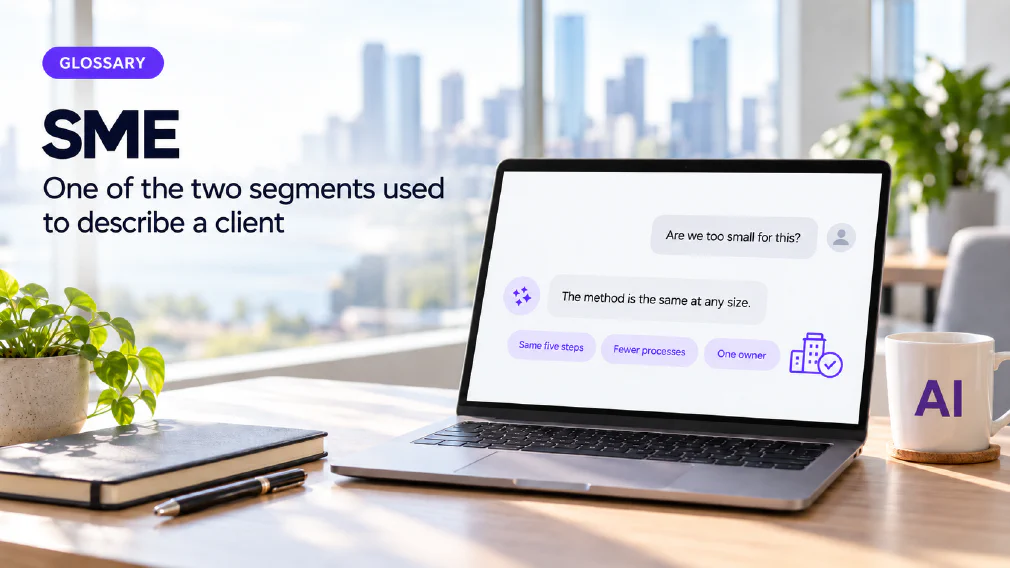
What SME means here
On this site SME is one of two segments the business describes a client by. The other is Enterprise. The label is used instead of naming the client on the case studies the site publishes, and everywhere else a client’s size matters.
That is a narrower meaning than the everyday one. Elsewhere, SME is a statistical category with a legal definition. Here it is a way of describing who a piece of work was for, without saying who they are. The rest of this page explains what follows from that.
A label, not a size test
The site does not define SME by headcount, turnover or assets, and this page will not invent a threshold. The definition is a segment label. A reader looking for the official size limits of an SME should take them from an official source and not from this glossary.
The About page does describe the organisations this work lands hardest with. It names service-based organisations of roughly 50 to 500 people, with structured teams in support, operations, administration and sales, that are process-heavy and already running on a CRM and a mainstream office suite. That describes who the business tends to work with. It is not a definition of the term.
Why a segment and not a name
The About page says the business describes the organisations it works with by segment, SME or Enterprise, and by sector, and that it does not publish client names. The segment tag is the small component that does this on the site’s cards. It puts a client’s size beside the work in place of a name.
The label lets a reader judge relevance without identifying anyone. A small firm reading a case can see it was for a small firm. The site’s cleared testimonials are a separate matter, governed by permission recorded elsewhere, and this page names no organisation.
The method does not change
The most important sentence about SMEs on this site is that the audit is run the same way for an SME as for an Enterprise. The same five steps run for both. Scale changes, and the method does not. What changes is the scale of what is examined, not the method used to examine it.
The AI audit page describes the steps. Every audit starts with a discovery call, and scope is set there, so a smaller organisation is not handed a cut-down version of a larger one’s work. It gets the same method applied to fewer processes.
What an Audit checks in a Smaller Business
The audit article says a security and model-integrity review suits an organisation running its own infrastructure at scale. A small or mid-sized business needs a plainer review, aimed at five things: data, tools, workflows, people and risk. It is a review of the business and not a scan of the technology.
The article adds two practical points. The audit checks what the business already pays for and does not use before recommending anything new, because the fastest gain is often switching something on. And the risk section is built around the two or three customer-facing processes a small business actually runs, and not copied from a template made for a much larger one.
Governance without a Compliance department
The governance article says AI governance at small and mid-sized scale does not need a compliance department. It needs an owner, a short written policy and a review point built into how work already gets done. For an organisation that deploys AI and does not build it, which the article says is most SMEs, it is mainly time and process.
The article’s sequence starts with an inventory of what is actually in use, including tools nobody approved, then classifies each use by real exposure and names a person and a checkpoint for the riskiest. The AI governance page covers the sequence, and the ownership article explains why small businesses are especially prone to unowned tools.
Tools arrive through individuals
The ownership article makes a point that fits smaller businesses well. In a small business the tools arrive through individuals. Someone starts using an assistant to summarise client calls. A manager buys a licence for the team. A department connects a tool to a shared drive. Each decision is sensible alone, and nobody adds them up.
The article’s fix is one named owner per tool, who can answer four questions: what it is for, who can use it, what data it can reach and when it was last checked. It says a small business can do this in about thirty days. It also notes that a business with no IT function is unlikely to be better placed than one with a dedicated team.
The EU AI Act applies by use
A common assumption at small scale is that the EU AI Act is written for large enterprises with compliance teams. The governance article says the Act does not draw its line there. It draws it at what the AI is used for. A small organisation deploying AI for a use case the Act classifies as high-risk carries the same core obligations as a large one.
Most day-to-day use sits outside that category. The article’s examples are drafting, summarising and internal search. But the only way to know which use case is which is to classify each one, and not to treat small size as an exemption. The heaviest obligations generally sit with the vendor that builds a high-risk system, and the article adds that the vendor handling compliance is not a defensible answer.
SME is not Small mid-cap
The governance article mentions a simplified compliance route that the Digital Omnibus agreement extended to small mid-cap companies. It defines that term by headcount together with turnover or total assets. That is a separate defined term with its own test.
This site does not use it as its definition of SME, and this page does not repeat its numbers under this heading, because a reader could mistake them for a size test for the term being defined here. The article’s reading is that the extension buys time and eases paperwork and does not remove the requirement to classify a use case correctly. Dates and thresholds move, so confirm the current position with an adviser.
Small enough to see a result
The booking page lists SMEs among the people the discovery call is for, and describes them as small enough that one good automation is visible in a week. It is a light description and not a promise. It reflects an idea the site develops elsewhere.
The well-scoped workflow article says a defined single-purpose workflow gives a result that can be measured, and a broad rollout usually does not. A smaller organisation has fewer processes, so one well-chosen AI workflow can be noticed and judged quickly. That is an advantage of scale, and the method for reaching it is the same as for a larger client.
Training a Smaller team
Both formats serve smaller organisations. The core AI courses run to a published outline, so a small team can read what a session covers and request it directly, at any level from a first introduction to advanced agent work. The bespoke format serves both SMEs and Enterprises and is scoped in a conversation.
The training article’s point applies at any size: training applied to real workflows is far more effective than generic training, because relevance is where the gain comes from. A small team has an advantage here, because its real workflows are few and known and the manager can name them in a one-hour briefing.
A worked example
This is an illustration, not a real client. A small firm asks whether it counts as an SME for the purposes of an audit. The answer on this site is that it does not need to pass a size test. The firm is described as an SME for the purposes of describing the work, and the same five steps apply as they would to a much larger client.
The discovery call puts three processes in scope, and the firm asks how much of the audit it can expect to be lighter. The answer is that the method is unchanged, and the risk check is sized to the two or three customer-facing processes it actually runs. The firm names an owner for each tool it finds. The label described the client. It did not change the work.
Mix-ups worth avoiding
Four confusions come up often enough to name. The first is treating SME as a size threshold defined by this site, when the site defines it as a segment label. The second is assuming a smaller client gets a lighter method. The scale changes, and the method does not.
The third is assuming the EU AI Act applies less to a small business because of its size. It applies by use. The fourth is confusing SME with the small mid-cap term the governance article uses for a simplified compliance route, which is a separate term.
Where it goes wrong
The commonest failure is assuming the rules do not apply because the organisation is small. A second is governance written against a guess about which tools are used, when the article says an inventory comes first. A third is a tool nobody owns, which fails quietly.
A fourth is treating the segment label as a promise about price or scope. It is neither. Scope is set in a conversation and rates are on the pricing page. A fifth is reading a description such as roughly 50 to 500 people as the site’s legal definition of an SME, when it describes who the business tends to work with.
Where it appears on the site
SME appears on the how we audit page, where the same sequence is used for an SME and for an Enterprise, and on the audits page, which says the sequence does not change between them. It appears on the About page in the description of who the business works with, and on the booking page among the people the call is for.
The book a meeting page is the way in, and the Enterprise page covers the other segment. The training catalogue is the one both segments draw on.
FAQ
Questions about SME
What does SME mean on this site?
One of the two segments the business describes a client by, alongside Enterprise. It is used instead of naming the client on the case studies the site publishes, and everywhere else a client's size matters. It is a label for describing a client and not a size test.
How big is an SME?
The site does not define SME by headcount, turnover or assets. Its definition is a segment label. The About page describes the organisations this work lands hardest with as service-based organisations of roughly 50 to 500 people, but that describes who the business tends to work with and is not a definition of the term.
Is an Audit Different for an SME?
The method is not. The same five steps run for an SME and for an Enterprise: map your processes, document how they run, identify the opportunities, test a prototype, and build and scale. Scale changes, and the method does not. What changes is how much is examined.
Does the EU AI Act apply to a Small Business?
It applies by what the AI is used for, not by headcount or turnover. A small organisation using AI for a use case the Act treats as high-risk carries the same core obligations as a large one. Most day-to-day use, such as drafting, summarising and internal search, sits outside the high-risk category, so each use case has to be classified.
Does a Small Business need a Compliance department for AI Governance?
No. The site's governance article says that at small and mid-sized scale governance needs an owner, a short written policy and a review point built into how work already gets done. For an organisation that deploys AI and does not build it, which is most SMEs, it is mainly a matter of time and process.
AI Governance for Small and Mid-Sized BusinessesAI Governance
Is an SME the same as a Small mid-cap company?
No. The governance article uses small mid-cap for the companies that qualify for a simplified compliance route under the EU AI Act, and defines that term by headcount together with turnover or total assets. That is a separate term with its own test. This site does not use it as its definition of SME.
Which Training suits a Smaller team?
Either format. Core AI courses run to a published outline and can be requested directly, at any level from a first introduction to advanced agent work. Bespoke programmes are built from your own processes and documents and scoped in a conversation, and they serve both SMEs and Enterprises.
Why does the site not name its clients?
It describes the organisations it works with by segment, SME or Enterprise, and by sector, and does not publish client names. The segment tag is how a client is described on the site's cards, in place of a name.
What it means for a Business
It is used instead of naming the client on the case studies this site publishes, and the audit methodology is run the same way for an SME as it is for an Enterprise.
Ready to Put This to Work?
Tell us where your team is with AI and we will tell you honestly what would make the biggest difference.