Does your brand show up when AI talks about you?
How to check whether AI assistants name your business, describe it accurately and cite the right pages, and what to fix first when they get it wrong.
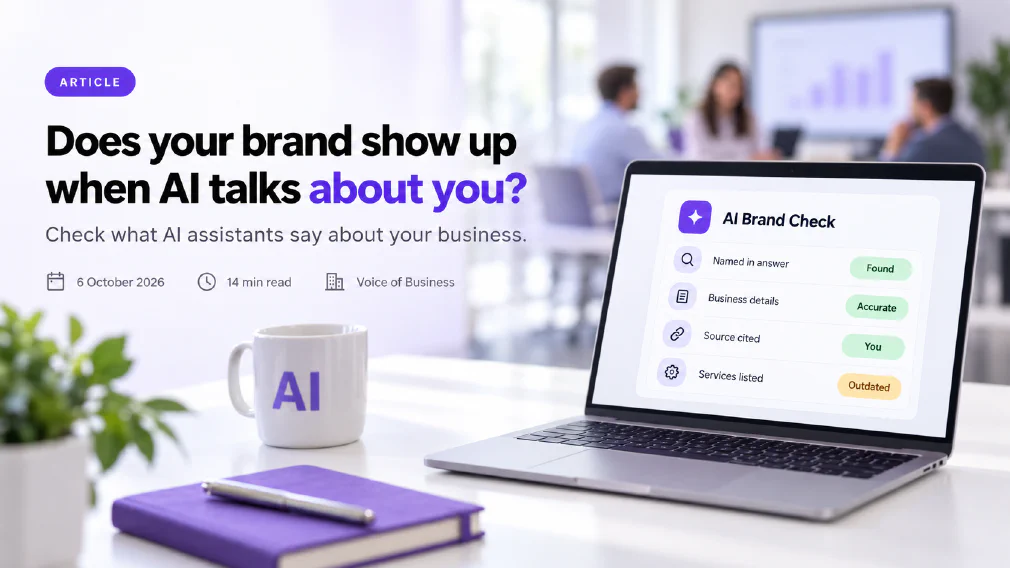
A growing share of the people who might hire you now ask an AI assistant about you before they ever type your name into a search box. What the assistant says is the first impression, and in most cases the business has never seen it. The answer may name you correctly, describe someone else’s services as yours, repeat a detail you changed two years ago, or leave you out of the list altogether.
This article is about finding out. It sets out what to check, how to run the check in an afternoon without any special software, why assistants get small businesses wrong, and what to fix first once you can see the gaps. It is written for owners and managers, not for specialists.
Key Takeaways
- Three things are worth checking: whether you are mentioned at all, whether what is said about you is accurate, and how you are framed next to others.
- One run proves nothing. Answers vary between assistants and between sessions, so the useful signal is the pattern across a fixed set of questions repeated over months.
- Wrong answers usually trace back to old, conflicting or third-party sources, not to the assistant inventing from nothing.
- Fix your own facts first, then the places that repeat them, then the independent sources that carry the most weight.
- No tactic guarantees a mention. The work is to be easy to recognise and easy to describe correctly.
- Someone has to own the check, or it stops happening after the first month.
Why the Answer matters before anyone visits your site
For two decades the first impression of a business was its search result: a title, a short description and a link. The visitor then decided whether to click. That order has changed. When an assistant or an AI-written summary answers the question directly, the reader may form a view of your business, and decide whether to contact you, without visiting a single page you control.
This is the same shift described in how AI Overviews are changing what counts as SEO, applied to your own name instead of a topic. In that earlier piece the point was that generic queries are the ones an assistant is most likely to answer on its own, while a search for a business by name, known as branded search, still tends to send a visit. That is true as far as it goes, but it assumes the assistant describes you well. If the summary that appears when someone checks your name is wrong, the visit that follows is a visit from someone who already has the wrong idea.
There is also a quieter version of the problem. A buyer who has never heard of you will often ask a category question: who does this kind of work, for this kind of company, in this place. If you are not named in that answer, the buyer never reaches the stage of searching for you by name. Being absent from the shortlist is invisible. Nobody tells you about the enquiry that never arrived.
None of this means abandoning ordinary search. It means that ranking well is not enough on its own, because the surface where your business is described has widened. The discipline built around this is called generative engine optimisation, and checking what AI says about you is its simplest starting point and the quickest way to see how wide that surface has become for your business.
What to look for: presence, Accuracy and framing
A useful check has three parts. Keep them separate, because they are fixed in different ways.
Presence asks whether you are mentioned when a buyer asks a question that does not contain your name. Ask what a business like yours does, who offers it for companies of your size, or how to solve a particular problem you solve. If competitors are named and you are not, you have a presence gap. That gap is about whether the assistant has enough clear, consistent material to recognise you as a relevant answer, which is a different question from whether it has the facts right. Record two things here: whether your name appears in the text of the answer, and whether your page is given as the source. The second is an AI citation, and an assistant can do one without the other.
Accuracy asks whether what is said about you is true. Ask directly: what does this company do, who runs it, where does it operate, who is it for, what training or services does it offer. Compare every claim against what you would say yourself. Sort each claim into accurate, outdated or wrong. Outdated is the most common category and the easiest to fix, because it nearly always has a specific old source behind it.
Framing asks how you are positioned. Which businesses are you compared with? What are you said to be best for? What reservations are attached? An assistant can describe you accurately and still place you in the wrong category, or describe you as a good fit for a kind of client you do not want. Framing is shaped by the comparison articles and listings that group you with others, so it is the part you control least directly.
How to run the check in an afternoon
You do not need a monitoring tool for a first pass. You need a list of questions, a few assistants, a way to record what comes back and about an hour.
Start with the questions. One published guide to auditing a company’s presence in AI answers recommends a fixed set of ten to twenty-five prompts across four types: questions that use your company name, category questions that do not, comparisons with named competitors, and problem-based questions that describe a real buyer scenario. Write them the way a person would type them, not the way a marketer would. Bear in mind that an assistant often splits one question into several searches behind the scenes, a process called query fan-out, so a category question can surface sources you would never have searched for yourself. A buyer asks “who can train my sales team to use AI” and does not ask for “AI training providers, small business, Europe”.
Then run the same set in each assistant you want to test, in a clean session with no history and, ideally, a private window, so that your own previous searches do not colour the result. Where an assistant can search the web, note that it is doing so, because a grounded answer built from live pages behaves differently from one built from what the model absorbed in training. The difference is explained in the glossary entry on grounding, and it matters here because the fix is different for each.
For every prompt, record five things: the assistant and the date, whether you were named, what was claimed about you, whether each claim was accurate, outdated or wrong, and which sources were cited if any were. A spreadsheet is enough. Take a screenshot as well, because the wording of an answer is hard to reconstruct later.
Finally, accept that the results will not be tidy. The same guide makes the point that asking the same question twice can produce different companies, different descriptions and different sources, and that a single run is an impression, not a measurement. That is why the instruction is to repeat the identical set monthly. The pattern across several runs is real. The detail of any one run is partly luck, and you should not rewrite your website because of a single odd answer.
Why Assistants get Small Businesses wrong
Once you have a list of wrong or missing claims, the useful question is where each one came from. Assistants do not invent a company from nothing. They assemble a picture from what they have absorbed and what they can find, and small businesses tend to have a thin, uneven trail.
Outdated sources persist. A directory listing from years ago, an old press mention, or a review describing a service you stopped offering can remain the most prominent description of you long after your own site has changed. A guide to fixing brand misinformation makes this point with a review of a deprecated feature that keeps surfacing after the feature has been replaced. The assistant has no way of knowing that the page is stale unless something more recent contradicts it clearly.
Other people’s words often outweigh your own. The same guide notes that independent reviews, forums and articles tend to be given more weight than a company’s own pages, because a company website is read as promotional. This is also why a strong set of facts on your own site, important as it is, does not settle the matter. What independent sources say about you is part of the evidence the assistant weighs.
Conflicting sources produce guesses. If your site says one thing, a directory says another and an article says a third, the assistant has to choose or blend. Where it blends, you get the plausible but wrong answer. This is the mechanism behind a hallucination: the system fills a gap with the most likely continuation, and the result reads exactly as confidently as a true statement.
Comparison pieces blur identities. Listicles and “versus” articles group businesses together repeatedly. Over time, features and claims attached to one business can drift onto another, particularly when names are similar or the businesses sit in the same category.
Training lags behind the world. A model that is not searching the web answers from what it absorbed before its cut-off date. A rebrand, a new service or a move that happened after that date does not exist for it. That is not a fault you can correct on your own site alone, which is why the next section includes the sources outside your control.
Notice what this list implies. Most of the causes are about consistency and clarity of the evidence around your business. They are not about a trick to persuade a particular assistant. That is good news, because consistency is something a small team can actually achieve.
What to fix, in order
Work from the sources you control outwards. The order matters, because fixing an outside listing while your own site is vague just replaces one unclear source with another.
1. State the plain facts on your own site. Your home page, About page and service pages should say, in ordinary sentences, what you do, who for, where you operate and who is behind the business. Avoid describing yourself only in slogans. An assistant, like a new customer, needs a sentence it can lift and repeat accurately. Questions people actually ask belong on the page too, answered in a few self-contained sentences, because those are the pieces that get quoted on their own. Experience, expertise, authority and trust, the qualities summarised as E-E-A-T, are judged from exactly this kind of visible evidence: named people, real credentials, clear provenance.
2. Mark up your organisation. Structured data on your home page tells machines what the business is in a form they do not have to guess at. A search engine’s own documentation says organisation markup can improve its understanding of your administrative details and distinguish your business from others with similar names, and recommends properties such as the name, address, logo, a short description and links to your official profiles elsewhere. The same documentation is clear that nothing is required and that using the markup does not guarantee any feature will appear. Treat it as a way of removing ambiguity, not as a lever.
3. Make every listing say the same thing. Check your business name, description, address, contact details and service list wherever they appear: business directories, professional profiles, social accounts, partner pages. Small differences, such as a former name or an abbreviated one, are what make two records look like two businesses. Pick one form and use it everywhere.
4. Correct the specific sources behind the wrong answers. Where an assistant cites a page, or where you can trace a wrong claim to one, ask the owner of that page to correct it. This is slow and not always possible, but it deals with the cause and not the symptom. Prioritise the sources that appear repeatedly, because they carry the most weight.
5. Earn accurate mentions on independent sites. A business that appears consistently across several reputable sources has a stronger identity than one that appears mainly on its own website. That means real coverage, genuine reviews from real customers, and contributions to your industry’s own publications. It cannot be shortcut, and attempts to fake it tend to create exactly the conflicting signals you are trying to remove. The research summarised in what gets content cited in AI answers points the same way: clear, specific, well-sourced material is what earns a citation, not volume.
6. Use the feedback routes, and do not rely on them. Most assistants offer a way to flag a wrong answer. It costs a minute and does no harm. It should not be your plan, because it carries no promise of a result or a date.
A realistic expectation on timing: the guide on fixing brand misinformation says corrections can take weeks to months to show up across platforms. Assistants that search the web as they answer may reflect a corrected page sooner, while those relying on training will change only when the model itself is updated.
What not to do
Do not overreact to one answer. Because answers vary, one wrong sentence in one session is a prompt to look again, not a reason to rebuild a page.
Do not argue with the assistant. Telling it in a chat that it is wrong may change that conversation. It does not change what it says to the next person.
Do not stuff pages with your name. Repeating the business name unnaturally, or publishing thin pages whose only purpose is to be quoted, adds noise. The sources that work are the ones a human would also find useful.
Do not publish claims you cannot support. A page that overstates what you do invites exactly the kind of mismatch between what is said and what is true that you are trying to avoid, and it is the first thing a careful buyer checks.
Do not treat the result as a ranking. What you are measuring is whether the description of your business is findable, accurate and fair. A good result is a boring one: you are named when you should be, and what is said is correct.
Keeping watch: who owns this
The check is cheap the first time and easy to forget by the third month. The practical safeguard is the same one that applies to any AI process: give it a named owner. One person holds the question list, runs it on a set day each month, files the results and decides what, if anything, to change. When that person leaves, the task passes to someone else by name.
It also belongs in the way you handle change. A rebrand, a new service, a move, a change of leadership or a piece of press coverage should each trigger a fresh run, because each one can make an older description wrong. Treat what AI says about you as one more part of your AI governance and your reputation together, rather than a one-off project. The questions in an AI audit overlap with this check: an audit looks at what your own systems do with AI, and this check looks at what AI systems say about you, and the second half is often the one nobody has looked at.
If you would like a structured version, an audit can cover how your business is described and which of your pages are best placed to be quoted, and it is a sensible first step when you do not know where to begin.
What to do next
This week, write ten questions a buyer might ask about your business: three that use your name, three about your category, two comparisons and two real problems you solve. Run them in two or three assistants in clean sessions and record what comes back. Mark each claim as accurate, outdated or wrong, and trace each wrong one to a source. Fix your own pages first, then the listings, then ask for corrections where you can. Put the same set in the diary for next month, with one person’s name against it. If you want a second pair of eyes on the results, how an audit works is a quick way to see what a structured review would cover.
Sources
- How to check what AI assistants say about your company: sets out a method of ten to twenty-five prompts across branded, category, comparison and problem-based questions, a five-part log for each answer, monthly repetition in clean sessions, and the caution that a single run is an impression and not a measurement.
- How to find and fix what AI gets wrong about your brand: lists why assistants misdescribe brands (outdated sources, third-party sources outweighing the company’s own, conflicting information, comparison articles and training lag) and the correction steps, including that updates can take weeks to months to appear.
- Organisation structured data documentation: a search engine’s guidance on marking up an organisation to disambiguate it in results, the recommended properties, that none are required, and that features consuming the markup are not guaranteed to appear.
FAQ
Questions we get asked
How do I find out what AI says about my Business?
Write a fixed set of questions a buyer might ask, covering your name, your category, a comparison with a competitor and a real problem you solve. Put each one to several AI assistants in a clean session, and record whether you were named, what was claimed, whether it was accurate and which sources were cited. Repeat the same set every month, because a single run is only an impression.
Why does AI get facts about my company wrong?
Usually because the sources it draws on are out of date, in conflict or written by someone else. Old directory listings, a stale review, a comparison article that lumps you in with competitors and training data from before you changed anything can all feed a wrong answer. Where sources disagree, the assistant fills the gap with its best guess, and that guess is delivered in the same confident tone as a correct answer.
Can I make AI Assistants mention my brand?
Not directly, and anyone who promises a guarantee is overstating what is possible. You can make it easier for an assistant to recognise and describe you correctly: state plain facts on your own pages, keep your details identical everywhere they appear, mark up your organisation with structured data, and earn accurate mentions on independent sites. Search engines say plainly that structured data does not guarantee any particular feature will appear.
How long does it take for a correction to show up in AI Answers?
Expect weeks to months, and expect it to be uneven. A published guide on fixing brand misinformation says updates can take weeks to months to appear across platforms. Assistants that search the web as they answer may pick up a corrected page sooner than those relying on what they absorbed in training.
How often should I check what AI says about my Business?
Monthly is a sensible rhythm for most small and mid-sized businesses, using the same set of questions each time so the results can be compared. Check sooner after a rebrand, a change of service, a new location or a piece of press coverage, since each of those can make older descriptions wrong.
Ready to put this to work?
Tell us where your team is with AI and we will tell you honestly what would make the biggest difference.