
AI Overviews
The AI-generated answer Google places above the ordinary search results. It answers the query directly, which is why more searches now end without a click going anywhere, and it names the pages it drew on as sources.
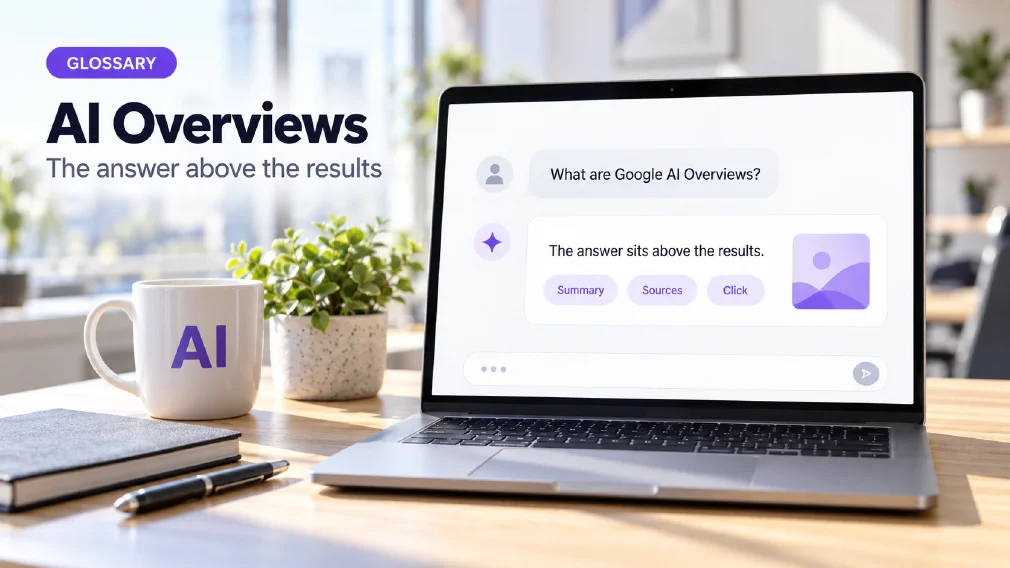
What an AI Overview is
An AI Overview is the answer Google writes itself and places above the ordinary results. A searcher types a question, and before the first blue link there is a short passage that answers it, with the pages it drew on named as sources. The searcher can stop reading there. For a large share of informational queries, that is exactly what happens.
Google’s own name for the wider category is generative AI search. The AI Overview is its most visible surface, not the whole of it. The same shift shows up in ChatGPT and Perplexity, which answer a search inside their own interface instead of sending the searcher to a ranked list. What is particular to the AI Overview is where it sits: on the results page that used to be the starting point for a click.
Who writes the summary
The summary is written by a large language model. In Google’s case that is Gemini, the model family behind its AI features. The model does not answer from memory alone. It reads across several live pages and writes a response from what it finds, which is the process the glossary calls retrieval-augmented generation. The pages it reads are the ones it then names.
That matters for a business because it changes who the reader is. The first reader of a page is now often a model deciding whether the page is worth quoting, and only after that a person deciding whether to click. A page has to do well with both.
Why it changes what a click is worth
Search Engine Optimisation was built on a simple mechanic: rank higher, get more clicks. That mechanic assumed the searcher had to visit a page to get an answer. An AI Overview removes the assumption for many queries. The outcome is more zero-click searches, which are searches that end with the answer delivered and no page visited.
A Pew Research analysis of 68,879 Google searches by 900 US adults in March 2025, reported in the SEO vs GEO review, found that people clicked a traditional result in 8% of visits when an AI summary appeared and in 15% when it did not. That is not a ranking problem in the usual sense. A page can hold its position, or improve it, and still see fewer visits, because the position stopped being the thing that decided whether a click happened.
What the Citation figures show
The ranking article reports the clearest numbers. In a July 2025 Ahrefs study, Google’s AI Overview cited top-10 pages 76% of the time. That is close to what conventional SEO predicts. A March 2026 follow-up, built on 863,000 keywords and 4 million AI Overview URLs, put the figure at 37.9%. Roughly six in ten citations now come from a page that would not have appeared on the first page of ordinary results for the same search.
Ahrefs points to Google’s move to Gemini 3 in January 2026 as the likely reason. A newer model appears to run a heavier fan-out before it answers, so it pulls sources across more variations of a query. The standalone assistants never tracked Google’s rankings closely. In the same 2025 data, only 12% of ChatGPT, Gemini and Copilot citations came from a page ranking top-10, and Perplexity sat at 28.6%. The AI Overview is moving towards a behaviour the assistants already had.
Ranking and being cited are two Outcomes
The practical result is that visibility splits into two questions. Does the page still rank, and separately, is it cited as one of the sources behind the answer? The two used to move together. They no longer do, which is why a citation is tracked separately from rank position.
A business that optimises only for the first question is working on a mechanic that decides fewer outcomes than it used to. That is not an argument for abandoning SEO. Ranking still puts a page into the pool the model draws from, and most traffic still arrives through ordinary search. It is an argument for treating ranking as the base and citation as a second measure on top of it.
How a page ends up in the Answer
The model behind an AI Overview does not summarise whichever page ranks first for the phrase typed into the search box. It breaks the phrase into related sub-questions and picks a source for each, a technique called query fan-out. The ranking article gives an example. A search for “AI training for HR teams” might fan out into what AI bias training for recruitment covers, what the EU AI Act requires of HR, and how CV screening tools get evaluated.
A page built narrowly around the first phrase wins that one query if it ranks first. A page that covers all four angles with real depth can be pulled into more of the merged results, even if it ranks sixth or seventh for the original phrase. That rewards depth on a narrow point over breadth across a broad one, and it is why specific, long-tail questions deserve more attention than they used to.
Two filters sit on top of fan-out. The first is authority. Choosing which few sources to name is closer to an editorial decision than a ranking one, so it leans on the signals described as E-E-A-T: demonstrated experience, subject-matter expertise, authoritativeness and trustworthiness. Clear authorship and evidence of direct experience decide whether a page is in the running at all. The second is structure, which decides whether the model can actually use the page once it is.
What makes a page easy to lift
The ranking article gathers the measured effects. Opening paragraphs that answer the query immediately are cited 67% more often. Pages with original data tables earn 4.1 times more AI citations than pages making the same claim in prose. FAQ schema is linked to a 28% increase in citation rate. A separate CXL study of 100 real AI Overview citations found that 55% of cited passages came from the first 30% of the page.
The throughline is that a model is doing extraction, not composition. A direct answer near the top of a section, a labelled table and a clearly formatted question and answer block each hand it a claim it can use as written. This is the discipline good web writing has always rewarded. What has changed is who is doing the skimming. A page written to be lifted by a model and a page written to be scanned by an impatient person want nearly the same things.
What Google says about it
The SEO vs GEO review reads Google’s own guide, last updated in July 2026. It states that optimising for generative AI search is still SEO. It names things you can skip, including special markup, AI text files and splitting pages into small chunks. What it recommends instead is unusual content with first-hand expertise, a sound technical foundation and accurate business data.
The review is careful about what that covers. It describes Google’s own AI features, which sit on top of Google’s ranking systems. ChatGPT, Perplexity and Claude run their own retrieval and make their own choices about what to cite. So for Google the overlap between SEO and GEO is large, and for everything else it is large but not guaranteed. The generative engine optimisation page covers the wider practice.
Where a click still survives
When a generic query is answered inside the Overview, the click often goes nowhere. A search for a business by name is different, because a model has far less reason to intercept a query that already asks for one named source. That makes branded search a more direct asset than it was. A business a searcher already knows how to name still gets found on purpose. One they have never heard of has nothing to fall back on once the generic version of its category’s query is absorbed into a summary.
Specific long-tail questions are the other place. A short, high-volume query is the kind an Overview is most likely to answer completely. A narrow question is more likely to need a source the model has not already synthesised.
What to track instead of a rank position
Search Console separates impressions and clicks tied to AI Overview appearances. The shape worth watching for is impressions holding steady or climbing while clicks on the same query drift down. That is not a tracking error. It is the query being answered on the results page, and it is the clearest sign that a page’s visibility and its traffic have started to move independently.
Two habits go with it. Track branded and non-branded queries as separate lines, because blending them hides exactly the split described above. And read the Overview by hand, periodically, for the handful of queries that matter most, noting which sources it names. A page that used to rank first can find a competitor cited in its place, or find itself cited only for a narrower sub-question than the one it was written to answer. Neither shows up in a rank tracker.
Mix-ups worth avoiding
Four confusions come up often enough to name. The first is treating the AI Overview as the whole of generative AI search, when it is one surface of it. The second is assuming a top ranking guarantees a citation, which the fall from 76% to 37.9% shows it does not. The third is treating a lost click as a lost ranking, when the page may be holding its position and the query is simply being answered above it.
The fourth runs the other way. A page cited in an Overview has not necessarily won anything a rank tracker will record. A citation can arrive without a visit, so the measure has to be whether and how often the page is named, not only whether it is clicked.
Where it goes wrong
An AI Overview is a generated answer, so it can state something wrong in the same confident tone as something right. That is hallucination, and a summary tied to a real, checkable source is less likely to do it than one that is not. For a business there are two readings of the risk. A searcher may act on a wrong summary of what the business offers, and a business may act on a wrong summary of someone else.
The habit that answers both is the same one the courses teach for any AI output: read the source, treat the first reply as a draft, and check anything that matters before it is used. For your own pages, that means reading what the Overview says about you now and then, not assuming it is accurate.
Where it is covered and where it appears in an Audit
The site covers AI Overviews in two articles. How AI Overviews are changing what counts as SEO sets out the shift and what still earns a click. Why ranking on Google isn’t enough sets out the citation figures and what to track. The SEO vs GEO review compares the two disciplines and gives the order of work: fix the foundations first, then add the habits that make content easy to quote.
An AI audit is how a site is checked against generative AI search and not against the ranking mechanic alone. It asks a question rank tracking cannot, which is whether a model reading across the top sources would choose this page as one worth citing. It starts with a discovery call about where the site currently stands, and the five-step audit methodology sets out how the work runs from there. To have a site checked, get an audit.
FAQ
Questions about AI Overviews
What is an AI Overview?
An AI Overview is the AI-generated answer Google shows above the ordinary results. It answers the query directly and names the pages it drew on, which is why more searches now end without a click. Google's own name for the wider category is generative AI search, and the Overview is its most visible surface.
Do I still need to rank on Google?
Yes, but ranking is no longer the whole target. The ranking article reports that the share of AI Overview citations coming from top-10 pages fell from 76% in a July 2025 study to 37.9% in a March 2026 one. Ranking still puts a page into the pool, and most traffic still arrives through ordinary search, but it no longer guarantees a citation.
Why ranking on Google isn't enough anymoreSEO vs GEO: What changes and what doesn't
Is optimising for AI Overviews Different from SEO?
For Google, mostly not. Its published guide, last updated in July 2026, says optimising for its generative AI features is still SEO and that no special markup or AI text file is needed. What changes is the finish line, which is being cited inside the answer as well as ranking beneath it. For other assistants the overlap is looser.
SEO vs GEO: What changes and what doesn'tSearch Engine Optimisation (SEO)
What is a zero-click Search?
A zero-click search ends with the searcher satisfied and no page visited, because the summary above the results already answered the question. AI Overviews raise how often that happens for informational queries. A page can hold its position and still see fewer visits, because the position stopped deciding whether a click happened.
How does an AI Overview choose which pages to cite?
The model breaks the search into several related sub-questions, a technique called query fan-out, and picks a source for each. A page can be cited without ranking first for the headline phrase. Authority signals decide whether a page is in the running, and a clear, self-contained answer decides whether the model can lift it cleanly.
What makes a page easy for an AI Overview to use?
The ranking article reports that opening paragraphs which answer the query immediately are cited 67% more often, original data tables earn 4.1 times more citations and FAQ schema is linked to a 28% increase. A separate study found that 55% of cited passages came from the first 30% of the page. Direct answers near the top and clear structure do most of the work.
How do I know whether my pages appear in AI Overviews?
Search Console separates impressions and clicks tied to AI Overview appearances. The pattern to watch for is impressions holding or climbing while clicks on the same query drift down. Track branded and non-branded queries as separate lines, and read the Overview by hand for the queries that matter most, noting which sources it names.
Where does an AI Audit come in?
An AI audit checks a site against generative AI search and not against the ranking mechanic alone. The question it adds is whether a model reading across the top sources would choose this page as one worth citing. Every audit starts with a discovery call about where the site currently stands.
What it means for a Business
Being cited in an AI Overview is a different goal from ranking first. Pages written with direct answers near the top and clear structure are the ones a summarising model can lift cleanly.
Ready to Put This to Work?
Tell us where your team is with AI and we will tell you honestly what would make the biggest difference.