
Generative Engine Optimisation (GEO)
Writing and structuring content so that AI answer engines choose it as a source when they assemble a response. It builds on traditional SEO fundamentals rather than replacing them.
What it means in practice
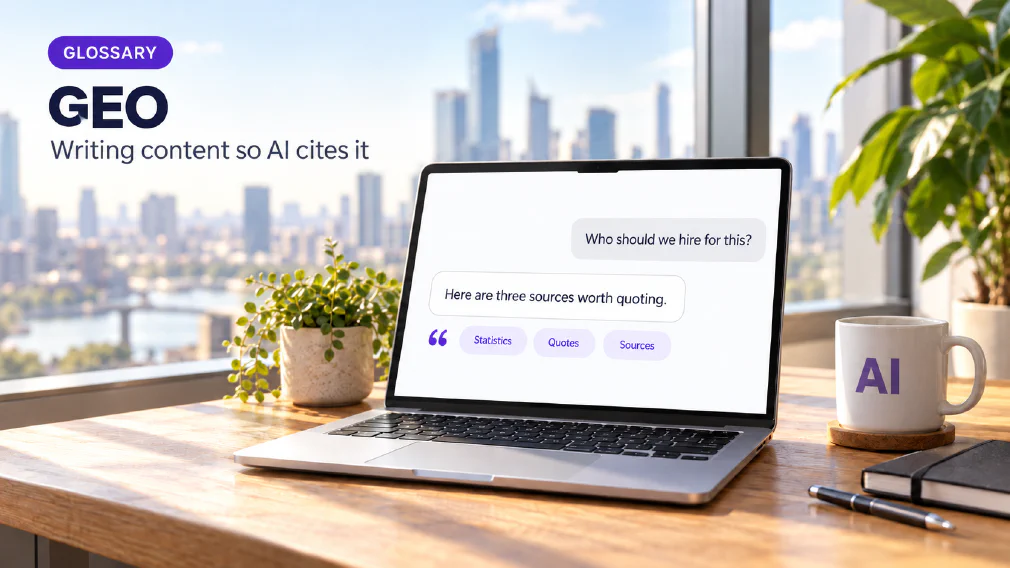
Generative engine optimisation, usually shortened to GEO, is the practice of writing and structuring content so that an AI answer engine chooses it as a source. A person asks a question in ChatGPT, Perplexity, Gemini or a Google AI Overview, the system gathers passages from several pages and writes one answer, and GEO is about being one of the pages it draws on.
The word that does the work is “source”. An AI answer engine is not ranking ten pages for a person to choose between. It is picking material to build a response from, and it names some of that material as a citation. The outcome GEO is after is therefore an AI citation, and the thing being written for is a passage that can be lifted out cleanly, not only a page that can be ranked.
Where the term comes from
The research behind almost every specific figure in this field traces back to one paper presented at the ACM SIGKDD conference in 2024 by a team from Princeton University, Georgia Tech, the Allen Institute for AI and IIT Delhi. The citation article calls it the first and still the most cited peer-reviewed study to measure which content changes move citations inside AI-generated answers.
The team built a benchmark called GEO-bench, with roughly 10,000 queries across nine content domains. For each query they simulated the usual pipeline, retrieving candidate sources and generating a cited answer, the pattern known as retrieval-augmented generation. They then tested nine content strategies against it, and checked the strongest results on Perplexity as a real-world step. Since then the term has become a marketing category with its own agencies and software. The SEO against GEO review reports the paper’s own headline as visibility gains of up to 40%, varying by subject, and asks readers to treat that as a research result and not a promise for their own site.
What moved Citations in the study
Three techniques produced the largest gains, and the citation article says they share a thread: they add information that can be checked and attributed, and do not just restate a claim more persuasively. Adding statistics improved citation visibility by 41%, the largest single gain. Adding direct quotations from named sources improved it by 28%. Citing external sources improved it by 115% for lower-ranked content specifically.
A fourth technique, fluency optimisation, meant writing in clean, readable, well-structured language. The article reports a smaller but still meaningful lift, and says the largest combined effect of any pairing came from fluency optimisation together with statistics. The reason the article gives is that answer engines tend to prefer content that offers something specific and checkable over general assertion. A page that says adoption is rising is less citable than one that gives a sourced percentage.
What did not work
Two negative findings matter as much as the positive ones. Keyword stuffing produced no meaningful benefit and in some cases reduced visibility, which is a break from older SEO practice where density was once treated as a signal. Adding more words also did nothing on its own. The article’s phrase is that the signal is data density and not length.
That is encouraging for a small organisation. The techniques that moved citations are additions to existing content, such as a specific statistic, a credible source or a relevant quotation, and not a requirement to publish much more of it.
Ranking and being cited are now Different Outcomes
The ranking article reports a large change in a short time. In a July 2025 study, Google’s AI Overview cited a top-ten page 76% of the time. A March 2026 follow-up on 863,000 keywords and 4 million AI Overview URLs put that at 37.9%. The standalone assistants never tracked rankings closely: only 12% of ChatGPT, Gemini and Copilot citations came from a page ranking in Google’s top ten for the same query, and Perplexity sat higher at 28.6%.
The citation article describes the same fall in overlap as sharp and notes that it opens room for content that never ranked first. It adds that brand mentions correlated roughly three times more strongly with AI visibility than backlinks did, at 0.664 against 0.218. Taken together, the finding is not that ranking is dead. A rank gets a page into the pool an answer engine draws from. It no longer reliably decides whether the page is named.
Why a Narrow page can win
The mechanism the ranking article gives is query fan-out. Before answering, the model quietly generates several variations of the question, pulls candidate sources for each, and merges the results, favouring a source that keeps appearing across the set over one that dominates a single phrasing. A page that is the clearest, most specific source for one sub-question can be cited without ranking first for the headline phrase.
That is why depth on a narrow point now competes with dominance on one exact phrase. It is also why a page that covers several related angles of a topic with real depth can be pulled into more of the merged results than a page built only around the phrase typed in the box.
How to write for it
The ranking article names three structural habits with a measured effect. Opening paragraphs that answer the query immediately are cited 67% more often. Original data tables earn 4.1 times more citations than the same claim in prose. FAQ schema is linked to a 28% rise in citation rate, because it hands a model a self-contained question and answer. A separate CXL study of where cited passages sat on the source page found 55% came from the first 30% of the page.
The thread through all of these is extraction. A model is lifting a claim, not composing one, so a direct answer near the top of a section, a labelled table and a clear question and answer block each give it something usable as written. The SEO against GEO review makes the same point as a writing rule: write each section so it makes sense if lifted out on its own, with the fact and its source close together. It is not a reason to chop pages into fragments, which Google says is unnecessary.
What Google says, and what it does not cover
The review reports that Google’s guide to its generative AI features, last updated in July 2026, says optimising for them is still SEO. It says you do not need new machine-readable files, AI text files, special markup or Markdown, that there is no special schema.org markup for AI features, and that you do not need to split pages into small chunks. What it recommends is original content with first-hand expertise, a sound technical foundation and accurate business data.
The review reads that guidance for what it covers. It describes Google’s own AI features, which sit on top of Google’s ranking systems. ChatGPT, Perplexity and Claude run their own retrieval and make their own choices. So the accurate version is that for Google, GEO is SEO, and for everything else the overlap is large but not guaranteed. This page does not take a side between that guidance and the trade-press advice on FAQ schema. It reports both, and the site’s own pages carry visible question and answer blocks because they are useful to a reader.
Measuring it
SEO has mature instruments: rank, clicks and conversions. GEO needs its own measure. The ranking article says citation frequency, tracked separately from rank position, is what shows visibility inside an AI answer, and that rank tracking alone no longer says whether a page is cited. It names Am I Cited, a tool this business partners with, as one way to track how often and how prominently a page is cited over time. It also suggests tracking branded and non-branded queries as two lines, because a page can lose ground on generic searches while holding on searches for the business by name.
For a first pass, no tool is needed. The brand article describes a fixed set of ten to twenty-five questions of four kinds: ones with your name, category questions without it, comparisons, and real buyer problems. Run them in clean sessions, record the date, whether you were named, what was claimed, whether each claim was accurate, outdated or wrong, and which sources were cited. One run is an impression and not a measurement, so repeat the same set monthly.
Presence, Accuracy and framing
The brand article splits a check into three parts that are fixed in different ways. Presence asks whether you are named when the question does not contain your name. Accuracy asks whether what is said is true. Framing asks what you are compared with and what you are said to be best for.
It also explains why answers go wrong. Wrong answers usually trace back to old, conflicting or third-party sources and not to the assistant inventing from nothing. A directory listing from years ago can remain the most prominent description of a business long after its own site changed. That points the work at consistency: state the plain facts on your own site, make every listing say the same thing, and correct the specific sources behind a wrong answer.
A worked example
This is an illustration, not a real client. A small consultancy has a page on a regulatory topic that ranks around sixth. It opens with a paragraph of background, makes its claims in prose, and names no sources. The consultancy checks a fixed set of buyer questions and finds that the assistants name two competitors and not itself.
It then rewrites the page. The first paragraph gives the direct answer. The key figures move into a labelled table, each with its source beside it, and one quotation from a named expert is added. A short question and answer block covers the follow-up questions buyers ask. Nothing about the page’s rank has changed. Over the next few months, the same question set is rerun, and the consultancy sees whether it is named more often. It treats the result as a trend and not a proof, because answers vary from one attempt to the next.
Mix-ups worth avoiding
Four confusions come up often enough to name. The first is treating GEO as a replacement for SEO, when the foundations are shared and a page that is not indexed cannot be retrieved by anything. The second is treating it as a set of tricks. The measured levers are statistics, quotations and sources, and the keyword and length tactics did nothing.
The third is assuming the Google guidance and the assistants are the same thing. The guidance covers Google’s features only. The fourth is expecting a click. A citation can be won without one, and the review reports a Pew analysis in which people clicked a traditional result in 8% of visits when an AI summary appeared and 15% when it did not. Ordinary search also still sends far more traffic, with a Similarweb comparison reported at about 191 billion monthly referrals from Google against 1.1 billion from all AI platforms combined.
Where it goes wrong
One failure is rewriting a whole site because of a single odd answer. Answers vary, so one wrong sentence is a prompt to look again. Another is publishing claims that cannot be supported, which invites exactly the mismatch between what is said and what is true that a careful buyer checks first. A third is stuffing pages with the business name, which adds noise and not evidence.
The last is buying GEO as a secret method at a fixed price. The review notes that the research is young, results vary by subject area, and the one authority that has published detailed guidance describes the work as ordinary search optimisation done well. Nothing here guarantees a mention, and this page makes no such claim.
Where it appears in an Audit
GEO shows up in an audit as two questions about content: which existing pages already perform under conventional SEO, since those are best placed to benefit first, and whether each important page would be chosen by a model reading across the top sources. The citation article’s advice is to start there, add specific, sourced statistics and credible external citations to that content first, and treat lower-ranked pages as opportunities and not lost causes.
An audit can also cover how the business is described and which pages are best placed to be quoted, and it starts with a discovery call about where a site stands today. If you want that mapped, you can get an audit to begin one. Whatever the audit finds, the closely related terms are search engine optimisation, AI Overviews and E-E-A-T, and the practical starting point for a business is checking what AI says about it.
FAQ
Questions about Generative Engine Optimisation (GEO)
What is Generative Engine Optimisation?
It is writing and structuring content so AI answer engines select it as a source. It builds on traditional SEO rather than replacing it.
Which Techniques improve Citations?
The citation article reports gains from adding statistics (41%), direct quotations (28%) and cited external sources (115% for lower-ranked content). Keyword stuffing produced no meaningful benefit, and adding more words did not improve citations either.
How is GEO Different from SEO?
SEO aims to rank a page in a list of results, and the reward is a click. GEO aims to have a passage retrieved and cited inside a generated answer, and the reward is a mention, with or without a click. The SEO against GEO review says the two share foundations, so the work overlaps far more than the labels suggest.
SEO vs GEO: What changes and what doesn'tSearch Engine Optimisation (SEO)
Does GEO replace SEO?
No. The review says ordinary search still sends far more traffic than AI platforms, and the citation article says most citations still align with pages that do well on long-established fundamentals such as structure, credible sourcing and relevance. The review's advice is to fix the SEO base first and add the habits that make content easy to quote.
SEO vs GEO: What changes and what doesn'tWhat actually gets Content cited in AI-generated Answers
Can a Small or Lower-Ranked site be cited?
Yes, and the citation article says it has the most to gain. The 115% gain from citing external sources was for lower-ranked content, and the overlap between top-ten Google rankings and AI citations has fallen sharply. A page that never ranked first can still be cited if it is the clearest source for one narrow question.
What actually gets Content cited in AI-generated AnswersQuery Fan out
Does Google say we need special markup for AI Features?
No. The review reports that Google's guide to its generative AI features, updated in July 2026, says optimising for them is still SEO and that no special markup, AI text file or content chunking is needed. That covers Google only. Other assistants run their own retrieval, and the ranking article reports a trade-press guide that links FAQ schema to a 28% rise in citations, so treat any claim of guaranteed benefit with care.
SEO vs GEO: What changes and what doesn'tWhy ranking on Google isn't enough anymore
How do we know whether GEO is working?
Track citations separately from rank. The brand article suggests a fixed set of ten to twenty-five realistic questions, run on a regular schedule in clean sessions, recording whether you are named, what is said and which sources are cited. One run proves little because answers vary, so the pattern over months is the signal.
Does your brand show up when AI talks about you?Why ranking on Google isn't enough anymore
Can anyone guarantee a Citation?
No. The brand article says no tactic guarantees a mention, and the review calls the research young, with results that vary by subject area. A supplier worth hiring will say which parts are established practice and which are experimental, and show you the difference in your own numbers.
SEO vs GEO: What changes and what doesn'tDoes your brand show up when AI talks about you?
What it means for a Business
The measurable levers are about content, not tricks: statistics, direct quotations and cited sources raise citation visibility, while keyword stuffing and simply adding more words do not.
Ready to Put This to Work?
Tell us where your team is with AI and we will tell you honestly what would make the biggest difference.