
Enterprise
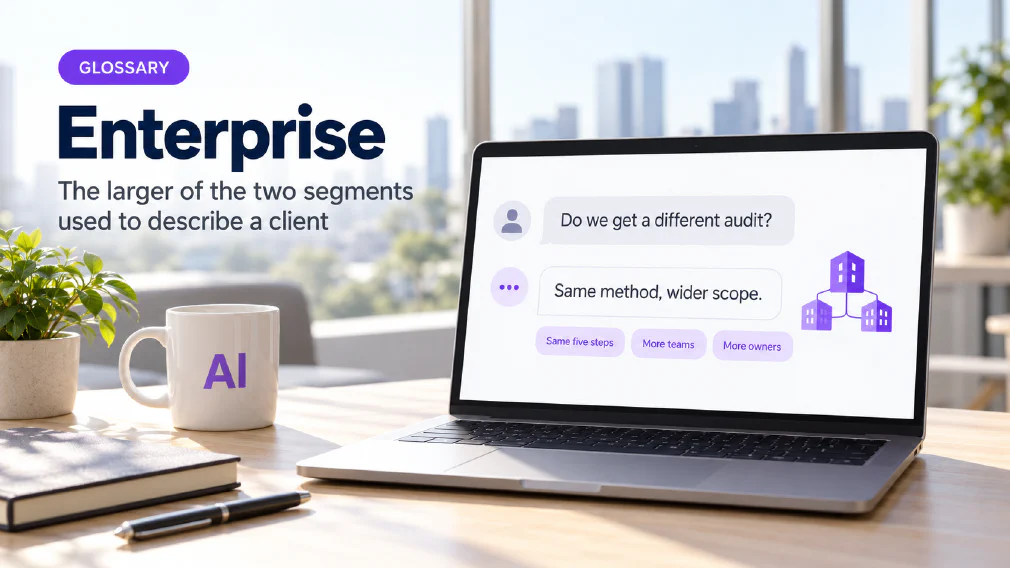
The larger of the two segments this business describes a client by, alongside SME.
What Enterprise means here
On this site Enterprise is the larger of two segments the business describes a client by. The other is SME. The label is used instead of naming a client, and it tells a reader who a piece of work was for without saying who they are.
It is a narrow meaning. Elsewhere, enterprise can mean a size class, a type of software licence or simply a big company. Here it is a way of describing a client. The sections below explain what follows from that, and what does not.
A label, not a size test
The site gives no employee count, turnover or balance-sheet limit for Enterprise, and this page invents none. The definition is a segment label, one of two, and the SME page makes the same point from the other side. A reader who needs an official size class should take it from an official source and not from this glossary.
The About page describes the organisations the work lands hardest with, but it does not say which segment any size band belongs to, so this page does not borrow that description. What it does say is that the business describes the organisations it works with by segment and by sector, and does not publish client names.
Same word, other meanings
Enterprise appears on this site in other senses, and none of them is this term. It is a tier name in vendor products. The ChatGPT page describes Team, Business and Enterprise as tiers of one product. The Gemini page separates Gemini inside Google Workspace from Gemini Enterprise, a different Google Cloud product. Microsoft uses the phrase Enterprise Data Protection for a set of commitments.
Those are described on the tool pages, with the vendors’ own statements, and this page adds nothing to them. They share a word with the segment and nothing else.
The method does not change
The most important sentence about Enterprise on this site is that the audit is run the same way for an Enterprise as for an SME. The same five steps run for both. Scale changes, and the method does not. What changes is the scale of what is examined, not the method used to examine it.
The AI audit page describes the steps. Every audit starts with a discovery call, which is where scope is set. A larger organisation is not handed a different methodology. It gets the same one applied to more processes, or to a wider set of teams.
What scale changes
Scale changes how much is examined and who has to be involved. The audit’s first step walks the operating processes end to end with the people who run them, and the discovery call settles who needs to be in the room. In a larger organisation that is more people across more teams, so the conversation matters more.
The automation page adds a rule that suits larger estates. Scaling happens one proven workflow at a time, and each new process returns to step one of the audit and is not added to a single result rolled across an operation that was never mapped for it. Every phase has to justify the one after it.
An Audit is not a Certification exercise
The site’s article on what an audit checks makes a point about published writing. Most of what is published on the topic is written for a different reader, it says: enterprise pieces that frame an audit as model security, data governance at scale and regulatory certification. Its own audit is a plainer review of how work actually gets done.
That holds for an Enterprise client too. The audit is a diagnostic and not a legal opinion. Obligations under the EU AI Act and GDPR are identified and checked against, and they are not certified. A larger organisation that needs a certificate or a legal view needs a qualified lawyer, and no audit substitutes for one.
The Act applies by use
A common assumption is that the Act is written for large enterprises with compliance teams. The governance article says it does not draw its line at size. It draws it at what the AI is used for. A small organisation and a large one running the same high-risk use case carry the same core obligations.
So being large does not change the classification, and it does not remove the need to classify each use. The article says the heaviest obligations generally sit with the vendor that develops a high-risk system. It adds that “the vendor handles compliance” is not a defensible answer, because a business that deploys a tool keeps oversight duties of its own. That is true at any size.
Governance at scale asks the same questions
The AI governance page describes the questions: which tools are approved, where a third-party tool’s terms stop being acceptable, who stays responsible for a result and how it is checked. They are the same in a large organisation. What differs is how many tools, teams and owners there are.
The ownership article’s warning fits a large estate well. Responsibility for an AI tool spreads across functions: one holds the account, another the use, another the risk and another the training. Each has a real claim to a slice and nobody holds the whole. The article’s answer is one named owner per tool, and it says ownership by committee is ownership by nobody.
Training a Whole organisation
The site’s training pathway suits a larger organisation. The recommended entry is a leadership briefing first and then all-staff foundations, so top-down commitment and bottom-up capability arrive together. The pathway runs from leadership to staff to advanced sessions to agents.
The all-staff briefing is the piece built for scale. It is designed to reach a whole organisation at once, delivered as a demonstration and not a follow-along, so audience size is not a constraint, and it is recorded. Half of its time goes on risks, compliance and regulation, including the organisation’s own approved tools and its AI systems register.
Practitioners and Real Deployments
The bespoke page’s comparison table sets what the business delivers against other providers. One row says its work is informed by real deployments inside regulated and enterprise environments, and another says it is delivered by practitioners who run AI operations daily. Both are the site’s own claims, repeated here as it states them.
This page adds nothing to them and does not name any client or deployment. It is the reason the bespoke format can be scoped to a large organisation’s own processes and documents, as the bespoke training page describes, and not run from a generic deck.
What the site does not publish
The site does not say how many of its clients are Enterprise. The training numbers page names the split of its trained figure by segment, sector and country as unpublished and as an open question. It says a figure nobody has checked is a claim and not a proof point, and it would rather leave one out than fill it in.
This page follows that rule. It states no share, no count and no size band for the segment. If a confirmed split is supplied, the site enters it once as a single record and every page that shows it updates together.
A worked example
This is an illustration, not a real client. A large organisation asks whether an Enterprise gets a different audit. The answer is the same five steps, applied to a wider scope. The discovery call settles which processes are in and who needs to be in the room, and because more teams are involved, the conversation names more owners.
The organisation asks for a certificate that its AI use is compliant. The audit cannot give one. It delivers a compliance checklist for the opportunities it recommends, and the organisation takes legal advice for the rest. Training starts with a leadership briefing, then the all-staff briefing reaches everyone at once. The label described the client. It did not change the method.
Mix-ups worth avoiding
Four confusions come up often enough to name. The first is treating Enterprise as a size test the site defines, when it is a segment label. The second is assuming a larger client gets a different method. The scale changes, and the method does not.
The third is confusing the segment with the product tiers that use the same word, such as the ones on the ChatGPT and Gemini pages. The fourth is assuming an audit for a large organisation is a security scan or a certificate. The site says it is neither.
Where it goes wrong
The commonest failure is asking for a certificate and expecting the audit to provide one. A second is scoping too wide, so nothing is mapped properly. A third is spreading ownership across a committee so no tool has one named owner.
A fourth is assuming the EU AI Act applies differently to a large organisation. It applies by use. A fifth is reading the label as a promise about price or scope. It is neither. Scope is set in a conversation and rates are on the pricing page.
Where it appears on the site
Enterprise appears on the how we audit page, where the same sequence is used for an SME and for an Enterprise, and on the audits page, which says the sequence does not change between them. It appears on the About page in the description of who the business works with, and in the bespoke training audience.
The book a meeting page is the way in, and the SME page covers the other segment. The training catalogue is the one both segments draw on.
FAQ
Questions about Enterprise
What does Enterprise mean on this site?
The larger of the two segments the business describes a client by, alongside SME. It is used instead of naming a client, and it is a label for describing who a piece of work was for. The site does not define it by headcount, turnover or assets.
Is the Audit Different for an Enterprise?
The method is not. The same five steps run for an Enterprise and for an SME: map your processes, document how they run, identify the opportunities, test a prototype, and build and scale. Scale changes, and the method does not. What changes is the scale of what is examined.
Is an AI Audit here a Security Audit or a Compliance certificate?
No. The site's article on what an audit checks says most published writing frames an audit as model security, data governance at scale and regulatory certification. An audit here is a review of how work actually gets done. It is a diagnostic and not a legal opinion, obligations are identified and checked against and not certified, and no audit substitutes for advice from a qualified lawyer.
Does the EU AI Act treat a Large organisation differently?
It draws its line at what the AI is used for and not at company size, so the same use case carries the same core obligations for a small organisation and a large one. The heaviest obligations generally sit with the vendor that develops a high-risk system, but the vendor handling compliance is not a defensible answer, because a deployer still has duties of its own.
How does Training work across a Large organisation?
The recommended sequence is a leadership briefing first and then all-staff foundations. The all-staff briefing is built to reach a whole organisation at once, delivered as a demonstration so audience size is not a constraint, and half of it covers risks, compliance and regulation. Advanced sessions and agents follow for the people who will build and run them.
AI & Responsible & Compliant useMasterclass AI for leaders and managers: Vision, impact & Strategy
Is Enterprise the same as ChatGPT Enterprise or Gemini Enterprise?
What share of clients are Enterprise?
The site does not publish it. The split of its training figure by segment, sector and country is named as an open question on the training numbers page, and no confirmed value has been supplied. The site prefers to leave a figure out than to fill it with something plausible.
What it means for a Business
It is the larger of the two segments, and the audit methodology is run the same way for an Enterprise as it is for an SME.
Ready to Put This to Work?
Tell us where your team is with AI and we will tell you honestly what would make the biggest difference.