
Gemini
Google's AI assistant, covered in the foundational courses as one of the leading chatbots alongside ChatGPT, Claude and Copilot. The advanced programme goes further and works through its agents.
What Gemini is
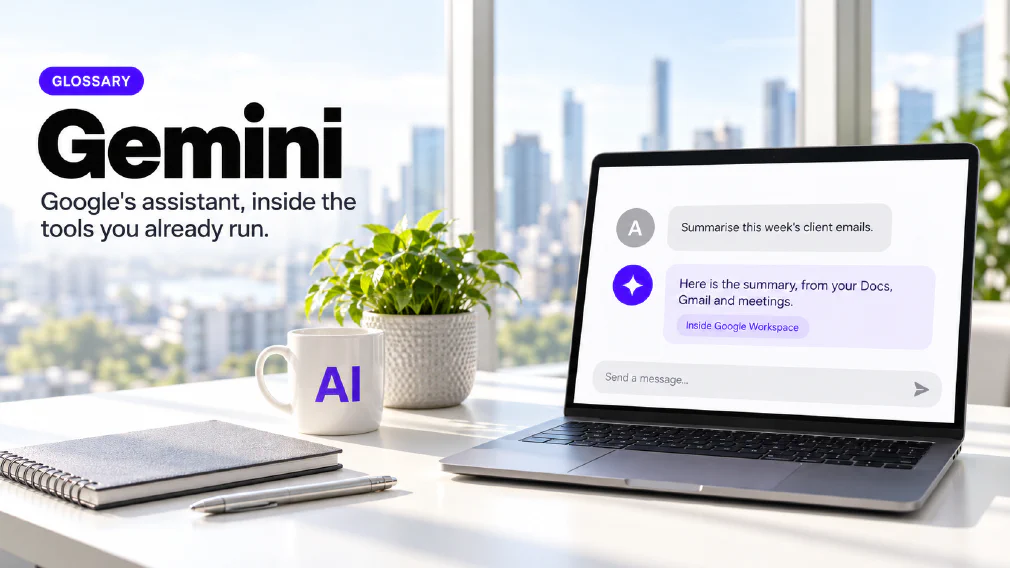
Gemini is Google’s AI assistant. You write a request in a chat window, or you meet it inside an application you already use, and it replies in text. On this site it counts as a chatbot and as one example of generative AI, the wider category of systems that produce new content instead of only sorting or finding existing content.
The foundational courses cover it as one of the leading chatbots, alongside ChatGPT, Claude and Copilot. It is not the tool any course is built on. It is one of the assistants a team should be able to place, so that people know what it is when a colleague mentions it.
One name, more than one product
The first thing to know about Gemini is that the name covers several things. Google uses it for the assistant, and it also uses it for the family of models behind its own features. The site’s articles on search describe Gemini as the model family behind Google’s AI Overview, the summary written directly on the results page, and note that Gemini 3 is the model now generating it.
For a business the confusion that costs money is a different one. Google sells generative AI for business under two names that are easy to conflate. Gemini inside Google Workspace is the assistant built into Gmail, Docs, Sheets, Slides, Meet and Chat, bundled into a Workspace subscription rather than sold on its own. Gemini Enterprise is a separate Google Cloud platform for building and running AI agents, previously called Agentspace, priced and bought apart from a Workspace plan.
A business asking what Gemini costs needs to know which of the two it means before any number is meaningful. The Gemini against ChatGPT review is built around that distinction, and so is this page.
The product and the Model
Like the others, Gemini rests on a large language model. The model is the technology that predicts and generates language. Gemini is the assistant built around it. That is why Gemini, ChatGPT, Claude and Copilot behave differently even though each rests on a language model. Each vendor trains its own, tunes it differently and wraps it in different features, and the wrapper decides much of what a business actually experiences.
With Gemini the wrapper is the point. Its design is to sit inside Google Workspace and answer from documents and messages a user already has open. ChatGPT is a separate destination reached directly or through an API. The review treats that difference as deciding more of the real-world outcome than either model’s raw capability does.
Where it sits: inside Google Workspace
A Workspace subscription bundles Gemini into Business and Enterprise plans, and the review dates that to March 2025. What a business gets rises with the plan tier rather than being switched on across the board. Business Starter carries Gemini in Gmail and Vids only. Standard extends it across Gmail, Docs and Meet. Full access across every app, Gmail, Docs, Sheets, Slides, Drive, Meet and Chat, needs Business Plus or above.
So a business reading only the entry-level Workspace rate is not necessarily reading a rate that includes full Gemini access at all. There is no standalone business price for Gemini inside Workspace. Its cost is whichever tier a team already pays for, or would need to move to. That makes a direct price comparison with a per-seat assistant the wrong question. The right one is what the existing or planned tier already includes.
Grounding in your own Content
What Gemini inside Workspace offers that a separate assistant does not, by default, is grounding. An organisation already running Google Workspace gets the assistant answering from documents, emails and meeting notes it already has open, with no separate integration project to reach that state.
ChatGPT has no default equivalent. It answers from what is in the conversation, from documents deliberately uploaded to it, or from whatever an organisation’s own integration connects it to through the API. That is a limitation for a business that wants AI to already know its own content, and an advantage for a business that wants one general-purpose assistant regardless of which platform the rest of the organisation runs on.
The point cuts both ways. A business running Microsoft 365 gets the equivalent from Microsoft 365 Copilot, not from Gemini, whichever model is technically stronger. Gemini’s main advantage does not apply to an organisation that does not run on Google Workspace.
What Google states about your Data
Because the data goes to the provider, the terms matter. The review reads Google’s own documentation. Google states that Workspace, including whatever Gemini processes inside it, is not used to train its generative AI models without the customer’s explicit permission, and that content is not reviewed by human reviewers for that purpose either.
The commitment attaches to Gemini inside Workspace. The separate consumer Gemini app is a different setting under different terms, and an administrator can choose the EU as the data region for Gemini’s Workspace integrations, an option that does not extend to the consumer app. Two people in the same company could therefore use Gemini under different terms, depending on which account they signed in with. A business should read the terms for the product and account it will actually use, decide what staff may enter, and not assume one policy covers every route in.
The review also lists Google’s certifications: SOC 1, 2 and 3, ISO 27001 and its related family, ISO 42001, FedRAMP High and HIPAA support with a signed agreement. OpenAI’s cover largely the same ground, so security written down on paper is rarely what decides the choice. Data protection covers what a commitment like this does and does not include.
Gemini Enterprise and Agents
Gemini Enterprise is the part that is easiest to mistake for something already bought. It is an AI agent platform on Google Cloud, sold and priced on its own, and a Workspace subscription does not cover it. A business that wants to build its own AI agents beyond the chat assistant should treat it as the separate purchase it is.
An AI agent differs from a chatbot in that it can act on a task, not only answer a question, and agentic AI covers the wider idea. The advanced generative AI programme works through Gemini agents in its session on agents, next to Mistral agents and other examples. The course also teaches the difference between a chatbot and an agent and which of the two to pick for a given job, which is the judgement a platform purchase should rest on.
Building a specific product on top of a model, whichever vendor supplies it, is automation work in its own right and not a feature of choosing a chat tool.
How the Courses use it
Gemini appears in the courses as a tool to compare and, in the advanced programme, as a tool to work in. The ChatGPT and Copilot courses set the leading assistants side by side, Gemini, Claude, Perplexity, Grok, DeepSeek and Mistral among them, so a team can tell which job belongs to which tool and does not memorise one interface.
The advanced generative AI programme goes further. Its spreadsheet block uses Gemini and Claude on Excel functionality, table improvement and a KPI dashboard. Its second session works through Gemini agents. The programme opens with a decision framework on how to choose your tools and covers multi-tool work, including multi-tool post creation and persona-based summaries, so participants see the same task done in more than one assistant.
Gemini is one of several tools across those sessions, and the point of using more than one is to learn which suits which job. The home page describes the business’s training in the same terms, as teaching teams on the AI tools they already pay for, with Gemini named among them.
Mix-ups worth avoiding
Four confusions come up often enough to name. The first is treating Gemini inside Workspace and Gemini Enterprise as one product, which produces a budget for something that was never bought. The second is reading the entry-level Workspace price as a price that includes full Gemini access, when full access starts at Business Plus.
The third is assuming the same terms cover every route in. The Workspace commitment on training data does not describe the consumer app, so the sign-in matters as much as the product. The fourth is treating the assistant and the model as one thing, which hides the fact that the wrapper decides much of what a business experiences.
Each of these comes from asking “which is better” before asking which ecosystem the business runs on and what the work handles. The review’s argument is that the second question comes first.
Where it goes wrong
Gemini can produce an answer that reads well and is wrong. This is hallucination, and it is a property of how generative AI works, not a fault of one product. The courses treat it as a working habit. Ask for the source, read the source and treat the first reply as a draft.
Grounding narrows the risk of an invented answer by tying the reply to content a user already has, but it does not remove the need to check. A summary of a meeting or a table improved in a spreadsheet still needs a person who knows what it should say. The larger the job handed over, the more the check matters.
Gemini compared with other Assistants
The site does not rank the leading assistants, and the reason is stated in the courses. Which tool suits which job depends on the tools an organisation already has, so that is what sessions run on. Gemini inside Workspace sits in Gmail, Docs, Sheets, Slides, Meet and Chat and answers from content the user can already see. Microsoft 365 Copilot does the same inside Word, Excel, Outlook and Teams. ChatGPT is a separate destination with more room to build on. Claude is a hosted assistant reached on its own or through products built on it.
The review names when each fits. Gemini fits an organisation that already runs its day on Google Workspace, that is willing to check its tier carefully, and that treats Gemini Enterprise as a separate purchase. ChatGPT fits an organisation that does not run Google Workspace, that wants one general-purpose assistant independent of its cloud platform, or that is building a product on the API. The Mistral Le Chat and Perplexity pages cover two more of the assistants the courses compare.
Where it is taught and where it appears in an Audit
The comparison runs through several courses. The ChatGPT Enterprise course and Copilot Essentials both place Gemini among the leading assistants. The advanced generative AI programme uses it for spreadsheets and agents. Copilot Essentials is one of the six core AI courses, and the rest sit in the wider training catalogue.
An audit meets Gemini as a tooling choice. Which assistant a process should use turns on the ecosystem the business already runs on and on what the process handles, and the Identify step is built to answer that, checked against the process and not decided from a features page. Once a tool is chosen, training turns the decision into something the people using it know how to do.
FAQ
Questions about Gemini
What is Gemini?
Gemini is Google's AI assistant. It is covered in the foundational courses as one of the leading chatbots, alongside ChatGPT, Claude and Copilot. Google also uses the name for the family of models behind its own AI features, which is why the word covers more than one product.
Is Gemini the same as Gemini Enterprise?
No, and the shared name causes real confusion. Gemini inside Google Workspace is the assistant built into Gmail, Docs, Sheets, Slides, Meet and Chat as part of a Workspace subscription. Gemini Enterprise is a separate Google Cloud product, an AI agent platform formerly called Agentspace, sold and priced on its own. A business budgeting for Gemini needs to know which one it means.
Is Data sent to Gemini used to train Google's Models?
Google states that Workspace, including whatever Gemini processes inside it, is not used to train its generative AI models without the customer's explicit permission, and that content is not reviewed by human reviewers for that purpose either. That applies to Gemini inside Workspace apps. A personal Google account using the separate consumer Gemini app is a different setting, under different terms.
Can EU Data stay in the EU with Gemini?
For Gemini's Workspace integrations, yes. Google lets an administrator choose the EU as the data region. That option covers those integrations and not the separate consumer Gemini app, so the specific product and plan in question is worth checking rather than assumed.
How much does Gemini cost?
There is no standalone business price for Gemini inside Workspace. Its cost is whichever Workspace tier a team pays for, and its reach rises with the tier. Starter carries it in Gmail and Vids only, Standard extends it across Gmail, Docs and Meet, and full access across every app needs Business Plus or above. Gemini Enterprise is priced separately by Google Cloud.
Should we choose Gemini or ChatGPT?
The site does not rank them. A business already running Google Workspace gets an assistant answering from documents, email and meeting notes it already has open, with no separate integration to build. A business outside that ecosystem loses that advantage before the comparison starts. The deciding question is which ecosystem the business already runs on, not which model tests better on a benchmark.
Which Courses cover Gemini?
None is built on Gemini, and the catalogue is honest about that. The ChatGPT and Copilot courses put it beside the other leading assistants so a team can tell which job belongs to which tool. The advanced generative AI programme uses it in its spreadsheet block and works through Gemini agents in its session on agents.
Generative Artificial Intelligence: Advanced Tools & Future Trends (Gen 2)Core AI Courses
Can Gemini be wrong?
Yes. Like every generative AI assistant, it can produce an answer that reads well and is wrong. The courses treat checking as a working habit: ask for the source, read the source and treat the first reply as a draft.
What it means for a Business
It is taught comparatively rather than as a product course. The question the catalogue actually puts is which chatbot suits which job and what is genuinely worth paying for, which is why it is listed beside the others rather than given a day of its own. Where it is treated at length is the review that sets it against ChatGPT, and it turns on one point: Gemini inside Google Workspace is not the same product as Gemini Enterprise.
Ready to Put This to Work?
Tell us where your team is with AI and we will tell you honestly what would make the biggest difference.