Gemini 4 Carbon Review
Gemini 4 Carbon reached paying users on 10 November 2026. What it does, what it costs, what Google's own benchmarks show and whether a small business needs it.
Google’s newest and strongest AI model, Gemini 4 Carbon, reached paying users on 10 November 2026, two weeks after Google first announced it and four weeks after its smaller sibling, Gemini 4 Argon. It arrives one day after Anthropic’s Claude Fable 5.2, so the top end of the market has just become crowded. Almost every number in the launch comes from Google itself. This review covers what Carbon is, what Google’s tests show, what it costs, who can use it and whether a small business should.
The short version: Carbon is a real step up for hard, long-running work, but Google’s own advice is to start with Argon, and most businesses should follow it.
Key takeaways
- Gemini 4 Carbon is Google’s strongest model. It was announced on 28 October 2026 and opened to paying developers, businesses and Google AI Ultra subscribers on 10 November 2026.
- It has a context window of about one million tokens and reads text, images, video, audio and PDFs. It replies in text only.
- The API price is $2 per million input tokens and $10 per million output tokens until 30 November 2026, then $4 and $20. It is not on the Free tier.
- In the Gemini app it needs the Google AI Ultra plan, which starts at €99.99 a month. Google AI Pro, at €21.99, includes Argon.
- Google’s own table has Carbon ahead on most tests against GPT-6 Astra and Claude Opus 5.5, but it compares against Claude Fable 5.1, not 5.2, and nobody independent has yet repeated the results.
- Google still calls Argon the ideal choice for most work. Most businesses do not need Carbon yet.
What is Gemini 4 Carbon?
Carbon is the newest model in Google’s Gemini range and a large language model aimed at the top end of the market. Google’s developer documentation calls it its “most capable reasoning model”, built for complex software engineering, mathematical and scientific problem solving, high factual accuracy and autonomous multi-step agents. In plain terms: it is the model you bring in when the job is hard, long, or both. If the word “agent” is new, our entry on agentic AI explains it, and so does the article on what an AI agent is.
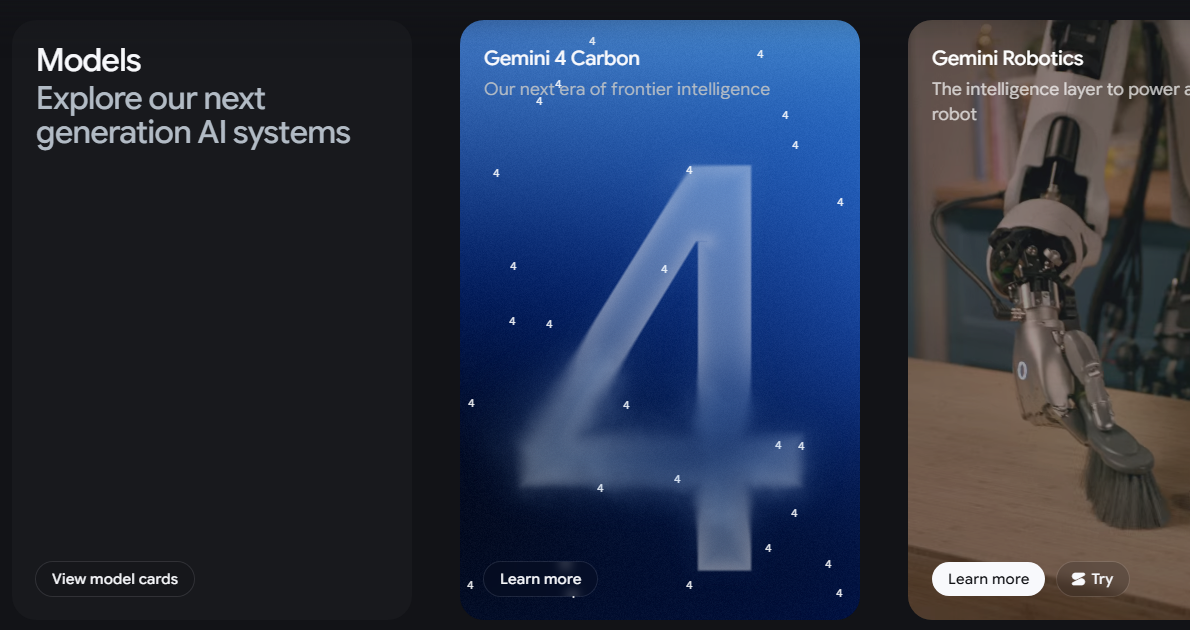
The timeline is worth getting straight, because the launch happened in stages:
- 13 October 2026: Gemini 4 Argon launches, the first model of the Gemini 4 family.
- 28 October 2026: Google announces Carbon and gives it first to a small group of cyber defenders through its Fairwind programme.
- 10 November 2026: Carbon opens to paying developers and businesses through the Gemini API and Gemini for business, and to Google AI Ultra subscribers in the Gemini app, AI Mode in Search and Google Antigravity.
Google’s documentation for Cloud customers lists two model IDs for each name, a standard one and a “cyber permissive” one. The cyber versions appear to belong to the security programme, and they are not the models most people will meet.
How is Gemini 4 Carbon Different from Gemini 4 Argon?
Google’s own framing is the clearest guide. Argon is “the ideal choice for most software engineering and knowledge work”. Carbon is for harder tasks such as complex multi-step debugging and open-ended research, and it uses more tokens to reason and verify its work. The two share the same introductory price.
| Gemini 4 Argon | Gemini 4 Carbon | |
|---|---|---|
| Released | 13 October 2026 | 10 November 2026 |
| Google’s positioning | Most software and knowledge work | The hardest tasks |
| API price until 30 November | $2 in, $10 out per million tokens | The same |
| Tokens used to reason | The baseline | More, according to Google |
| Gemini app plan | Google AI Pro and Ultra | Google AI Ultra only |
The row that matters most for a budget is the one on tokens used to reason. Because Carbon thinks for longer, the same task can cost more on Carbon than on Argon even when the price per token is identical. Google gives no ratio and no cost-per-task comparison between the two, so you cannot work out the extra cost from the launch material. Our review of Claude Sonnet 5.5 against Opus 5.5 makes the same point about a different family: the model that scores highest is not always the model that is cheapest for your task.
What do the Gemini 4 Carbon benchmarks show?
Google’s launch post includes a table that sets Carbon beside Argon, OpenAI’s GPT-6 Astra, Anthropic’s Claude Opus 5.5 and Claude Fable 5.1. It is the fullest comparison available, and also the most one-sided, because Google chose the tests and ran them.
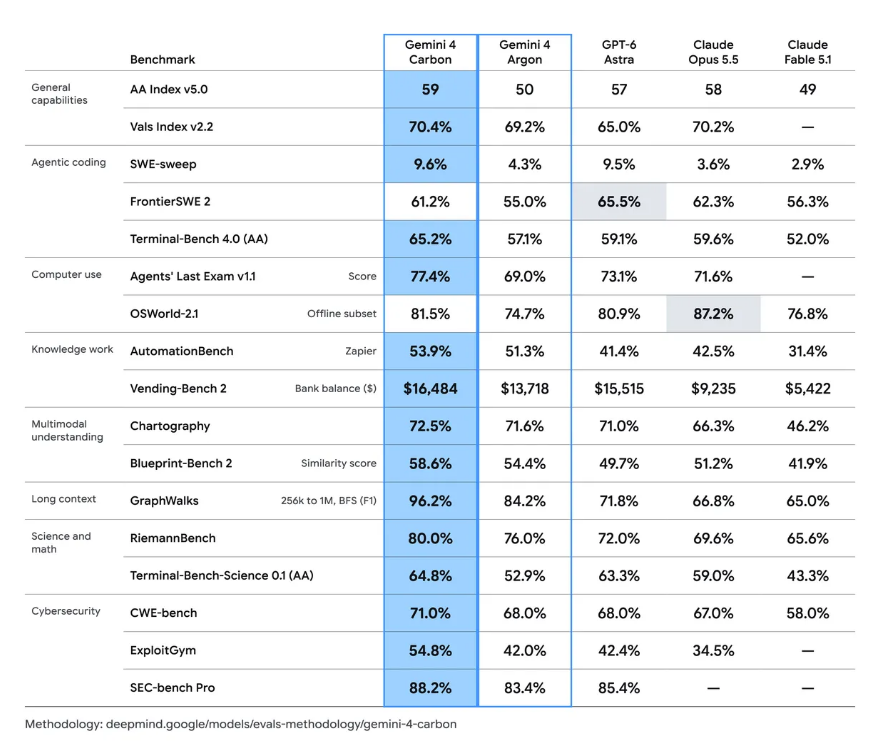
Read in plain English, the table says four things.
Carbon leads on most rows. It tops the table on 15 of its 17 rows. The headline figure is the Artificial Analysis Intelligence Index, an independent group’s composite score, where Google reports Carbon at 59, ahead of Claude Opus 5.5 at 58, GPT-6 Astra at 57 and Argon at 50.
It does not win everywhere. GPT-6 Astra scores higher on FrontierSWE 2, a coding test (65.5% against Carbon’s 61.2%), and Claude Opus 5.5 scores higher on OSWorld-2.1, a test of using a computer (87.2% against 81.5%). Google highlights both in grey in its own table.
The gap over Argon is large on some tests. On SWE-sweep, a coding test, Carbon scores 9.6% against Argon’s 4.3%. On ExploitGym, a security test, it scores 54.8% against 42.0%. On long-context retrieval (GraphWalks), it scores 96.2% against 84.2%.
The table is not up to date on Claude. It compares against Fable 5.1. Anthropic released Claude Fable 5.2 on 9 November 2026, the day before Carbon opened to the public, so a fair head-to-head with the newest Claude model does not yet exist.
Some of the tests in the table are close to everyday business work. Zapier’s AutomationBench measures how well a model handles automation tasks, and Carbon scores 53.9% against 41.4% for GPT-6 Astra and 42.5% for Opus 5.5. Vending-Bench 2, which asks a model to run a simulated vending business over a long period, ends with a bank balance of $16,484 for Carbon. Treat these as hints at how the model behaves over long tasks, not as a forecast of what it will do in your office.
Google also reports that Carbon ranks first on CursorBench 4.0, Perplexity’s WANDR and Zapier’s AutomationBench at “more than 2X lower cost per task” than the next best external model from another company. It does not name that model, and it does not say how Argon fared on cost.
How much does Gemini 4 Carbon cost?
There are two answers, because Google sells Carbon in two ways.
Through the API, per token. Google’s pricing page lists these rates for paying users, with the second figure in each pair starting on 1 December 2026:
| Route | Input per million tokens | Output per million tokens |
|---|---|---|
| Standard | $2.00, then $4.00 | $10.00, then $20.00 |
| Batch and Flex | $1.00, then $2.00 | $5.00, then $10.00 |
| Priority | $3.60, then $7.20 | $18.00, then $36.00 |
Cached input is much cheaper: Google’s launch post prices it at 95% off the input price. Google’s pricing page lists no extra charge for long prompts. It also states that the output price includes thinking tokens, so a model that thinks for a long time bills for that thinking.
To make that concrete, a 20,000-word report is roughly 27,000 tokens, which costs about five cents to read at the introductory input price and about ten cents after 1 December. A two-thousand-word summary written back is roughly 2,700 tokens, which costs about three cents at the introductory output price and about five cents afterwards, plus whatever the model spent thinking. Single tasks are cheap. The cost builds up when a workflow runs hundreds of times, which is why our guide to what an AI workflow actually costs to run tells you to measure the cost per run, not the price per token.
Through the Gemini app, per month. The price is a plan, not a token count. On Google’s Irish subscriptions page, Carbon belongs to Google AI Ultra, which starts at €99.99 a month. Argon is included from Google AI Pro, at €21.99 a month.
The Free tier of the Gemini API does not include Carbon. Google says the introductory rate is a launch price, so if you plan a budget on it, plan on the December price.
Who can use Gemini 4 Carbon, and on which plan?
Access is narrower than the launch headlines suggest. Here is who gets what, taken from Google’s launch post and subscriptions page.
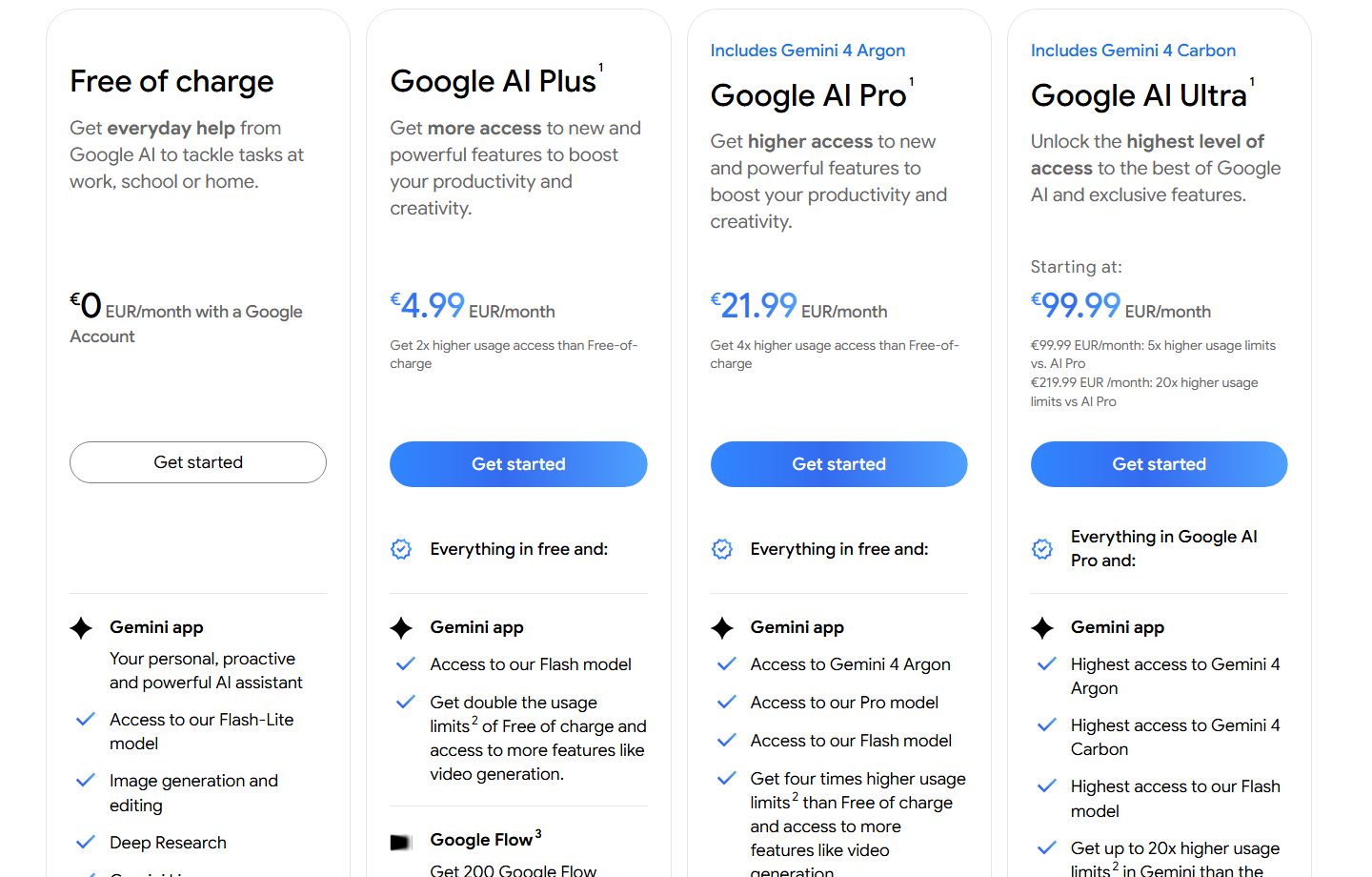
- Google AI Ultra subscribers get Carbon in the Gemini app, in AI Mode in Search and in Google Antigravity, Google’s coding and agent platform.
- Paying developers and businesses get it through the Gemini API, in Google AI Studio, and through Gemini for business.
- Free users and Google AI Pro users do not get Carbon. Pro includes Argon.
- Eligible scientists can apply for six months of free access to Argon and Carbon through Antigravity’s highest usage tier, on a rolling basis.
- Cyber defenders get a special version, “Carbon for cyber”, through the Fairwind programme.
If you run Gemini inside Google Workspace, check carefully what your tier includes before you assume Carbon is part of it. Our comparison of Gemini against ChatGPT for business explains why Gemini’s cost often sits inside a Workspace subscription, and the review of Microsoft Copilot against Google Workspace AI covers the same question from the other side.
What are the specifications of Gemini 4 Carbon?
For readers who build with it, Google’s model page sets out the specification.
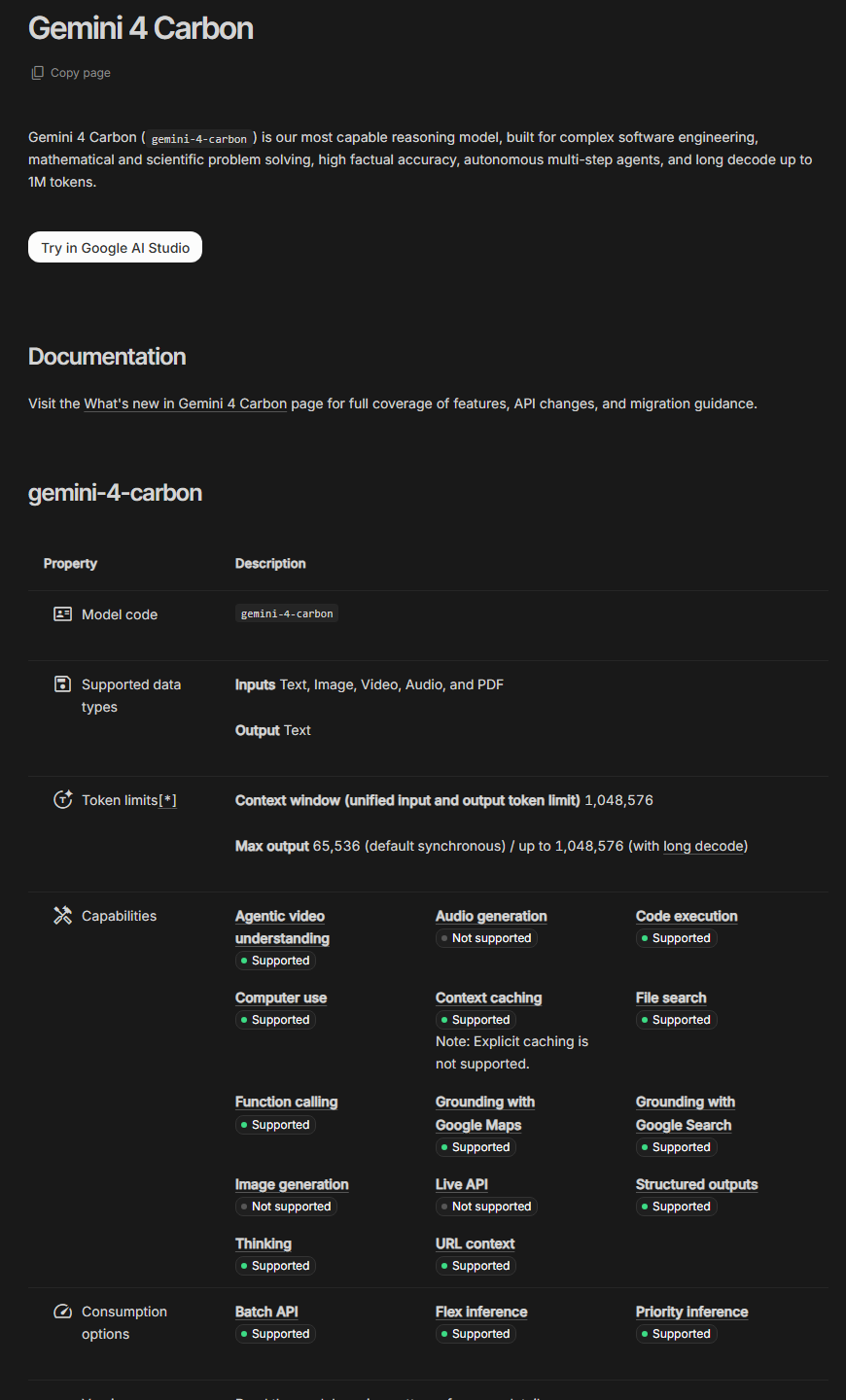
- Model code:
gemini-4-carbon. - Inputs and outputs: it accepts text, images, video, audio and PDF files and replies in text. It is multimodal on the way in only. It cannot generate images or audio, and it does not support the Live API for real-time voice.
- Context window: 1,048,576 tokens, shared between input and output. Our article on what a context window is explains why that matters.
- Output limit: 65,536 tokens by default, and up to the whole window with Google’s long decode setting.
- Thinking: supported at low, medium and high settings, so you can trade depth against cost.
- Tools: it supports function calling, code execution, structured outputs, computer use, file search, URL context and grounding with Google Search and Google Maps. The first of these is how it connects to your own systems, and grounding is how it checks answers against the web. Our entry on grounding explains the idea.
- Caching: implicit only. Explicit caching is not supported.
Google does not state a knowledge cutoff on the model page, so check what the model knows about recent events before you rely on it for anything dated.
What can Gemini 4 Carbon actually do for a Business?
Google lists four areas, and three of them matter to a small business.
Knowledge work. Google says Carbon can synthesise dense legal, financial and enterprise documents and produce spreadsheets, presentations and reports that follow strict schemas. Two finance firms, Hebbia and Balyasny, report that it matched or topped the other models they tested on financial research. These are Google’s partners reporting their own tests, so treat them as encouraging, not proven. If your main job for AI is working through documents, our review of NotebookLM for business documents shows a Google tool built for that purpose.
Agentic coding. Carbon handles multi-package migrations, root-cause investigations and build-and-verify loops for web apps. Google says its own teams have seen it run for days on a single engineering task. For a business without developers, the useful reading is that tools built on Carbon should get better at vibe coding, where you describe an app and let the model build it. A preview feature in Antigravity called /swarm coordinates several agents from one prompt, with Carbon planning and checking the work.
Long, multi-step tasks. The case for Carbon is strongest when a job takes many steps, many files or many hours. That is where the long context window and the long-horizon design should show. For short tasks, a cheaper model finishes in less time.
Science and security. Google highlights protein research, formal verification and a security version for defenders. Unless you work in those fields, this part of the launch is not aimed at you.
How does Gemini 4 Carbon compare with Claude and GPT-6 Astra?
On Google’s table, Carbon is ahead of both on most rows, and the margin over GPT-6 Astra and Opus 5.5 is often a few points rather than a leap. Beyond the table, three differences matter more to a business.
- Access. Carbon needs a paid API account or the €99.99 Ultra plan. Claude Fable 5.2 is on paid Claude plans, and the Free plan does not include it. Our comparison of Claude Free against Pro shows where the model lines fall for Claude.
- Ecosystem. Carbon is strongest if your work already runs on Google Workspace, Search and Antigravity. Our reviews of GPT-6 Astra, Claude Fable 5.2 and Mistral Large 4 cover the others, and Claude against ChatGPT for business explains how the assistants differ on data and admin.
- Evidence. Google’s table is the only head-to-head so far, and the company selling a model chose the tests. Independent testers will publish their own comparisons in the weeks ahead. Until then, a fair test on your own work is the only comparison that counts.
Is Gemini 4 Carbon Safe to use with company Data?
Google reports strong safety figures for Carbon, but there are two separate questions here: is the model hard to attack, and is your data handled properly.
On the first, Google reports that in simulated cyberattack tests Carbon had a per-attempt breach rate of 0.8%, against 3.1% for Argon. On an indirect prompt injection test, where a hidden instruction in a document tries to hijack the model, Google reports a 0.0% attack success rate against 0.7% for Argon. Google adds that prompt injection robustness “remains an area for continued improvement”, which is the honest reading: no model is immune, so be careful when an AI agent reads untrusted emails or web pages.
On the second, Google’s pricing page says that on the paid API tier your data is not used to improve Google’s products. That is useful, but it is not a data protection review. Before you send personal data to any new model, find out where it is processed, how long it is kept and what your contract says. Our guide to what is safe to paste into AI tools sets out a simple rule for the data you should keep out, and the entries on data residency and GDPR explain the terms.
What are the downsides of Gemini 4 Carbon?
None of these are reasons to avoid it. They are reasons to test before you commit.
- The evidence is Google’s. The benchmark table, the safety figures and the partner results all come from Google or from partners Google chose.
- It costs more to run than the price suggests. Carbon uses more tokens to reason than Argon, and thinking tokens are billed as output.
- The price is changing. The introductory rate doubles on 1 December 2026.
- It can still be wrong. Google reports that Carbon declined to make up missing experimental data 98% of the time and passed 92% of an honesty test, against 70% for Argon. That is progress. It is also a reminder that it fails some of the time. Our guide to reducing AI hallucinations and the entry on hallucination explain what to do about it.
- It is text out only. It cannot make images or voice replies.
- It is gated by plan. Most individuals will need Ultra to try it.
Should a Small Business use Gemini 4 Carbon?
For most small businesses, not as the default. Three questions settle it.
- Does a cheaper model already do the job? If Argon or a Flash model handles your drafting, summaries and spreadsheets well, Carbon adds cost for little visible gain. Our article on how to choose an AI vendor helps if you are still comparing providers at all.
- Is the task genuinely hard and long? Carbon’s edge shows on work that spans many files or sources and needs sustained judgement. Think a large contract review or a long research brief, not an email.
- Can your data rules allow it? Check the terms for your plan and your region before sending anything sensitive. Our entry on shadow AI explains the risk when staff try new tools on their own.
If you answer yes to all three, test Carbon on one real task. If you cannot answer the second question, you almost certainly do not need it yet.
How to test Gemini 4 Carbon on your own work
A fair test costs an afternoon, and it is worth more than any benchmark.
- Pick one task you actually do, such as summarising a long customer contract or turning a messy spreadsheet into a report.
- Run it on the model you use now, then on Carbon, with the same instructions and the same files.
- Score both against a short list of what a good answer contains.
- Try Argon too, since it is the cheaper option and Google’s own default.
- Compare the time taken and the cost of each run, not only the quality.
- Have a person check the answer, as our guide to checking AI output before it goes to a customer describes.
For a structured way to run this, our 30-day AI pilot guide sets out the steps. If you want a second pair of eyes on which model suits which job, an AI audit looks at your actual tasks and tools.
Verdict
Gemini 4 Carbon is a real advance for hard, long-running work, and Google’s table makes a credible case that it is among the strongest models on sale. It also arrives in a market where the gap between the top model and the one just below it matters less to most businesses than how well the work is checked. Google’s own advice is to use Argon for most work, and that is sound.
The sensible move is to keep your current model for everyday tasks, test Carbon on the one or two hardest jobs you have, and judge it on your own results and your own bill. Treat every benchmark here as a hint until independent testers have had their turn, and plan your budget on the December price, not the launch price.
Further reading
- Claude Fable 5.2 Review: the Anthropic model that launched the day before Carbon.
- GPT-6 Astra Review: the OpenAI model Google compares against.
- Gemini vs ChatGPT: Which fits your business?: how Gemini sits inside Google Workspace and what it costs there.
- What is an AI agent?: the idea behind long-running agent work.
Sources
- Gemini 4 Carbon: our next frontier model (Google): the 28 October announcement, the benchmark table, safety figures and the Fairwind programme.
- Gemini 4 Carbon is now available (Google): the 10 November launch, availability by product, the price schedule and the Argon comparison.
- Gemini 4 Carbon model page (Google AI Studio docs): model code, context window, output limits and supported features.
- Pricing (Google AI Studio docs): per-token rates by route, thinking-token billing, the Free tier and data use on the paid tier.
- Google AI plans, Ireland (Gemini): the plans, euro prices and which plan includes Argon and Carbon.
- Models (Google DeepMind): the current model line-up and where each is available.
- Model versions and lifecycle (Google Cloud docs): the Argon and Carbon model IDs and release dates.
- Gemini 4 Carbon reaches AI Mode for Ultra subscribers only (PPC Land): independent coverage of the consumer rollout and the cost caveat.
- Gemini app rolling out Gemini 4 Argon to AI Pro and AI Ultra (9to5Google): the 13 October Argon launch and which plans it reached.
FAQ
Questions we get asked
What is Gemini 4 Carbon?
Gemini 4 Carbon is Google's strongest AI model. Google announced it on 28 October 2026 and opened it to paying developers, businesses and Google AI Ultra subscribers on 10 November 2026. Google built it for the hardest work: long coding jobs, multi-step research, document-heavy analysis and security tasks. It reads text, images, video, audio and PDFs, replies in text, and has a context window of about one million tokens.
How much does Gemini 4 Carbon cost?
Through the API, Google lists an introductory price of $2 per million input tokens and $10 per million output tokens until 30 November 2026. From 1 December 2026 the price rises to $4 and $20. Thinking tokens are billed as output. In the Gemini app, Carbon sits in the Google AI Ultra plan, which starts at €99.99 a month on Google's Irish page.
Is Gemini 4 Carbon better than Gemini 4 Argon?
On Google's own tests, yes, on most of them. But Google itself calls Argon the ideal choice for most software and knowledge work and keeps Carbon for harder tasks. Carbon also uses more tokens to reason and verify, and the two share the same introductory price. For everyday business tasks, the extra capability may not justify the extra usage.
Can I use Gemini 4 Carbon for Free?
No. Google's pricing page states that Carbon is not available on the Free tier of the Gemini API. In the Gemini app it is part of the Google AI Ultra plan, and Google lists Argon, not Carbon, under Google AI Pro. Eligible scientists can apply for free access through Google Antigravity for six months.
Is Gemini 4 Carbon better than ChatGPT or Claude?
Google's launch table shows Carbon ahead of GPT-6 Astra and Claude Opus 5.5 on most of the tests it chose, and behind on a few. The table compares against Claude Fable 5.1, not the newer Fable 5.2, and the results are Google's own. Independent testing of the three has not yet caught up, so test the models on your own work before you decide.
Can Gemini 4 Carbon make mistakes?
Yes. Google reports that Carbon invents less than Argon, but it does not claim it never makes things up. Every language model can give a confident wrong answer. Keep a person in the loop for anything that reaches a customer, a contract or a financial decision, and check figures against the source.
Is Gemini 4 Carbon Safe to use with customer Data?
Google's pricing page says that on the paid API tier your data is not used to improve Google's products. That is a helpful statement, but it is not a full data protection review. Check where the data is processed, how long it is kept and what your contract says before you put personal data into any new model.
How big is the Gemini 4 Carbon Context window?
Google's model page lists a context window of 1,048,576 tokens, shared between what you send and what the model writes. The default reply limit is 65,536 tokens, and a long decode setting lets a single reply run up to the full window. Google's API price does not change with the length of your prompt.
Do I need Gemini 4 Carbon for everyday work like Emails and reports?
Almost certainly not. Google positions Argon as the model for most work, and a cheaper Flash model can handle simple tasks. Carbon earns its place on hard, long and multi-step jobs, such as a large contract review or a complicated data analysis. If your current model already does the job, switching adds cost without visible gain.
Ready to Put This to Work?
Tell us where your team is with AI and we will tell you honestly what would make the biggest difference.