
Generative AI
AI that produces new text, images or other content in response to a prompt, rather than only classifying or retrieving what already exists. It is the foundational subject of every course in the training catalogue.
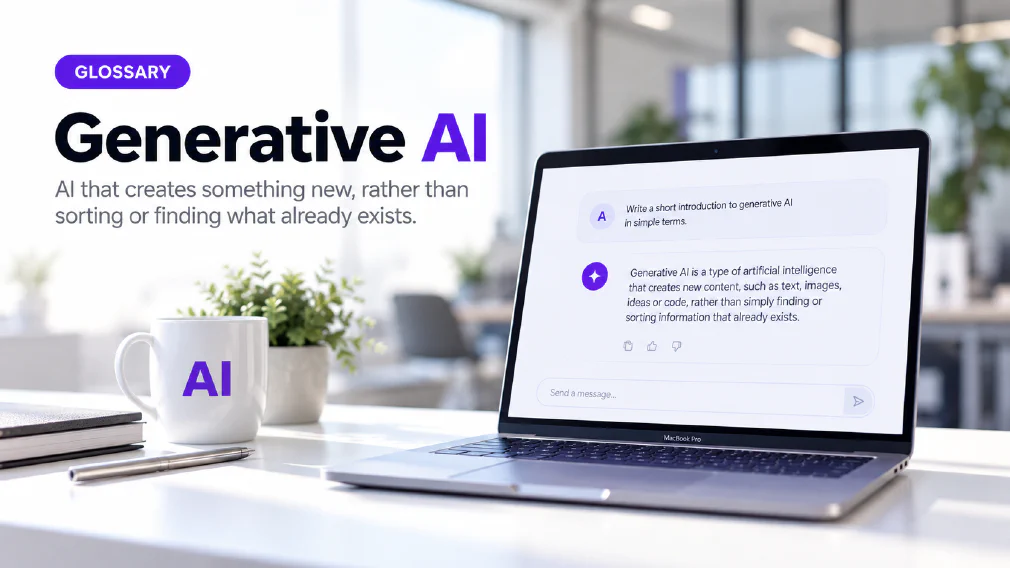
What Generative AI actually is
Most of the AI systems built before this current wave did one of two jobs. They sorted things into categories: this email is spam, this transaction looks fraudulent, this photograph contains a face. Or they retrieved something that already existed: a search result, a recommended product, a matching record in a database. Neither job produces anything new. A spam filter does not write an email. A recommendation engine does not invent a product.
Generative AI does a third job. Given an instruction, called a prompt, it produces content that did not exist in that exact form before the prompt was made: a paragraph, an image, a block of code, a spreadsheet formula. It is not pulling a stored answer out of a database. It is constructing one, piece by piece, based on patterns learned from a very large amount of existing material.
That is also the reason the word “generative” is doing real work in the name. Classification and retrieval both point at something that already exists. Generation makes something new sit next to it, and that single difference is why this branch of AI reshaped how people write, design and code faster than any earlier wave of the technology did.
It is worth being clear that “new” here means newly produced, not necessarily unprecedented. A model asked to draft a standard meeting agenda will produce text built entirely from patterns it has seen thousands of times before, arranged for this particular prompt. That is still generation, in the technical sense used throughout this page, even where the content itself is unremarkable. The term describes the mechanism, prediction and assembly rather than lookup, not a claim about how inventive any single output happens to be.
How it produces an Answer
A generative model is trained by being shown enormous amounts of existing material: text pulled from books, articles and websites for a text model, images paired with their captions for an image model. During training, the model is not memorising that material. It is learning the statistical relationships within it, which words tend to follow which other words, which shapes and colours tend to sit together, at a scale no person could hold in their head.
Once training is finished, the model is given a prompt and produces its answer one step at a time. For a text model, that means predicting the next most likely word given everything written so far, then the next, then the next, until a full sentence and then a full answer has been built. It is not looking anything up. It is completing a pattern.
This is also the direct source of the technology’s best-known weakness. Predicting what a plausible answer looks like is not the same operation as knowing whether that answer is true. A model can produce a wrong statement in exactly the same confident, well-formed sentence it would use for a correct one, because fluency and accuracy are two separate things to it. That failure mode has a name on this site: see hallucination. The opposite of it, an answer tied back to a real, checkable source, is grounding.
The main forms it takes today
The same underlying idea shows up across several different kinds of tool, built for different kinds of content.
Text generation is the form most people meet first, usually through a chatbot: drafting an email, summarising a document, answering a question, rewriting a paragraph in a different tone. Image generation takes a written description and produces or edits a picture from it. Code generation writes or explains programming code from a plain-language request, which is why it has changed how software gets written as much as it has changed how prose gets written. Audio and video generation produce speech, music or short clips from a prompt, the newest and least mature of the four.
Most of the named tools in this glossary sit in the text category, sometimes combined with one of the others: ChatGPT, Claude, Gemini and Microsoft 365 Copilot are all built on text generation at their core, with image and file handling layered on top of it.
How it differs from Ordinary Automation
Automation and generative AI both get described as “the AI doing the work now,” but they solve different problems and it is worth being precise about the difference. Automation follows a fixed rule: when a particular condition is met, carry out a particular, predetermined action, the same way every single time. A rule that files an invoice into the right folder based on its sender does the same thing on the thousandth invoice as it did on the first.
Generative AI has no such fixed rule to follow. Give it the same prompt twice and it can hand back two different, both reasonable, answers, because it is generating a response to the prompt rather than executing a stored procedure. That makes it well suited to work where there is no single correct answer: a first draft, a summary, a list of options to consider. It makes it poorly suited to work that needs the identical result every time, which is still automation’s job, not generative AI’s.
A business process usually needs both, in different places, and confusing the two leads to real cost. Putting a fixed automated rule on a task that genuinely needs judgement produces a rigid result that breaks the first time a case does not fit the rule. Putting generative AI on a task that needs the identical, auditable outcome every time produces inconsistency where a business actually needed reliability. An audit that looks at where a business’s processes actually sit on that line, rather than assuming every process wants the same tool, is described on how an audit works on this site.
Where it gets things wrong
Three limitations come up constantly and are worth naming plainly rather than glossing over.
The model can state something false with the same confidence it uses for something true, because, as above, it is predicting a plausible pattern rather than checking a fact. This is hallucination, and no amount of clever prompting removes it entirely. A model asked for a source it does not have can still produce one that reads correctly formatted, a citation, a case number, a statistic, and every part of it can be invented. It can be reduced, not eliminated, which is why the check has to happen after the fact rather than being trusted away in advance.
The model’s knowledge has a cut-off. It was trained on material available up to a particular point, and anything that happened after that point is simply not in it unless the tool has been separately connected to a live source, a technique with its own name, retrieval augmented generation. Ask an ungrounded model about a change made last week and it will either say it does not know or, worse, answer confidently from older material as though nothing has changed.
The model also reflects whatever bias existed in the material it was trained on. If that material skewed in a particular direction on a particular subject, or represented some groups, languages or viewpoints more than others, the model’s output can skew the same way, and this is not something a user can see just by reading a fluent, well-punctuated answer. It takes a deliberate check against the actual question being asked.
None of this is a reason to avoid the technology. It is the reason a generated first draft stays a first draft, checked and edited by a person, rather than becoming a finished, published answer on its own.
Generative AI and a Large Language Model are not the same thing
The two terms get used almost interchangeably in everyday conversation, but they answer different questions. Generative AI describes what a system does: produce new content. Large language model describes one particular kind of system built to do that, one trained specifically on text. Every large language model is a generative AI system. Not every generative AI system is a large language model. An image generator is generative but is not a language model at all, since it was never trained on language in the first place.
That distinction matters in practice because the two terms get chosen to fit different tools. A business choosing a text assistant is choosing a large language model. A business choosing an image tool for marketing material is choosing a generative AI system that is not a language model. Both sit under the same umbrella term, and getting the umbrella term right is what keeps a conversation about tools from drifting into a conversation about only one kind of tool.
It also matters for anyone reading about AI regulation. The EU AI Act and most other current rules are written to cover generative AI as a category, not language models specifically, because an image generator and a text assistant raise many of the same questions about accuracy, disclosure and oversight even though only one of them is a language model. Reading “generative AI” in a regulation and mentally narrowing it to “chatbots” is a common and avoidable misreading.
FAQ
Questions about Generative AI
Is Generative AI the same thing as Artificial Intelligence?
No. Artificial intelligence is the broad field. Generative AI is one branch of it, the branch that produces new content rather than sorting, scoring or retrieving existing content. A spam filter, a fraud detection system and a product recommendation engine are all AI. None of them is generative, because none of them writes a new sentence or draws a new picture.
What is the difference between Generative AI and a Large Language Model?
Generative AI describes what a system does, which is produce new content. A large language model describes one particular kind of system built to do that with text specifically. Every large language model is a generative AI system. Not every generative AI system is a large language model, since an image generator is generative but is not a language model at all.
Why does Generative AI sometimes give a wrong Answer with complete confidence?
Because it is predicting a plausible continuation of the prompt, not checking a fact against a source. The model has no built-in way to tell the difference between a pattern that happens to be true and a pattern that merely looks right, so a fluent, well-formed answer can still be invented. This failure has a name, hallucination, and it is the single biggest reason any output needs a human check before it goes out under a business's name.
Do I need to be Technical to use a Generative AI Tool?
No. The interface for most generative AI tools is a text box. You type an instruction in plain English and read the result, the same way you would send a message to a colleague. The skill that actually separates a good result from a poor one is writing a clear, specific instruction, which is what prompt engineering teaches, not programming.
Is everything a Generative AI Tool produces original?
It is newly assembled rather than copied from one source, but it is built entirely from patterns learned in existing material, so calling it wholly original overstates what happened. Two people who give a model near-identical prompts can get near-identical answers back. Anything generated for external use, a client-facing document or a public statement in particular, should be reviewed and edited by a person before it goes out.
How is Generative AI Different from Ordinary Automation?
Ordinary automation follows a fixed rule: when this happens, do that, every time, the same way. Generative AI does not follow a fixed rule. Given the same prompt twice it can produce two different answers, because it is generating a response rather than executing a set procedure. That makes it good at tasks with no fixed right answer, drafting, summarising, brainstorming, and poorly suited to tasks that need the same result every single time.
What it means for a Business
It is the foundational subject of every course in the training catalogue, so a core AI course and a bespoke programme both start from what it can and cannot do rather than from the tools.
Ready to Put This to Work?
Tell us where your team is with AI and we will tell you honestly what would make the biggest difference.