
Agentic AI
The approach rather than the individual system: designing work so that AI carries out a sequence of steps on its own instead of answering one prompt at a time. Adoption that is early and specific to one workflow consistently outperforms broad, general rollout.
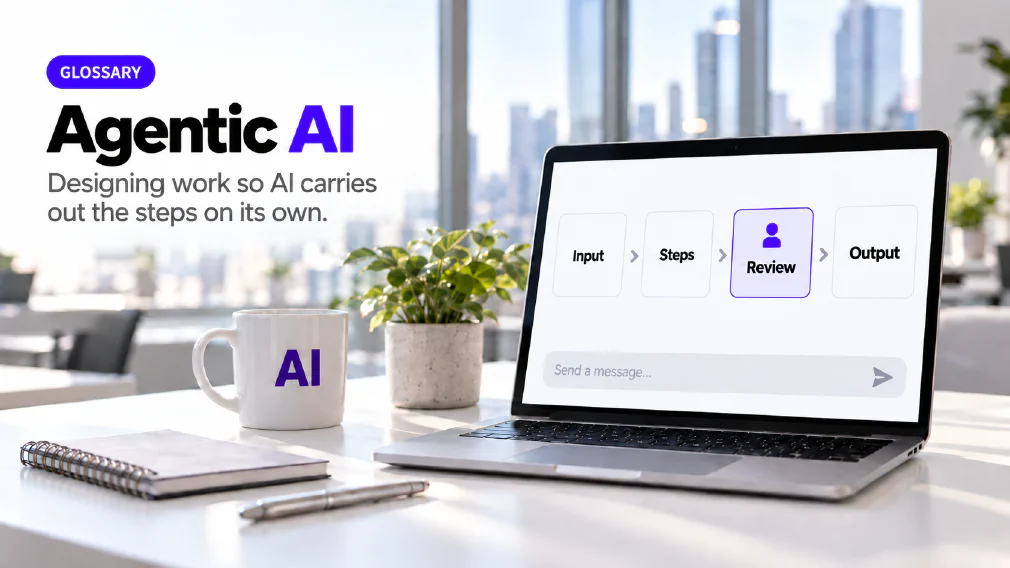
What Agentic AI means
Agentic AI is the approach, not the individual system. It means designing work so that AI carries out a sequence of steps on its own, instead of answering one prompt at a time. The steps might be reading a request, checking a source, choosing between options and sending a result. What makes the design agentic is that nobody has to prompt each one.
The distinction matters because the two words are used loosely. An AI agent is a system that carries out that sequence. Agentic AI is the decision to organise a piece of work around such a system, and the thinking that goes into where it belongs. A business can build an agent and never adopt an agentic approach. It can also adopt the approach carefully and end up building only one.
Where it sits among the other terms
The vocabulary layers on top of itself, and each term answers a different question. Generative AI is the umbrella for systems that produce new content. A large language model is the kind that does it with text, and it answers one prompt and stops. A chatbot is a tool you hold a conversation with, one prompt at a time.
An agent takes the same pieces and adds a sequence of steps carried out on its own. Agentic AI is the approach that decides whether that is the right design for a given piece of work. Automation sits beside all of these, and it is the hand-over of repeatable work to a system, often by a fixed rule. The two overlap without being the same. A rule suits work that never varies, and an agentic approach suits work where the steps involve judgement.
Why starting Narrow works
The definition on this site carries one claim that shapes everything else: adoption that is early and specific to one workflow consistently outperforms broad, general rollout. Our article on what a well-scoped AI workflow delivers sets out the evidence. A defined, single-purpose workflow produces a result that can be measured. A general rollout across an organisation usually does not, and the return goes missing.
The reason is not technical. A narrow workflow has a clear input, a clear output and a point where a person reviews the result, so there is something specific to compare against. A broad initiative has none of those, so nobody can say whether it worked. The same technology gives a measurable result in one case and a much smaller one in another, depending on how narrowly it was applied. Scope is the decision that determines the result.
What a Well-Scoped Workflow looks like
An AI workflow on this site is a single, specific process rebuilt around AI, with a clear input, a clear output and a defined point where a person reviews the result. Workflow design is the stage between naming an opportunity and building anything, when one process is redrawn end to end and those three things are settled before a prototype exists. Scope is fixed there, not discovered during the build.
The well-scoped article names four principles: a clear objective, a defined scope, built-in guardrails and a business impact that can be shown. Guardrails belong in that list from the start. A workflow that gains steps carried out on its own also gains places where a mistake can travel unseen, so the review point is part of the design and not a step added after something goes wrong.
Deciding what to hand over
An agentic design still has to decide how much to hand over. Our article on automating a task against automating a decision makes the point that far more tasks than whole jobs can be automated, and that the gap between the two is the argument for sorting work onto a ladder instead of treating it as one block.
The ladder has four levels: Assist, Recommend, Execute and Never delegate. The sort depends on volume, consequence, reversibility, how clear the rules are and whether the decision needs legitimacy a model cannot supply. Hiring, dismissal and anything with legal, safety or rights implications sit permanently at Never delegate, whatever the technology can do. A well-scoped agentic workflow is one where every step has already been placed on that ladder.
Whether a Process needs it at all
The question an audit asks is whether a process genuinely needs a sequence of steps carried out unattended, or whether something simpler does the job. That answer is not assumed at the start. The prompting workshop closes on a decision framework for choosing between a prompt, a template, a scheduled prompt and an agent, and the agents course teaches when an agent is the wrong answer. Many tasks belong lower down that list.
At business scale an audit works through five steps: map your processes, document how they run, identify the opportunities, test a prototype, and build and scale. The third step, opportunity identification, weighs each candidate on how often it repeats, what the manual version demands in effort, whether the data it needs exists in a usable state and what regulatory exposure attaches. Candidates that are possible but not worth doing are named and set aside with the reason recorded, because a list that says yes to everything is not a prioritised list.
Testing Narrow before building Wide
The audit runs the approach in a deliberate order. The highest-ranked opportunity is built as a working prototype and put in front of the people who would use it, running on real work or a realistic sample of it. It is narrow and specific on purpose. The prototype exists to answer one question, which is whether it behaves well enough on this organisation’s own work to be trusted with it.
A prototype that fails answers that question as usefully as one that succeeds, and it does so before anything has been rolled out or rebuilt around it. The people who do the work judge the result, and their verdict decides whether the next step happens. What comes out is a documented result: what it did, where it broke, what a person still has to check and whether it is worth building properly.
Scaling then happens one proven workflow at a time. Each returns to the first step for the next process, instead of rolling a single result across an operation that was never mapped for it. Every phase is meant to justify the one after it, which is the opposite of a broad rollout that has to be defended as a whole.
A worked example
The tender review agent, which appears in the agents course and the bespoke build day, shows the approach in one workflow. The input is a set of tender documents. The output is a structured evaluation against published criteria. The review point is a person, because the course marks the place where the judgement must stay with them.
On the ladder from the task and decision article, the evaluation sits at Assist or Recommend. The final judgement does not move down to Execute. That is what a well-scoped workflow looks like: the tedious, structured part is handed over, and the decision that carries the consequence is not. The scope is narrow enough to measure, and the guardrail is built into the design instead of added after a mistake.
Readiness comes before Technology
Our article on what predicts whether an AI project reaches production argues that readiness matters more than capability. A readiness assessment before launch, properly governed data, a named executive sponsor, a defined success measure and an internal champion are the traits shared by projects that reach production. Projects without them tend to drift.
That applies with extra force to an agentic design, because an agent acts on the data it is given. If the data is poor, the sequence of steps carries the problem forward. The article also finds that projects combining internal specialists with outside expertise do better than internal-only builds, and that assessment adds time at the start while preventing more expensive changes of direction later.
Regulation and Oversight
An approach that lets AI take steps on its own has to be governed by design. In an audit, EU AI Act and GDPR obligations are assessed inside the ranking of opportunities, not added as a review at the end. The EU AI Act applies by what a system does, not by the size of the organisation using it, so classifying each workflow comes before building it.
The courses treat oversight as part of the material. The agents course includes governance and security essentials, and it teaches human-in-the-loop design so that verification is built into the process. Our article on why banning AI at work backfires makes the related point that a rule drawn by kind of data, together with an approved tool, does more than a blanket prohibition.
Where it is taught and where it shows up in an Audit
Agentic AI appears in the catalogue at several levels. The generative AI basics course includes a section called The AI Agentic Era, covering how AI agents work with a simple use case. The admin and document workflows session looks at agentic tooling and what is arriving next, and the agents day builds agents end to end.
An audit is where the approach is decided. The systems that follow are the automation this business builds, which is step five of the audit and not a separate product. Every audit starts with a discovery call, and the answer to whether a workflow should be agentic comes from the steps that follow it, not from an assumption made before the work starts.
FAQ
Questions about Agentic AI
What is Agentic AI?
Agentic AI is the approach of designing work so that AI carries out a sequence of steps on its own, instead of answering one prompt at a time. It describes a way of organising work, not a single product. The individual systems that do the steps are AI agents, and the approach is what decides where, if anywhere, a business should use them.
What is the difference between Agentic AI and an AI Agent?
An AI agent is the system: it carries out a sequence of steps, calling tools and making decisions along the way. Agentic AI is the approach: the decision to design a piece of work around that kind of system. A business can build one agent without adopting the approach broadly, and the approach is only worth the effort where a process genuinely needs steps carried out unattended.
What is the difference between Agentic AI and Generative AI?
Generative AI produces new content, such as text or images, in response to a prompt. Agentic AI goes a step further and uses that ability inside a workflow that runs through several steps by itself. A language model answers one prompt and stops. An agentic approach connects that answer to the next step, and the one after.
Is Agentic AI the same as Automation?
They overlap but differ. Automation hands a repeatable piece of work to a system instead of a person, and a fixed, repeatable rule is often the right way to do it. An agentic approach suits work where the steps involve judgement along the way. An audit separates the processes worth automating from the ones to leave alone, and decides which kind of system each one needs.
Should a Business adopt Agentic AI broadly or start with one Workflow?
Start with one workflow. Adoption that is early and specific to one workflow consistently outperforms broad, general rollout, because a defined single-purpose workflow gives a result that can be measured and a general rollout usually does not. The clearest starting point is the process with a clear input, a clear output and a defined point where a person reviews the result.
How do we know whether a Process needs an Agentic approach?
An audit answers it for each process. It maps how the work actually moves, documents how it runs, and then assesses what AI can do reliably against it and what it cannot. Candidates that are technically possible but not worth doing are set aside with the reason recorded. Some processes end up needing only a prompt, a template or a scheduled prompt, and the agents course teaches when an agent is the wrong answer.
What should stay with a person in an Agentic Workflow?
Anything where the consequence, or the need for legitimacy, is too high. Our article on automating a task against automating a decision sorts work onto four levels: Assist, Recommend, Execute and Never delegate. Hiring, dismissal and anything with legal, safety or rights implications sit permanently at Never delegate, whatever the technology can do. Everywhere else the workflow needs a defined point where a person reviews the result.
What does a Business need in place before starting?
Readiness matters more than the technology. Our article on what predicts whether an AI project reaches production points to a readiness assessment before launch, properly governed data, a named executive sponsor, a defined success measure and an internal champion. Projects that combine internal specialists with outside expertise also fare better than internal-only builds. Assessment adds time at the start and prevents more expensive changes of direction later.
What it means for a Business
It is the approach rather than any one system, so the question an audit asks is whether a process genuinely needs a sequence of steps carried out unattended, or whether something simpler does the job.
Ready to Put This to Work?
Tell us where your team is with AI and we will tell you honestly what would make the biggest difference.