RAG vs Fine-Tuning for Business: Which fits better?
RAG and fine-tuning fix different problems: one gives an AI your documents, the other changes how it behaves. How to tell which one your business needs.
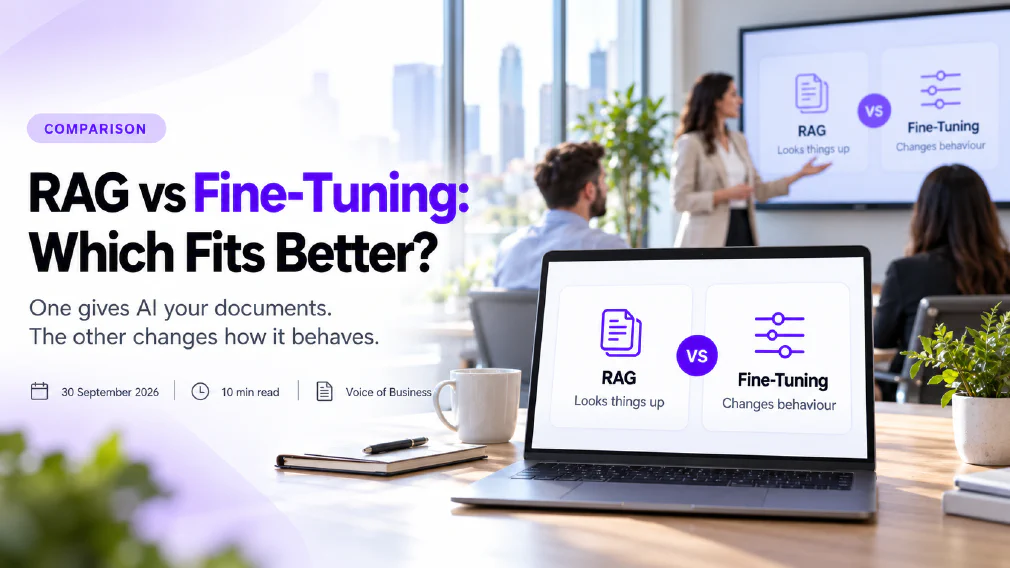
RAG and fine-tuning are not two versions of the same thing, and choosing between them as if they were is the most common mistake in this area. RAG gives an AI access to your documents at the moment it answers. Fine-tuning changes how the AI behaves. One solves a knowledge problem, the other a behaviour problem, and most businesses have the first.
This review sets out what each one does, where each fails, how they differ on data protection and cost, and a way of deciding which one a given piece of work needs, with a plain answer for a small business at the end.
Key takeaways
- RAG (retrieval-augmented generation) looks up your documents when a question is asked and leaves the model unchanged. Fine-tuning retrains the model on examples so it behaves consistently.
- RAG solves a knowledge problem: what the AI knows about your business. Fine-tuning solves a behaviour problem: how it writes, formats or classifies.
- For adding new facts, RAG is the stronger route. A 2023 study found it outperformed fine-tuning for both existing and new knowledge.
- RAG keeps answers current and traceable to a source. Fine-tuning goes stale until it is retrained and is hard to audit.
- Data used to fine-tune a model is absorbed into it, and a document in a RAG store can be removed directly, so the two differ sharply on data protection.
- The usual order is clearer instructions first, then RAG, and fine-tuning only for a narrow, repetitive task that RAG cannot reach.
What RAG and Fine-Tuning each do
A large language model knows what it learned in training and nothing else. It has never seen your price list, your contracts, your staff handbook or last week’s client emails. Both techniques exist to close that gap, and they close it in opposite ways.
RAG stands for retrieval-augmented generation. When someone asks a question, the system first searches a store of your documents, picks the passages most relevant to the question, and hands them to the model alongside the question. The model then writes its answer from that material. The model itself is not changed. Think of an open-book exam: the candidate has not memorised the textbook, but they are allowed to look things up, and they can point to the page.
Fine-tuning takes the opposite approach. It trains the model further on a set of examples, so that its behaviour shifts and stays shifted. Nothing is looked up at answer time. Whatever the model has learned is now part of it. Think of an apprenticeship: after months of examples, the trainee writes and responds in the house style without opening a manual.
RAG
Your documents are stored and indexed
At question time, the relevant passages are found
The unchanged model answers from those passages
Fine-tuning
Examples of the desired behaviour are prepared
The model is retrained on those examples
The changed model answers from what it has learned
The distinction that matters most in practice is this. RAG changes what the model can see. Fine-tuning changes what the model is. A business that wants staff to ask questions about its own policies needs the model to see the policies, which is RAG. A business that wants every customer reply to follow an exact structure, or wants thousands of support tickets sorted into the same categories every time, is asking for a change in behaviour, which is where fine-tuning starts to earn its place.
Many everyday tools already do the first part for you. When an assistant answers from the files a team has connected, it is grounded in that material, and that is RAG under another name. Most small businesses will meet RAG as a feature before they ever build it as a project.
Where each one is Strong and where each one fails
RAG is strong where knowledge changes, where answers need to be traceable, and where the source material is yours. Because the documents are looked up fresh each time, updating the knowledge means updating a document, not retraining anything. Because the answer is drawn from identifiable passages, a reader can be pointed to the source and check it. That matters for hallucination, the confident wrong answer, because a claim tied to a source can be checked and a claim from nowhere cannot.
The evidence points the same way on facts. A 2023 study that compared the two methods for teaching a model new information found that RAG consistently outperformed fine-tuning, both for knowledge the model had met in training and for entirely new knowledge. Fine-tuning is a poor way to load facts into a model. It is a good way to shape behaviour.
RAG fails in quieter ways. It is only as good as what it retrieves. If the documents are out of date, contradictory or badly organised, the model will answer confidently from bad material. If the search step pulls the wrong passage, the answer is wrong in a way that looks well sourced. And if the permissions on the document store are loose, the system can surface something to someone who should never have seen it. Most RAG failures are failures of the documents and the access rules, not of the model.
Fine-tuning is strong where the job is narrow, repetitive and needs identical behaviour every time: a fixed output format, a consistent tone, a classification applied the same way across a large volume of cases. It fails in the opposite places. It goes stale, because what the model learned is frozen until it is retrained. It depends on good examples, and preparing them is usually the slowest part. It can make a model worse at things it did well before. And it is hard to audit, because there is no passage to point to, only a behaviour.
A worked illustration makes the split concrete. This is an example, not a real client. A 25-person accountancy firm wants two things from AI. First, staff should be able to ask questions about the firm’s own procedures, such as how a certain client type is onboarded and which forms apply. Second, every client letter should sound like the firm and follow the same structure. The first is a knowledge problem: the procedures live in documents, they change, and staff need to see where an answer came from, so RAG fits. The second is a behaviour problem, but a mild one, and clear saved instructions with two or three model letters will usually meet it. Fine-tuning would only enter the picture if the firm were sorting thousands of documents a week into fixed categories, and it is not.
Here is the comparison in one place.
| The question | RAG | Fine-tuning |
|---|---|---|
| What does it change? | What the model can see | How the model behaves |
| What problem does it solve? | Knowledge: what the AI knows about you | Behaviour: tone, format, consistency |
| Keeping it up to date | Update the document | Retrain the model |
| Showing where an answer came from | Yes, to the passages used | Not directly |
| Removing something | Delete it from the store | No single step |
| Where the effort goes | Organising documents and access rules | Preparing good training examples |
| Typical failure | Wrong or outdated document retrieved | Frozen, stale or over-narrow behaviour |
| Best for | Questions about your own material | Narrow, high-volume, repetitive tasks |
What each means for Data Protection, Control and cost
The sharpest difference between the two is what happens to your data.
With RAG, your documents stay in a store you manage. The model reads passages at the moment of a question and does not keep them. If a document must go, because it is out of date, a client has asked for it to be removed, or it should never have been included, you remove it from the store and the index built from it, and clear anything that saved answers drawn from it. That is a direct action you can check. The control that matters is access: who can reach the store, and whether the system respects the permissions the documents already carry.
With fine-tuning, the data used for training is absorbed into the model. There is no single step that takes one person’s information back out, and a model can reproduce fragments of its own training data. The EU data protection board’s opinion, adopted in December 2024, says that whether a model built on personal data counts as anonymous has to be assessed case by case, and that the bar for showing it is high. In practice, that means personal data should not be put into fine-tuning without a clear legal basis and a data protection check first. Data protection and GDPR duties attach to the personal data, however it is used.
The EU AI Act adds a second layer. It scales its obligations to the risk of the system, not to the technique underneath it, so a RAG system and a fine-tuned model face the same question: what is the use, and does it fall into a high-risk category? The governance article sets out how a small business classifies that.
Access is where RAG projects most often go wrong in practice. A document store built by copying every shared folder into one searchable place can quietly remove the permissions those folders had, so a question from one member of staff surfaces a paragraph from a file they were never meant to open. Before anything is connected, decide what goes in, who may see which parts, and who is responsible for removing material that no longer belongs. Keep a short record of the answers, because it is the first thing a client, an auditor or your own team will ask for.
Cost is worth comparing by shape and not by size. RAG is quicker to stand up and has running costs: storing, indexing and refreshing documents, and the ongoing work of keeping them accurate. Fine-tuning front-loads the cost into preparing examples and running the training, and repeats it whenever the behaviour has to change. Neutral explainers describe RAG as typically the more cost-efficient route, and that is a fair general rule. The hidden cost in both is the same and rarely budgeted: someone has to own the material. A knowledge base nobody maintains, or a tuned model nobody re-tests, decays in exactly the way the article on what happens when nobody owns an AI tool describes.
How to decide which one your Business needs
Start with the cheapest thing that could work, and move up only when it fails. The order most careful teams follow is clearer instructions first, then RAG, then fine-tuning.
First, try better instructions to the model. Many problems that look like a need for fine-tuning are a need for a clearer request, a worked example in the prompt, or saved custom instructions that set the tone and format. This is quick to test and settles a surprising share of cases.
Second, if the answers need your own material, use RAG. Staff asking about policies, procedures, contracts or product details; a support team answering from a knowledge base; a sales team finding the right case study: all of these are knowledge problems. Work out where the documents live, who is allowed to see which, and who keeps them current, before you buy or build anything. A good off-the-shelf tool already connected to your files may be all that is needed, and whether it runs cloud or on-premise is a separate decision from either technique.
Third, consider fine-tuning only for a narrow, repetitive task. The signs are volume and sameness: thousands of similar items, one correct format, and a measurable definition of good. If the instructions and RAG still miss it, and you have clean examples you are allowed to use, fine-tuning is worth testing on that one task. It is rarely the first tool and almost never the answer to “make the AI know our business”.
Combine them last. A common mature pattern is to fine-tune for manner and use RAG for facts, so the model writes in the house style and answers from current, checkable documents. It is a sensible destination. It is a poor starting point, because each part adds something that has to be maintained.
Two questions cut through most of the debate. Is the gap something the model does not know, or something it does not do the way you need? And could you show a client, an auditor or a regulator where an answer came from? If the answer to the first is “does not know”, and to the second is “we would need to”, the choice is RAG.
Which one belongs on which process is decided by what that process handles, who is accountable for it and what happens when it is wrong, not by the technique. That is the question an audit is built to answer, and an audit weighs it against the actual work, not in the abstract. Whichever you choose, name one person who owns it this week.
Sources
- Fine-Tuning or Retrieval? Comparing Knowledge Injection in LLMs: 2023 research paper comparing unsupervised fine-tuning with retrieval-augmented generation, finding that RAG consistently outperformed it for both existing and entirely new knowledge.
- RAG vs. fine-tuning: technology explainer on how the two approaches differ, what each is best for, how each keeps information current and how their costs compare, including that they can be combined.
- Opinion 28/2024 on data protection aspects of AI models: the EU data protection board’s opinion of December 2024 on when an AI model built on personal data can be considered anonymous, which it says has to be assessed case by case.
FAQ
Questions we get asked
What is the difference between RAG and Fine-Tuning?
RAG looks up your documents at the moment a question is asked and hands them to the model, so the model itself is left unchanged. Fine-tuning adjusts the model by training it on examples, so it behaves in a consistent way afterwards. RAG solves a knowledge problem, meaning what the AI knows about your business. Fine-tuning solves a behaviour problem, meaning how it writes or classifies.
Is RAG cheaper than Fine-Tuning?
Usually it is cheaper to start and simpler to keep current, which is why explainers from neutral sources describe RAG as typically the more cost-efficient route. The cost shapes differ, though. RAG has running costs for storing, indexing and refreshing your documents, while fine-tuning front-loads the cost into preparing good training examples and repeats it whenever the behaviour needs to change. The right comparison is between those two shapes for your workload, not between two headline numbers.
Can you use RAG and Fine-Tuning together?
Yes, and some mature systems do. A common pattern is to fine-tune for the manner, such as tone, format or a narrow classification task, and use RAG for the facts, so answers stay current and traceable. It should be a second step, not a starting point. Start with RAG, see where the model's behaviour still falls short, and fine-tune only that gap.
Does Fine-Tuning stop an AI from making things up?
Not reliably. Fine-tuning is a weak way to add new facts: a 2023 study comparing the two found RAG consistently outperformed fine-tuning, for knowledge the model had seen in training and for entirely new knowledge. A fine-tuned model can still produce a confident wrong answer. RAG reduces the problem by tying answers to a source that can be checked, but it does not remove it, because retrieval can pull the wrong document.
Which is better for GDPR and Data Protection?
RAG is generally easier to control, because your documents stay in a store you manage and removing one is a direct action. Data used to fine-tune a model is absorbed into it, and the EU data protection board has said whether a trained model counts as anonymous has to be assessed case by case. Neither choice removes your duties. Both attach to the personal data involved, so the choice should follow a data protection check.
Does a Small Business need to fine-tune a Model?
Rarely. Most small business needs are knowledge problems, such as staff asking questions about policies, contracts or product information, and those are solved by RAG or by a tool already grounded in your documents. Fine-tuning earns its place when a narrow, repetitive task needs identical behaviour thousands of times. Before either, check whether clearer instructions to the model solve the problem, because they often do.
How do I remove a Document from a RAG System?
Delete it from the document store and from the index built from it, then clear anything that stored answers drawn from it, such as cached summaries. That is a direct, checkable action, which is one of RAG's practical advantages. Keep a record of what was removed and when. With a fine-tuned model there is no equivalent single step, which is why what goes into training needs deciding before it is used.
Ready to Put This to Work?
Tell us where your team is with AI and we will tell you honestly what would make the biggest difference.