How to choose an AI Vendor
Twelve questions to ask an AI vendor before you sign: data, GDPR, security, accuracy, the EU AI Act and exit terms, with the red flags to watch for.
Choosing an AI vendor comes down to twelve questions about your data, your contract, your risk and your exit. Ask them in writing before you sign, then test the answers against your own work. A vendor who answers plainly is worth more than one with the longest feature list.
This guide is for owners and managers of small and mid-sized businesses buying an AI tool, platform or service for the first time, or replacing one. It sets out what to ask, why each question matters, which answers are red flags, and how to compare two or three vendors on one page. It is general guidance, not legal advice.
Key takeaways
- Most AI buying mistakes are made before the demo ends. The tool looks impressive, the contract is skimmed, and the questions about data, sub-processors and exit are never asked.
- Twelve questions cover almost everything that matters: data storage, training use, retention, the processing agreement, sub-processors, transfers, access, security evidence, accuracy, EU AI Act duties, incident handling and exit.
- Under the GDPR you remain responsible for the personal data you put into a tool. The vendor is your processor, and you are required to use processors that give sufficient guarantees.
- Ask for the plan you will actually use. Consumer plans and business plans from the same company can treat your data differently.
- Test with your own material for two to four weeks before you sign anything long.
- Name one owner for the vendor relationship, and put a review date in the diary.
How do you choose an AI Vendor?
Work in five steps, in this order. Most people start at step three and regret it.
- Name the job. Pick one task, one owner and one measure of success. A vendor can only be judged against a job. If you are unsure where to begin, start with the guide to your first AI task.
- List what the tool will touch. Which files, mailboxes, customer records and systems? Sort them by sensitivity. This tells you how hard to press on every question below.
- Shortlist two or three vendors. More than that and you will compare brochures, not behaviour. Decide whether you need an off-the-shelf tool or a custom workflow, and whether a cloud or on-premise set-up suits the data involved.
- Ask the twelve questions in writing. Put them in an email or a shared sheet so every vendor answers the same list and you keep the replies.
- Test, then decide. Run a 30-day pilot on the real task. Score it against the measure you set in step one, not against how the demo felt.
Without steps one and two, you cannot tell which answers matter. Without step four, the sales conversation decides for you.
What should an AI Vendor tell you about your Data?
Start here, because everything else depends on it. Three questions cover where your information goes and what happens to it.
Question 1: where is my data stored and processed? You want a named region, and also a list of the other places it can be touched, such as backup locations and support teams working from outside the EU. The location of your data, its data residency, is about more than the main server. Ask whether you can choose the region, and whether that choice is in the contract.
Question 2: is my data used to train your models? Some vendors train on customer inputs by default, some only with permission, and some never. The answer often depends on the plan, and it can differ between the chat product and the programming interface. Ask for the setting, who controls it, and where the commitment is written. A promise on a web page that can be edited is weaker than a clause in the contract. If you already use a tool, the guide on how to stop a tool training on your data shows what the setting usually looks like.
Question 3: how long do you keep my data, and how is it deleted? Look for a retention period for prompts, uploaded files and outputs, a deletion process you can trigger, and confirmation of what happens to backups. Ask separately about logs, because logs can contain your content.
A good answer is specific, written and the same across the sales deck, the privacy notice and the contract. A weak answer is “we take privacy very seriously” with no setting, no period and no clause behind it.
Is an AI Vendor GDPR Compliant?
No vendor is simply “GDPR compliant” in the abstract. What you can check is whether the vendor will work with you as a processor and whether the paperwork supports it. Three more questions follow.
Question 4: will you sign a data processing agreement? If the tool handles personal data for you, the GDPR requires a binding written contract with the processor. Article 28 says it must set out the subject matter, duration, nature and purpose of the processing, the type of personal data and the categories of people, and your rights and obligations. It must also require the processor to act only on your documented instructions, keep staff bound by confidentiality, secure the data, assist with individuals’ requests, and delete or return the data at the end of the service, at your choice.
The European Data Protection Board adds that such a contract should not merely repeat the regulation, and that choosing processors who give sufficient guarantees is a continuing duty, not a one-off at signing. So review the agreement again when the vendor changes its terms or its suppliers.
Question 5: who are your sub-processors? AI tools usually sit on top of other suppliers: a model provider, a cloud host, a support platform. Under the GDPR, a processor cannot engage another processor without your prior specific or general written authorisation, and must pass the same obligations down. Ask for the current list, how you are told about changes, and whether you can object.
Question 6: how do you handle transfers outside the EU? If personal data leaves the EU, there must be a lawful mechanism. For transfers to the United States, the European Commission adopted an adequacy decision on 10 July 2023 covering companies that take part in the Data Privacy Framework, so ask whether the vendor and its sub-processors participate, or rely on standard contractual clauses instead. Do not accept “we are compliant” as the answer. Ask which mechanism, for which flow.
Treat these three as the legal floor. If a vendor cannot answer them, the rest of the conversation is academic. For the wider picture, read about data protection and what customer data staff may paste into tools.
What Security checks should you run on an AI Vendor?
Security is where small buyers feel least confident, so keep the questions concrete.
Question 7: who can access my data, and is it logged? You want to know which of the vendor’s staff can see your content, under what conditions, and whether access is recorded. Ask whether you get an audit trail you can read: who used the tool, when, with which files.
Question 8: what independent evidence of security do you have? A recognised certification or an independent audit report shows that security is managed as a routine. Ask what is in scope, which product and sites it covers, and when it was last renewed. A certificate for one service says little about another, and a certificate is evidence of a management system, not a guarantee against failure.
Question 9: how do you handle incidents, and how fast will you tell me? The GDPR expects personal data breaches to be handled quickly, and as the controller you may have a short window to notify your authority once you know. Your contract should therefore set a maximum time for the vendor to tell you, and say what information they will give. Ask also how the vendor defends against prompt injection, which is when hidden instructions in a document or web page steer an AI tool that has access to your files or systems. A vendor that has never thought about it is telling you something.
The more a tool can reach, the more a mistake costs. Before you connect an AI tool to your email and files, decide which folders and mailboxes are in scope and which are not.
How do you test an AI Vendor’s claims about Accuracy?
Benchmarks measure the vendor’s tests, not your work. The only evidence that matters is how the tool performs on your material.
Question 10: how do you measure accuracy, and how can I test it on my own work? Ask what the vendor evaluates, how often, and what it does when the tool is wrong. Then run your own test.
Take 20 to 30 real examples of the task, including a few messy ones and inputs the tool should refuse. Have someone who knows the answers mark each result right, partly right or wrong, and time the whole cycle including checking, because a tool that takes as long to check as to do by hand has saved nothing.
Fluent output is not evidence. Language models can produce confident, plausible, wrong answers, which is what people mean by hallucinations. Your test shows how often that happens in your case and how easy it is to spot. Our guide to how to check the output sets out a routine for it.
Ask, too, whether the tool shows its sources, whether answers can be traced back to a document, and whether you can keep a human in the loop on anything that reaches a customer. If the tool has no way to show its working, plan for more review, not less.
What does the EU AI Act mean when you buy AI Tools?
For most small businesses, the EU AI Act changes how you ask questions more than what you buy. If you use an AI system in your business, you are a deployer in the Act’s terms. The vendor is usually the provider. What you owe depends on the risk level of the use, not on the size of your company.
Question 11: how do you support my obligations under the EU AI Act? For most uses the answer is light: transparency, staff AI literacy and sensible use. For uses that are high-risk, such as certain decisions about hiring or managing staff, the Act puts specific duties on deployers. Article 26 includes using the system in line with the provider’s instructions, assigning human oversight to people with the right competence and authority, keeping the logs the system generates for at least six months where they are under your control, and informing workers before a high-risk system is used at work.
Ask the vendor how they classify the product and why, whether they provide instructions for use, logs and documentation you can keep, and whether they will tell you if the intended purpose or classification changes.
This covers purchase questions, not full compliance. If your use might be high-risk, for example screening candidates, read what the EU AI Act requires of a small business before you sign, and consider an AI audit of the use case, which is described in what an AI audit checks.
How do you avoid Vendor lock-in with AI Tools?
The last question is the one buyers skip, because leaving feels far away. It is much easier to negotiate before you have a year of work inside the tool.
Question 12: what happens if I leave? Ask:
- Which of my data and outputs can I export, and in what format?
- How long do you keep them afterwards, and when are they deleted?
- How much notice do I need to give, and are there penalties for ending early?
- What happens to anything built on your platform, such as custom assistants, prompts, templates and connections?
The EU Data Act gives customers of cloud and similar data processing services rights to switch provider, and it provides for switching charges to end from 12 January 2027. Whether it covers a particular AI product depends on how the service is supplied, so ask the vendor to say in writing how they meet it. Do not assume it solves your exit; a clear export, in a format you can read, is still the practical test.
Keep your own copy of the prompts, templates and routines you would be sorry to lose, because switching otherwise means rebuilding them.
What are the red flags when buying AI Software?
You will not see all of these at once, but each one is a reason to slow down.
- No written answers. The vendor will discuss everything on a call and commit to nothing in writing.
- Different stories in different documents. The sales deck says data is never used for training; the terms say it may be, or the promise belongs to a higher plan than the one quoted.
- No processing agreement, or one that only repeats the regulation without saying how it will be met.
- A sub-processor list that is missing, out of date or changed without notice.
- Pressure to sign quickly with a long, automatic renewal.
- No way to export, or exports that only the vendor can read.
- Vague answers on accuracy, with no way for you to test the claim.
If staff already use a tool without approval, that is shadow AI, and a vendor review is a good moment to bring it into the open, and banning AI tools pushes use out of sight, so a sanctioned, well-chosen tool is the safer route.
What does an AI Vendor really cost?
This guide puts no figures on tools, because plans change often and the right comparison is your own. What matters is the total cost of ownership, which is wider than the subscription. For each vendor, count the licence or usage charges at your expected volume, setup time, checking time on every run, training, ownership (someone must watch for drift) and the time to export and rebuild if you leave.
The honest question is whether the tool is actually saving time once all of that is counted. The guide to the cost to run an AI workflow shows how, and the method works for a bought tool as well as a built one.
How do you compare AI Vendors side by side?
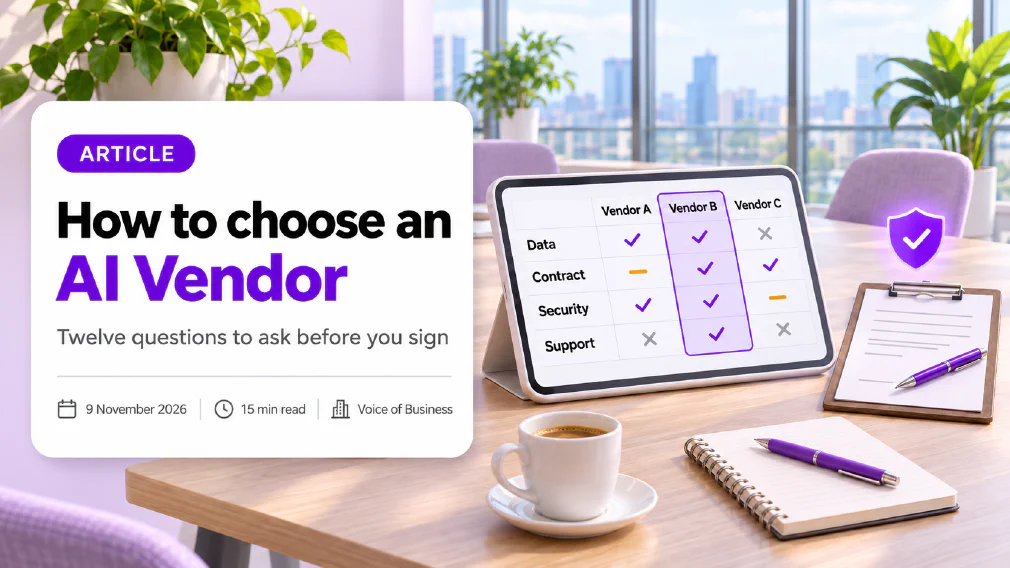
Put the twelve questions on one page, one column per vendor, and score each answer. Keep the scale simple: 2 for a clear written answer, 1 for a partial answer, 0 for no answer or a red flag. Weight the rows by the sensitivity of the data you listed in step two.
| Area | Questions | What a good answer looks like |
|---|---|---|
| Data | 1 to 3: storage, training, retention | A named region, a written no-training commitment for your plan, a stated retention period and a deletion process |
| Contract | 4 to 6: processing agreement, sub-processors, transfers | A signed agreement, a current sub-processor list with change notice, a named transfer mechanism |
| Security | 7 to 9: access, evidence, incidents | Role-based access with logs, independent evidence with a clear scope, a set notification time |
| Quality | 10: accuracy | A way to test on your own work and a visible method for showing sources |
| Regulation | 11: EU AI Act | A stated classification, instructions for use and logs you can keep |
| Exit | 12: leaving | Export in a readable format, a deletion date, no penalty that traps you |
A vendor that scores low on data or contract rows should not win on features alone. A vendor that scores well on those but fails your own accuracy test should not win either. The scorecard is there to make the trade-off visible, not to decide for you.
Who should sign off on an AI Vendor?
One person should own the relationship, and a second should have the authority to say no. The owner keeps the twelve answers, runs the pilot and sets the review date. The second person, such as a director or an outside adviser, checks the contract against those answers before anyone signs. Without a named owner, tools drift, which is what happens when nobody owns the AI you have rolled out.
Tie the decision to your AI use policy and your wider AI governance, so the vendor choice, the staff rules and the review date sit together.
What should you do before you sign?
Do four things this week. Write down the one job the tool must do. List the data it will touch. Send the twelve questions to your shortlist in writing. Agree a pilot with a named owner and a decision date.
If you would rather have an independent view, an AI audit looks at the tools you already use and the ones you are about to buy, and it asks these questions on your behalf. You can read how we audit before deciding whether it suits you.
Sources
- General Data Protection Regulation, Regulation (EU) 2016/679, EUR-Lex: the full legal text, including Article 28 on processors, which requires a binding written contract, authorisation for sub-processors and deletion or return of data at the end of the service.
- European Data Protection Board, Guidelines 07/2020 on the concepts of controller and processor: explains who counts as a controller or processor and says a processing contract should set out concretely how the requirements will be met, not just restate the regulation.
- European Data Protection Board, Opinion 22/2024 on reliance on processors and sub-processors: sets out that the duty to use only processors providing sufficient guarantees is continuing, and what controllers should know about the chain of sub-processors.
- European Commission, EU-US data transfers: describes the adequacy decision of 10 July 2023 under which personal data can move from the EU to companies participating in the Data Privacy Framework.
- EU AI Act Service Desk, Article 26: obligations of deployers of high-risk AI systems: the Commission’s text of the deployer duties, including use in line with instructions, human oversight, log retention of at least six months and informing workers.
- Data Act, Regulation (EU) 2023/2854, EUR-Lex: the full legal text, including the rules on switching between data processing services and the end of switching charges from 12 January 2027.
FAQ
Questions we get asked
What questions should I ask an AI Vendor?
Ask twelve things, in writing: where your data is stored, whether it trains the vendor's models, how long it is kept, whether you get a data processing agreement, who the sub-processors are, where data is transferred, who can access it, what security evidence exists, how accuracy is tested, how the vendor supports your EU AI Act duties, what happens if something goes wrong, and how you leave. Keep the answers, because they become your record of why you chose the vendor.
Is it Safe to put customer Data into an AI Tool?
It can be, but only once you know where the data goes, who can read it and whether it is used to train models. Consumer plans and business plans of the same product often treat data differently, so check the plan you will actually use. Until you have the vendor's written answers and a data processing agreement, keep customer personal data out of the tool.
Do AI Vendors train their Models on my Data?
Some do by default, some only if you allow it, and some never do. The answer often depends on the plan, and it can differ between the chat product and the programming interface. Ask for the setting in writing, find out who can change it, and confirm that it is covered in the contract and not only in a web page that can be edited.
Do I need a Data processing agreement with an AI Vendor?
If the tool will handle personal data on your behalf, yes. The GDPR requires a binding written contract with any processor, and it must cover the subject, duration, nature and purpose of the processing, the types of data, your instructions, confidentiality, security, sub-processors, assistance with individuals' rights, and deletion or return of the data at the end.
Where should an AI Vendor store my Data?
Ideally in a region you have chosen and can name, with a written list of any other places it is processed or supported from. Storage inside the EU is simpler to explain to customers and regulators, but support access, backups and sub-processors can still move data elsewhere. Ask for all of it, not only the headline location.
Does an AI Vendor need a Security Certification?
A recognised, independent certification or audit report is good evidence that security is managed as a routine, and its absence is worth asking about. It is not a guarantee. Check what the certificate covers, which product and sites are in scope, and when it was last renewed, because a certificate for one service says little about another.
How do I leave an AI Vendor without losing my Data?
Agree it before you sign. The contract should say which of your data and outputs you can export, in what format, how long the vendor keeps them afterwards and when they are deleted. The EU Data Act also gives customers of cloud and similar data processing services rights around switching, including an end to switching charges from 12 January 2027.
Should a Small Business buy an Off-the-Shelf AI Tool or build its own?
Start with a tool that already exists for the job, because it is faster to test and cheaper to abandon. Build only when the work is specific to your business and an existing tool keeps failing it. Either way, the same twelve questions apply, because a custom build still depends on model, hosting and software suppliers.
Who is Responsible if an AI Vendor's Tool gets it wrong?
Usually you are, towards your customers and staff, whatever the vendor's contract says between you. Read the liability and indemnity clauses, find out what the vendor will and will not stand behind, and keep a person checking anything that reaches a customer. Responsibility for the decision stays with your business.
How long should I test an AI Vendor before signing?
Two to four weeks on one real task is usually enough to see how the tool behaves with your own material. Set the success measure and the owner first, include inputs it should refuse, and decide in advance what result means yes, no or extend. A short, structured trial beats a long, vague one.
Ready to Put This to Work?
Tell us where your team is with AI and we will tell you honestly what would make the biggest difference.