What is an AI Agent?
What an AI agent is, how it differs from a chatbot, what it can do for a small business, and whether you need one yet. A plain-English answer.
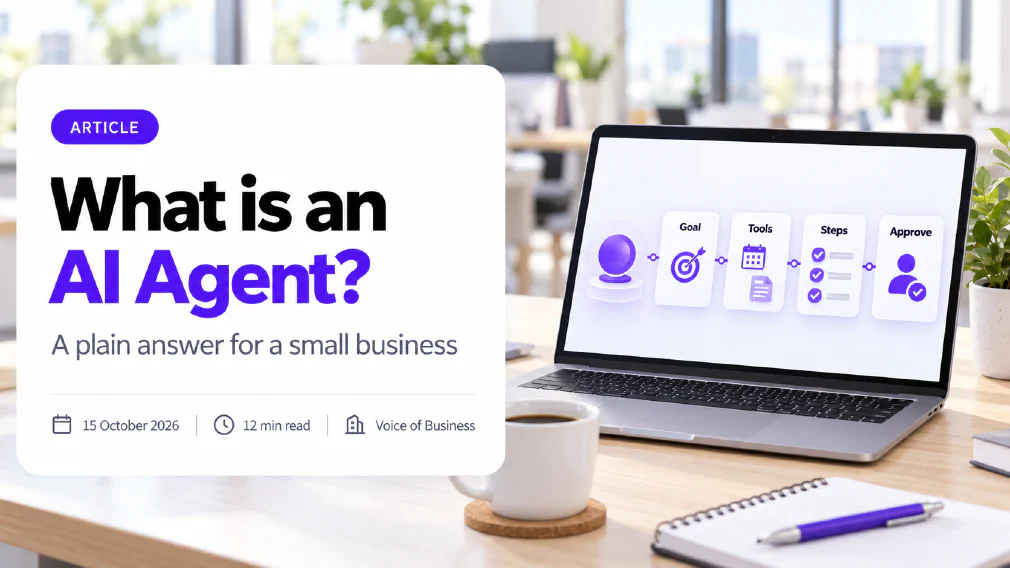
An AI agent is a system that is given a goal and carries out the steps to reach it, using tools it has been allowed to use, instead of answering one question and stopping. Most small businesses do not need one yet, and the ones that do should start with a single, narrow job that a person checks.
This article explains what an agent is in plain English, how it differs from a chatbot, how it works, what it can do for a small business, and how to decide whether you need one. It is written for owners and managers who keep hearing the word and want a straight answer before spending any time on it.
Key takeaways
- An AI agent takes a goal, works out the steps and carries them out with tools it has been given access to. A chatbot answers one prompt and waits.
- Every agent has a language model underneath it, but the model alone does not plan, open a calendar or send an email. The tools and instructions around it do.
- Four things separate an agent from a chatbot: a goal, a set of tools, several steps taken in order, and a limit on how far it can go without a person.
- Most small businesses get more from a well-briefed chatbot or a simple template than from an agent. An agent earns its place on a task that repeats, follows rules and needs more than one step.
- The risks come from access and from errors that compound across steps. Decide what an agent may see and do before you build it, and keep a person on anything that reaches a customer.
- Start with one narrow, internal task, one named owner and a two-week trial.
What is an AI Agent, in Plain English?
An AI agent is software that can plan and carry out a job in several steps on its own. You give it an instruction, it works out what needs doing, uses the tools it has been given to do it, and keeps going until the job is finished or it needs a person to decide something.
A good way to picture it is a new colleague with a narrow job description. They know their role, they have a folder of documents to work from, and they can use a few systems. They do not wait for you to tell them each step. They also do not have the run of the building.
The phrase “agentic AI” describes the wider idea of designing work around agents like this. The agent is the worker; agentic AI is the approach of building tasks so that one can do part of the job.
How is an AI Agent Different from a Chatbot?
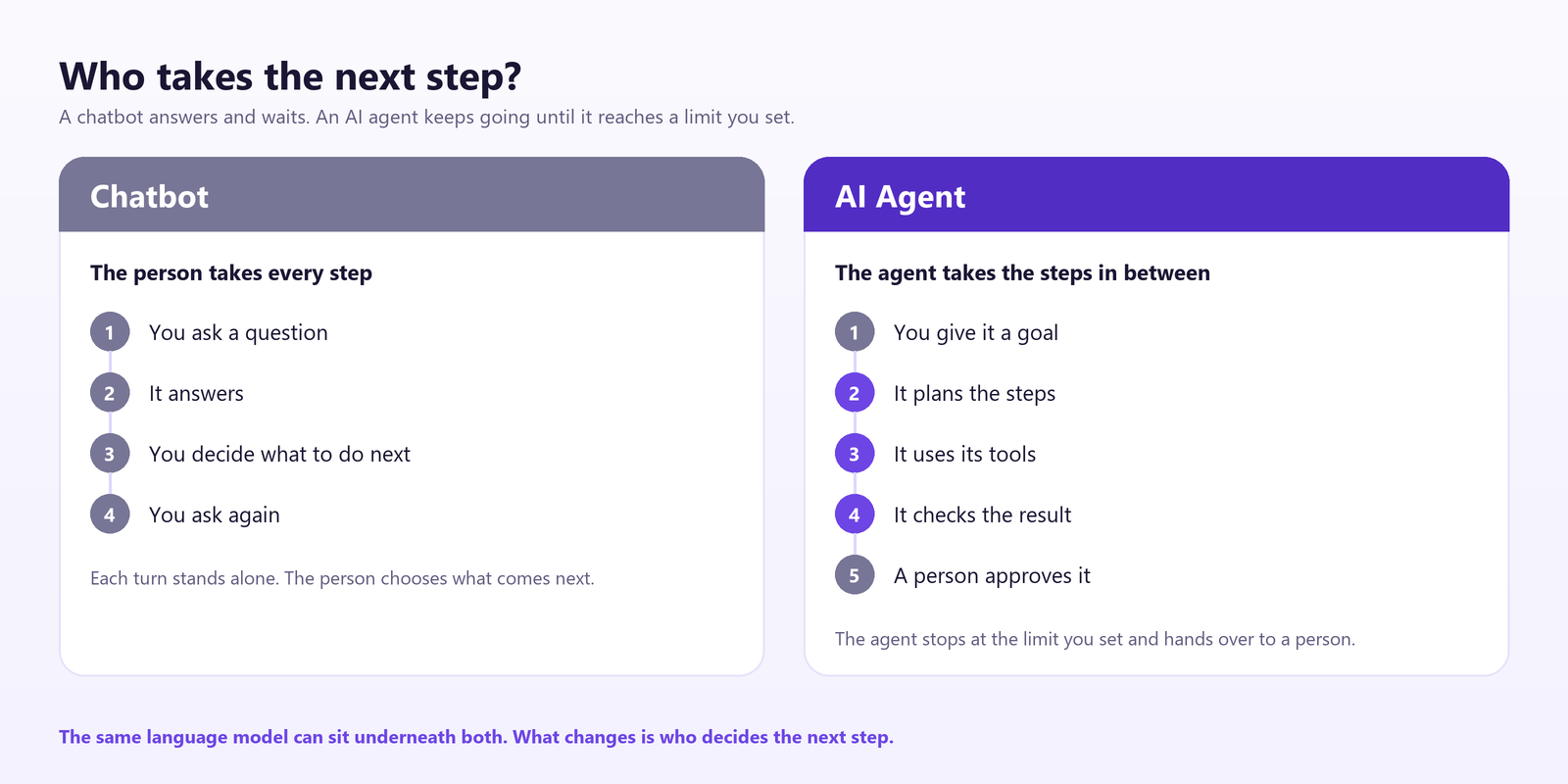
A chatbot is a tool you hold a conversation with. You ask a question, it replies, and it waits for your next message. Each answer is one step, and you decide what happens after it.
An agent is built to take the next step itself. If you ask a chatbot about a customer enquiry, it drafts a reply. An agent given the same job could read the enquiry, look up the order in a system it is connected to, draft the reply, and queue it for a person to approve.
The parts underneath are the same. Both rest on instructions, a source of knowledge and, sometimes, tools. The difference is that an agent uses them to carry out a sequence of steps without being prompted at each one. That is also why the line is blurry: a chatbot that has been given a job, a source and a way to act starts to behave like an agent.
Our article on how to tell a real AI workflow from a chatbot with extra steps covers the same boundary from the workflow side, and it is worth reading before you buy anything described as an agent.
How do AI Agents work?
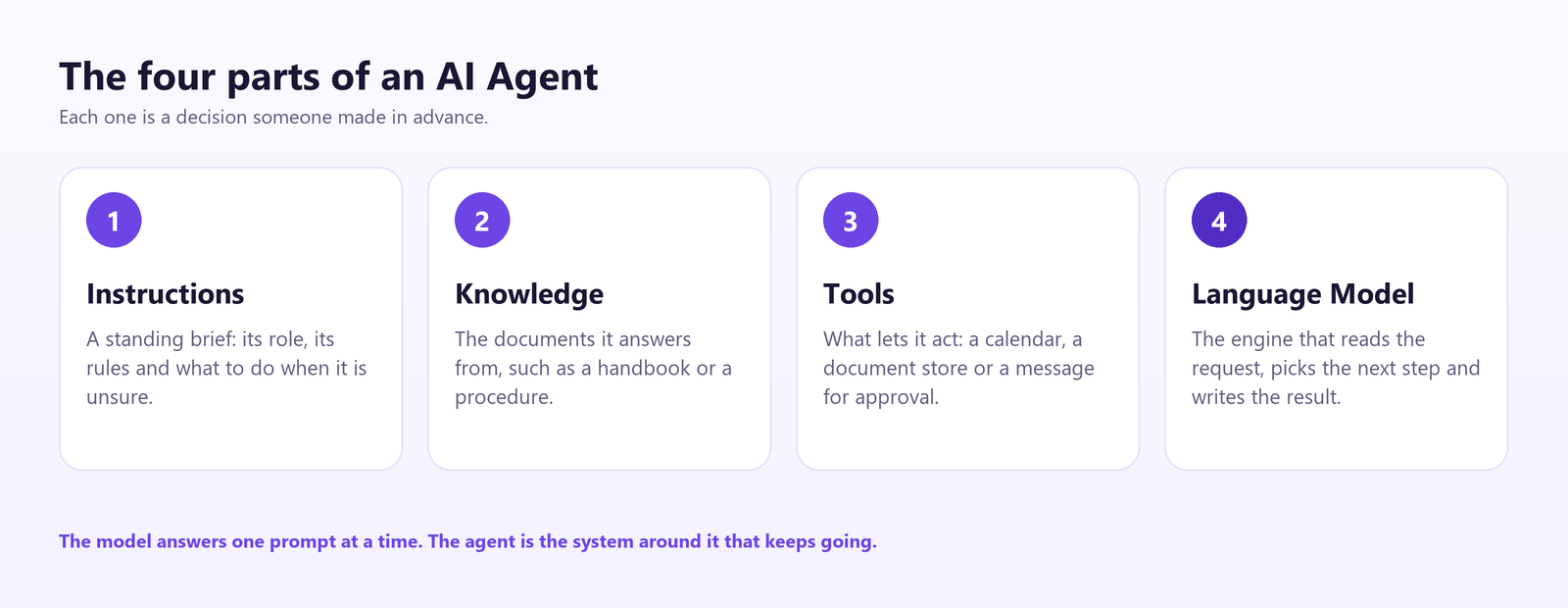
An agent has four working parts, and each one is a decision someone made in advance.
Instructions. A permanent brief that says what the agent is for, what it should do, what it must not do and what to do when it is unsure. The person using it does not have to rewrite this each time.
Knowledge. The material it answers from, such as a handbook, a set of procedures or a product guide. Tying answers to a source is called grounding, and it makes the agent far more predictable than one that improvises from general patterns.
Tools. What lets it act: reading a calendar, searching a document store, filling in a spreadsheet, sending a message for approval. A tool is what turns a text assistant into something that reaches beyond the chat.
A language model. The engine that reads the request, decides which step comes next and writes the output. The language model answers one prompt at a time and stops. The agent is the system built around it that keeps going.
When the agent runs, it reads the goal, picks a step, uses a tool, looks at the result, and decides the next step. It repeats this until it reaches the goal or hits a limit you set, such as a point where it must ask a person.
What are the four Core characteristics of an AI Agent?
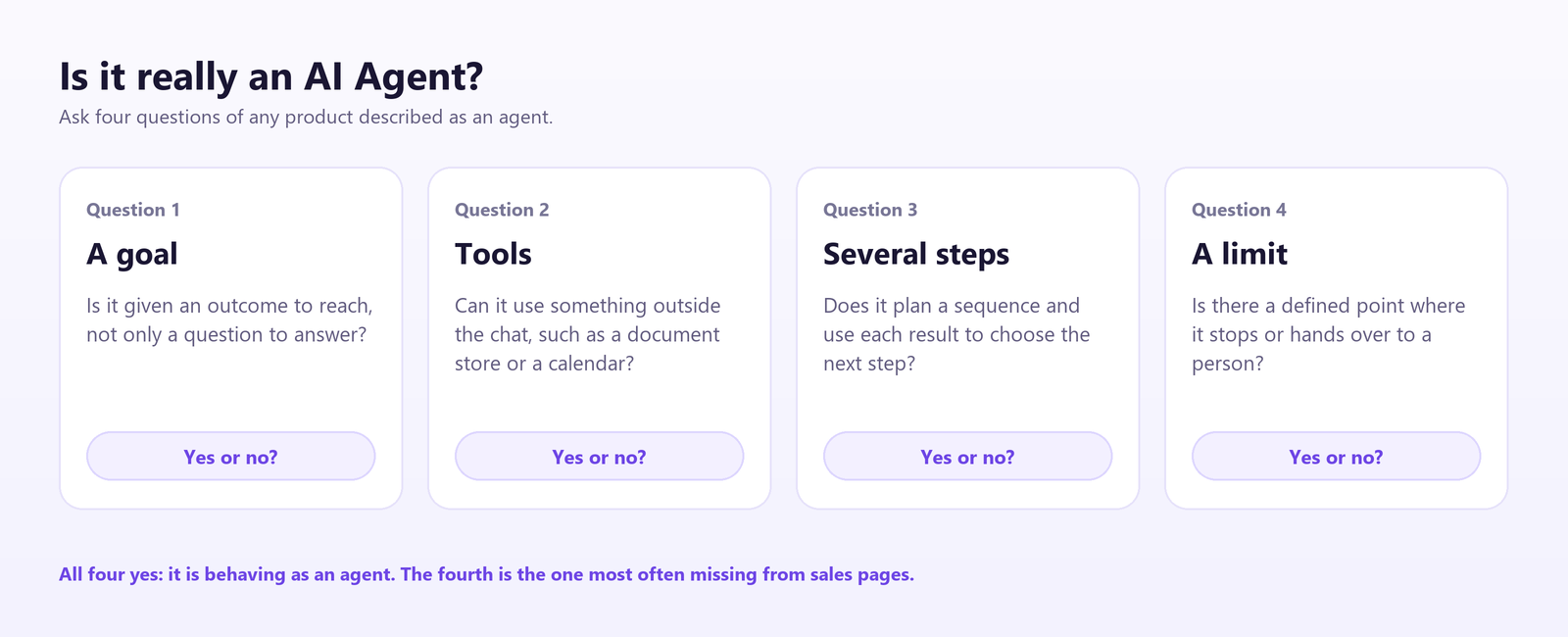
There is no single official checklist, so treat this as a working test rather than a standard. When someone describes a product as an agent, ask whether it has these four things:
- A goal. It is given an outcome to reach, not only a question to answer.
- Tools. It can use something outside the chat, such as a document store, a calendar or another system.
- Several steps. It plans and carries out a sequence, and it uses the result of one step to choose the next.
- A limit. There is a defined point at which it stops or hands over to a person.
If a product has the first and nothing else, it is a chatbot with a good brief. If it has all four, it is behaving as an agent. The fourth is the one most often missing from sales descriptions, and it is the one that matters most for safety.
What can an AI Agent do for a Small Business?
An agent is useful where a task repeats, follows rules and needs more than one step. The jobs that suit a small business fall into a few groups.
Writing support. An agent that turns rough notes into a standard format, rewrites a message in the house style or summarises a long document for a person to check.
Answering from documents. An assistant grounded in the staff handbook that answers questions about leave and policy, and says “not specified in the document” when the handbook is silent instead of guessing.
Practice and simulation. An agent that plays a customer or a candidate so a team member can rehearse a difficult conversation.
Decision support. An agent that sorts expenses into categories or checks a proposal against published criteria, with the judgement staying with a person.
Working with live tools. An agent connected to a calendar or a spreadsheet that books, updates or reports. This is the group that most clearly counts as agent work, and the one that needs the most care.
For most small teams the first four are the right place to begin, because they stay inside the business until someone has read the result.
What are some Real examples of AI Agents?
Concrete examples are easier to judge than definitions. These are the shapes that appear most often in practice:
- A policy assistant. Its role is to answer staff questions. Its knowledge is the handbook. Its instructions tell it what to do when the answer is not there, and an escalation sends the question to a person.
- An enquiry sorter. It reads each new enquiry, tags it, summarises it and proposes a reply. A named person reads the proposal and sends it.
- A calendar administrator. It has a live connection to a calendar, finds a slot and proposes the booking. A person confirms.
- A report builder. It reads a table of figures, runs a fixed set of checks and writes a summary, flagging anything that looks wrong.
- A document reviewer. It checks a draft against a list of criteria and returns the gaps, leaving the decision to the reviewer.
Each of these has a narrow role, a defined source and a point where a person steps in. None of them runs the business. That narrowness is what makes them reliable.
Does a Small Business need an AI Agent?
Probably not yet, and that is a useful answer. Agents are the top of a short ladder, and most tasks belong lower down. Plain automation sits on the same ladder, and often does the job with less to check.
- A prompt handles a one-off job.
- A template handles a repeated job with a fixed structure.
- A scheduled prompt runs by itself at set times, such as a weekly digest.
- An agent holds its own instructions and knowledge and takes several steps.
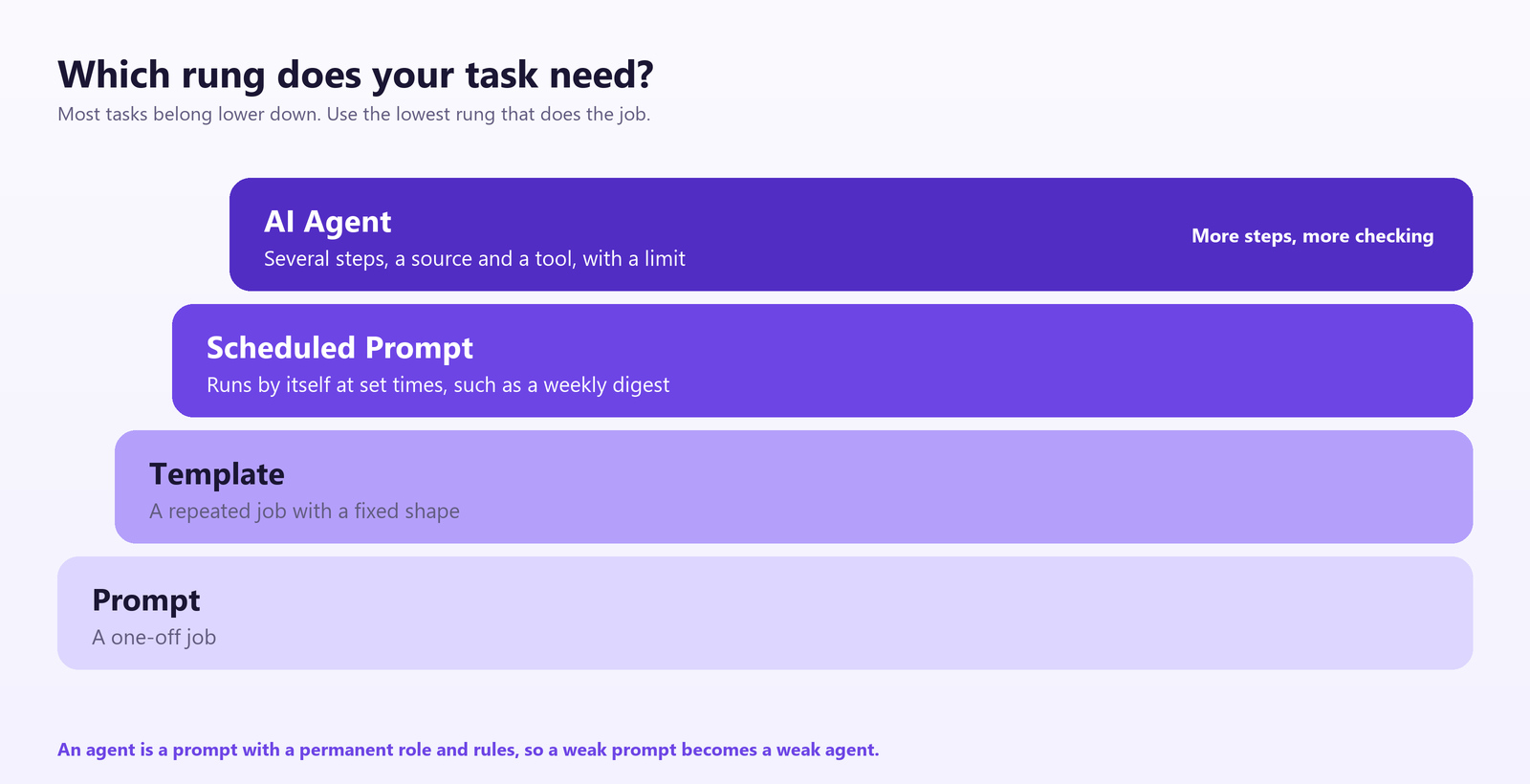
If your task is a one-off or has a fixed shape, a prompt or a template is simpler, cheaper to maintain and easier to check. Reach for an agent when the same task recurs, needs a source and a tool, and cannot be done well in a single step.
It is worth looking at what businesses are actually doing. Eurostat reports that 20.0% of EU enterprises with ten or more employees used AI technologies in 2025, up from 13.5% the year before, and the most common uses were analysing and generating written language. Those figures count any use of AI, not agents specifically, and they exclude the smallest businesses, so they do not tell you how many firms run agents. What they do show is that most adoption so far is people reading, writing and checking with AI alongside them. A team that has not yet got a routine for checking AI output is not ready for an agent, and an agent will not fix that.
A sensible test: if you cannot name the task, the person who will own it and the way you will check it, do not build an agent yet. Run a simple AI workflow first and see whether it earns an upgrade.
What does an AI Agent cost to run?
The honest answer is that the tool itself is rarely the main cost. An agent has four ongoing costs, and the first three are time, not money.
- Building it. Writing the brief, gathering and tidying the documents it works from, and connecting it to anything it needs.
- Testing it. Running it against the questions it will really meet, including the ones it should refuse, and fixing what it gets wrong.
- Checking it. The minutes a person spends reading its output every time it runs. If checking takes as long as doing the task by hand, the agent has saved nothing.
- Owning it. Someone has to notice when it starts to drift, update its documents and decide when to retire it.
On top of those sits the licence or subscription for whatever platform it runs on, which varies by tool, so check it against the supplier’s current terms. Our guide to what an AI workflow actually costs to run sets out how to count the whole cycle, and the same method applies to an agent. Count the time spent on every run, not only the time the tool took.
What are the Risks of AI Agents?
An agent inherits every weakness of the language model underneath it and then acts on the result. Three risks matter most for a small business.
Compounding errors. A language model can produce output that is plausible but wrong. In a chat, you see it and correct it. In an agent, a wrong early step can feed into later steps, and the error grows without anyone noticing.
Access. An agent that reads documents or reaches systems is a decision about data. What it may see, where that information goes and who can read the results all need an answer before the build. Questions of data protection come first, not last.
Too much delegation. An agent can do more than it should. Hiring, dismissals and anything with legal, safety or rights consequences should stay with a person whatever the technology allows. Below that line, the design question is where the person sits, and the answer should be built into the agent, not added afterwards. The working rule is that a person stays in the loop on anything that matters.
A fourth risk sits outside the tool. If staff are already using AI tools that nobody approved, an agent project is the moment to bring that into the open. That is shadow AI, and banning it does not make it go away. Clear rules about which data goes where do.
These risks are problems of oversight, not of technology. They are the subject of AI governance, which for a small organisation can be a one-page rule set and a named owner.
How do you start with your first AI Agent?
Start small and keep it internal.
- Choose one narrow task. Pick something frequent, with an answer you can check quickly and no harm if the first result is wrong. A handbook assistant or an enquiry sorter are typical.
- Name one owner. A single person accountable for how it is set up, who checks it and who decides at the end.
- Write the baseline first. How long does the task take now, how often does it happen, and what does a good result look like? Without this you cannot tell whether anything improved.
- Write a proper brief. Role, goal, rules, sources, output format and what to do when unsure. This matters more than any technical choice.
- Test it against real questions. Include the ones it should refuse. This is where you find the gaps before your staff do.
- Run it for about two weeks. Time the whole cycle, including checking. Then keep it, stretch it to a neighbouring task, or stop.
If you are deciding whether a task should be an agent or something simpler, an AI audit answers exactly that question. It looks at the work already running in your business and says where an agent fits and where a plainer tool does the job better. Teams who want to build one with support can start with an agents day or a bespoke build day that works from their own documents.
What follows
Choose one task, name its owner, write the baseline and decide what the agent may see and do before you build anything. Leave customer-facing replies and decisions about people until you have a month of evidence about how your own team checks and corrects the output.
Sources
- Eurostat, “AI adoption among EU enterprises surges in 2025”: the EU statistics office reports that 20.0% of enterprises with ten or more employees used AI technologies in 2025, up from 13.5% in 2024, and lists the most common uses, which are analysing and generating written or spoken language.
FAQ
Questions we get asked
What is Agentic AI?
Agentic AI is the approach of designing work around AI agents, so that a system takes several steps towards a goal instead of answering one question at a time. An AI agent is the thing; agentic AI is the way of building with it. For a small business the practical meaning is the same: decide which task an agent should do, what it can touch, and where a person checks the result.
Is ChatGPT an AI Agent?
On its own, a general-purpose AI assistant is a chatbot: you ask, it answers, and it waits. It becomes agent-like when it is given a standing role, a source to work from and a way to act, such as reading a document store or sending a message. Many assistants now offer features that do this, so the label depends on how the tool is set up, not on its name.
What is the difference between an AI Agent and an AI Assistant?
An assistant responds when you ask and leaves the next step to you. An agent is given a goal and works out and carries out the steps itself, using tools it has been allowed to use. The line is blurry in practice, because the same product can behave as either depending on how it is configured and how much it is allowed to do without asking.
Do I need to Code to build an AI Agent?
No. Many agents are built with plain-language instructions, a set of documents and a few connections, using no-code tools that sit inside software teams already use. Code becomes useful when an agent has to reach a system that has no ready-made connection. For a first agent, writing a clear brief matters far more than writing code.
Are AI Agents Safe to use with customer Data?
They can be, but only if you decide the rules before you build. An agent that reads documents or reaches systems is a decision about data, so settle what it may see, where that information goes and who can read the results. Leave sensitive personal data out of a first agent, and check your data protection obligations before connecting anything that holds customer records.
What is the difference between an AI Agent and Automation?
Traditional automation follows fixed rules: if this happens, do that. An AI agent uses a language model to read unstructured information, such as an email, and decide what to do within limits you set. Automation is more predictable; an agent copes with messier input but needs more checking. Many good setups combine the two, with fixed steps around one judgement step.
How long does it take to set up an AI Agent?
A simple agent, such as one that answers staff questions from a single handbook, can be built in a day. Most of the time goes on testing it against the questions it will really meet, including the ones it should refuse. Plan for a two-week trial with a named owner before you rely on it, because that is how you learn where it slips.
Ready to Put This to Work?
Tell us where your team is with AI and we will tell you honestly what would make the biggest difference.