
Search Engine Optimisation (SEO)
The practice of improving a page so that search engines can find it, rank it and show it to people searching. It is still the foundation, but AI-generated answers have changed what a good result looks like.
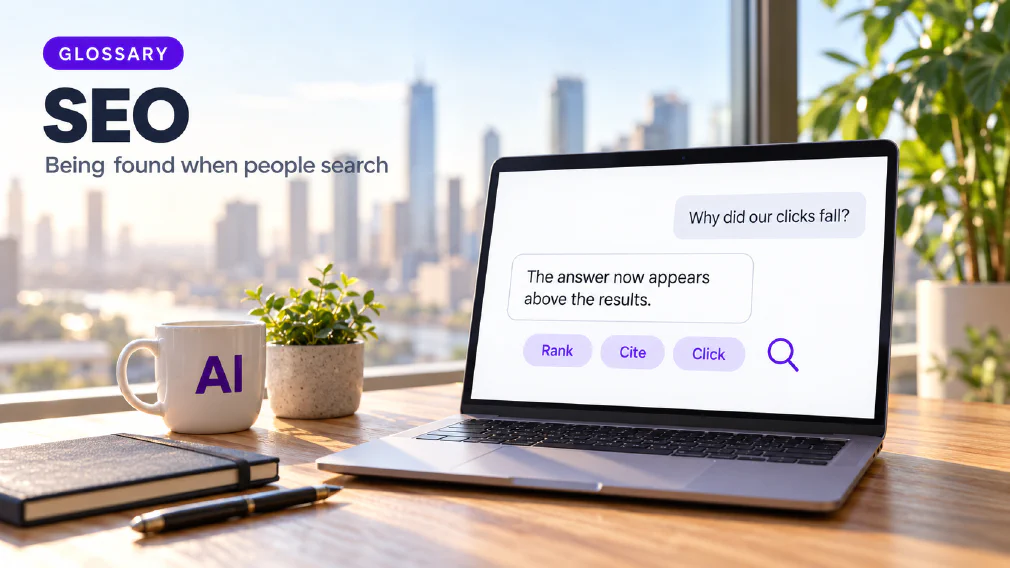
What SEO means
Search engine optimisation, or SEO, is the long-established practice of making a site easy for search engines to find, understand and rank. The SEO against GEO review describes the shape of it. The unit of success is a page, the reward is a click, and the measure is a position and the traffic that follows. A business does it so that when someone searches for what it offers, its page is among the results.
The site’s own definition adds the part that matters now. SEO is still the foundation, but AI-generated answers have changed what a good result looks like. A high ranking used to mean a visit. It no longer reliably means a visit or a mention, and that is the reason this page exists in a glossary about AI.
What the Foundations are
The review names the foundations Google points to, because they serve both SEO and the newer work built on it. Pages need to be crawlable and indexed, load properly, and carry content that cannot be found elsewhere in the same form. A page that is not indexed cannot be retrieved by anything, which is why the review says SEO-first fits any business whose key pages are not indexed, load slowly or repeat what a dozen competitors already say.
The brand article adds the visible side. Experience, expertise, authority and trust, summarised as E-E-A-T, are judged from visible evidence: named people, real credentials and clear provenance. None of this is new. It is the work that has always decided whether a page is worth ranking.
Why a ranking no longer guarantees a click
The AI Overviews article explains why. SEO was built on a simple mechanic: rank higher, get more clicks. That assumed the searcher had to visit a page to get an answer. An AI Overview removes that assumption for a large share of informational queries, because the model reads across several ranking pages and writes the answer on the results page itself.
The measurable effect is a rise in zero-click searches. The article is careful about what that means. A page can hold its position, or even improve it, and still see fewer visits, because the position stopped being the thing that decided whether a click happened. The review reports a Pew analysis of 68,879 Google searches in March 2025 in which people clicked a traditional result in 8% of visits when an AI summary appeared and in 15% when it did not.
Ranking and being cited are now two questions
The same article says visibility has split. One question is whether a page still ranks. The other is whether it is cited as one of the sources behind the generated answer. A business optimising only for the first is optimising for a mechanic that decides fewer outcomes than it used to.
The ranking article puts numbers on the gap. In a July 2025 study, Google’s AI Overview cited a top-ten page 76% of the time. A March 2026 follow-up on 863,000 keywords and 4 million AI Overview URLs put that at 37.9%. The standalone assistants never tracked rankings closely: 12% of ChatGPT, Gemini and Copilot citations came from a top-ten page, and Perplexity sat at 28.6%. The article is clear that the AI Overview still correlates with rankings more than the assistants do, so the work that earns a rank still buys real value.
Why a Narrow page can still be cited
The mechanism is query fan-out. The model breaks one search into several related sub-questions and picks a source for each, so a page no longer needs to win the single most competitive version of a query. It needs to be the clearest, most specific source for one of the sub-questions.
That rewards depth on a narrow point over breadth across a broad one. It is part of why the AI Overviews article says long-tail questions deserve more deliberate attention than they did when a single head-term ranking was the whole game. The review makes a related point about wording. Because generative systems understand synonyms and intent, rewriting copy to chase exact keyword variants, which was always a weak tactic, is now a worse one.
Authority and Structure decide who is chosen
Ranking has long weighed relevance and authority together. A model choosing what to cite applies a narrower filter on top, closer to an editorial decision than a ranking one. The AI Overviews article says it leans harder on the signals search engines have described for years: demonstrated experience, subject expertise, authoritativeness and trustworthiness.
It lists what those look like on a page: clear authorship, evidence of direct experience of the subject and not a rewritten summary of other pages, and a track record a model can find corroborated elsewhere. Being well written is necessary but no longer sufficient. Being credibly the kind of source an answer should be attributed to is the harder bar.
Writing a page that can be lifted
Authority gets a page into the running. A separate, more mechanical question decides whether it is used: can the model extract a clean, self-contained answer without much interpretation. The article names a direct answer stated plainly near the top of a section, a clearly labelled list or set of steps, and specific facts in a sentence that stands on its own.
This is largely what good web writing has always rewarded: say the answer first, format for skimming and keep a claim specific. What has changed is who does the skimming. The article adds that a model choosing between two structurally similar sources will lean towards the one with a checkable date and a specific figure over the one making the same claim in vaguer terms. The citation article reports that keyword stuffing gave no meaningful benefit in its study, which is a break from older practice.
What Google says about its own AI Features
The review reports that Google’s guide to its generative AI features, last updated in July 2026, says optimising for them is still SEO. It names things you can skip: new machine-readable files, AI text files, special markup or Markdown, special schema.org markup for AI features, and splitting pages into small chunks. What it recommends instead is original content with first-hand expertise, a sound technical foundation and accurate business data.
The review reads that guidance for what it covers. It describes Google’s own features. ChatGPT, Perplexity and Claude run their own retrieval, so for Google the work is SEO, and for everything else the overlap is large but not guaranteed. Markup is a separate matter from AI features. The review says it still earns rich results in ordinary search and costs little to keep accurate. The brand article says organisation markup can remove ambiguity about what a business is, with nothing required and no guarantee that any feature appears.
Where the click still survives
The AI Overviews article names branded search as one of two places a click still tends to survive. When a generic query is answered inside an overview, the click often does not happen. What does not disappear is a searcher’s habit of searching for a business by name, and a model has far less reason to intercept a query that already asks for one named source.
That makes recognition a more direct SEO asset than it used to be. A business nobody can name has nothing to fall back on once the generic version of its category’s query is absorbed into a summary. Branded search is built over time and not in a single sprint, and the citation article reports that brand mentions correlated roughly three times more strongly with AI visibility than backlinks did.
What to track
The old dashboard, rank against traffic, no longer tells the whole story. The AI Overviews article says Search Console separates impressions and clicks tied to AI Overview appearances, and the shape to watch for is impressions holding steady or climbing while clicks on the same query drift down. That is not a tracking error. It is the query being answered on the results page. The review adds that Google now provides a generative AI performance report in Search Console for its own features.
Two habits follow. Track branded and non-branded queries as two lines and not one blended total, so a drop in overall clicks can be read as the market shifting or the brand holding up. And check by hand, periodically, what an overview says for the few queries that matter most and which sources it names, because neither a competitor being cited in your place nor being cited only for a narrower question shows up in a rank tracker. The ranking article says rank tracking now answers a narrower question than it used to.
A worked example
This is an illustration, not a real client. A small professional services business has a page on a common client question that ranks around fourth. Its Search Console figures show impressions steady and clicks falling. The owner reads this as a ranking problem and begins rewriting the page around more keyword variants.
A closer look changes the diagnosis. An AI Overview now answers the question on the results page, and the page is not among its sources. The business rewrites the opening paragraph to give the direct answer, puts its key figures in a labelled table with sources beside them, names the author and their experience, and adds the narrower follow-up questions clients actually ask. Its rank has not changed. It then watches whether the page is named in the overview and whether clicks on the narrower questions hold, and it records branded and non-branded queries separately so it can read the result.
Mix-ups worth avoiding
Four confusions come up often enough to name. The first is treating a high ranking as the goal in itself, when the AI Overviews article says it no longer decides whether a click or a citation happens. The second is treating SEO as obsolete. The review says ordinary search still sends far more traffic than AI platforms, with a Similarweb comparison reported at about 191 billion monthly referrals from Google against 1.1 billion from all AI platforms combined.
The third is treating GEO as a separate discipline built from nothing, when the citation article says it sits on top of SEO. The fourth is assuming the Google guidance covers every assistant. It covers Google’s own features only.
Where it goes wrong
One failure is chasing exact keyword variants or stuffing a page with a phrase, which gave no meaningful benefit in the citation article’s study. Another is watching only rank and traffic and misreading steady impressions with falling clicks as a fault, when it is a query answered on the results page.
A third is a technically sound page with no visible authorship or evidence of experience, which can fail to read as a source worth attributing a claim to. The last is expecting a result. Nothing here guarantees a ranking, a click or a citation, and this page makes no such claim.
Where it appears in an Audit
SEO appears in an audit as a different question from the one it used to ask. The AI Overviews article says most of the work is not a rewrite. It is an audit of what a site already has, checked against two questions: not only whether a page ranks, but whether a model reading across the top sources would choose it as one worth citing.
The citation article’s advice is to start with the pages that already perform under conventional SEO, since those are best placed to benefit first. Every audit begins with a discovery call, and you can get an audit to start one. The closely related terms are generative engine optimisation, AI citation and AI Overviews, and a practical starting point is checking what AI says about your business.
FAQ
Questions about Search Engine Optimisation (SEO)
What is SEO?
SEO is the practice of improving a page so search engines can find, rank and show it. It remains the foundation for being found, including by AI answer engines.
Is SEO still worth doing?
Yes. The citation article says generative engine optimisation builds on traditional SEO fundamentals rather than replacing them, and the AI Overviews article says authority signals matter more under the new model, not less.
How AI Overviews are changing what counts as SEOWhat actually gets Content cited in AI-generated Answers
Does a high ranking still bring clicks?
Less reliably than it did. The AI Overviews article says an overview can answer a query before anyone clicks, so a page can hold its position and still see fewer visits. The review reports a Pew analysis in which people clicked a traditional result in 8% of visits when an AI summary appeared and 15% when it did not.
How AI Overviews are changing what counts as SEOSEO vs GEO: What changes and what doesn't
Is SEO the same as GEO?
No, but they share foundations. SEO aims to rank a page and earn a click. GEO aims to have a passage cited inside a generated answer. For Google's own AI features, the review reports that Google calls the work still SEO. For other assistants the overlap is large but not guaranteed.
Generative Engine Optimisation (GEO)SEO vs GEO: What changes and what doesn't
Does Google say AI Features need special markup?
No. The review reports that Google's guide to its generative AI features, updated in July 2026, says no special markup, AI text file or content chunking is needed, and that optimising for them is still SEO. That covers Google only. Markup still earns rich results in ordinary search and costs little to keep accurate.
What should we track now?
More than rank and traffic. The AI Overviews article says to watch impressions and clicks tied to AI Overview appearances, track branded and non-branded queries as two separate lines, and check by hand what an overview says for the queries that matter most. The ranking article adds that citation frequency needs its own tracking.
How AI Overviews are changing what counts as SEOWhy ranking on Google isn't enough anymore
Where does a click still survive?
The AI Overviews article names two places: branded search, where someone searches for a business by name, and specific long-tail questions that an overview has not already answered. A generic query is the kind an overview is most likely to answer completely on its own.
Branded SearchHow AI Overviews are changing what counts as SEO
What makes a page easy for an AI Answer to use?
A direct answer stated plainly near the top of a section, clearly labelled lists or steps, and specific facts that stand on their own. The AI Overviews article says a page written for skimming humans and one written for extraction by a model reward largely the same habits. Keyword stuffing gave no meaningful benefit in the citation article's study.
How AI Overviews are changing what counts as SEOWhat actually gets Content cited in AI-generated Answers
What it means for a Business
A high ranking no longer guarantees a click or a citation. Authority, structure and direct answers decide whether a page is chosen as a source.
Ready to Put This to Work?
Tell us where your team is with AI and we will tell you honestly what would make the biggest difference.