
Multimodal
A model that works across more than one kind of material (text, image, video and voice) rather than being built for one. Choosing between a broad multimodal model and a specialised one for a given job is the judgement that matters.
What Multimodal means
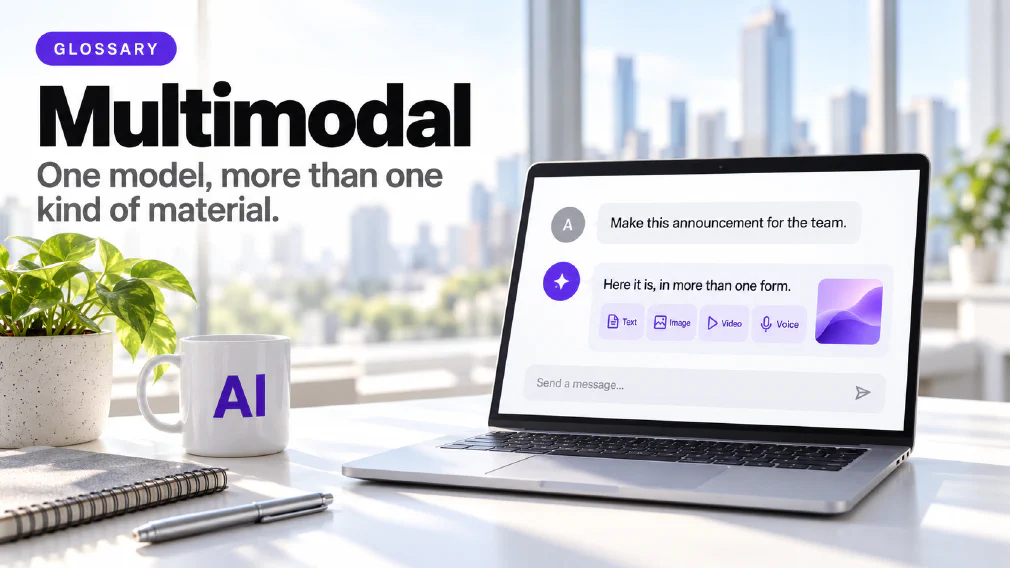
A multimodal model works across more than one kind of material, such as text, image, video and voice, rather than being built for one. A kind of material is called a modality, and multi means more than one. The word is a description of what a model takes in and puts out, not a measure of how good it is.
The site treats the term as a choice and not as a feature list. The advanced generative AI course covers the newest generation of video, image and voice tools and the difference between broad multimodal models and specialised ones, and participants leave with the judgement to pick one for a given job. That judgement is the point of this page.
Text only, and more than text
The clearest way to see the term is against its opposite. A large language model is built on language specifically. An image generator learns patterns in pictures instead of words, and it is not a language model, even though it sits in the same wider category of generative AI. A multimodal model is defined by working across more than one kind of material, so a text-only language model is the single-kind case of the same technology.
The difference shows in how the models are built. The generative AI page explains that a text model learns from text pulled from books, articles and websites, while an image model learns from images paired with their captions. A model that works across kinds has to learn the relationships between them. The site does not go further into how that works, and nothing on the page depends on it.
The kinds of material
The generative AI page names the main forms it takes today. Text generation is the one most people meet first, usually through a chatbot, for drafting, summarising, answering and rewriting. Image generation takes a written description and produces or edits a picture from it. Code generation writes or explains programming code from a plain-language request. Audio and video generation produce speech, music or short clips from a prompt, and the site calls them the newest and least mature of the four.
Most of the assistants named on this site are text at their core, with image and file handling layered on top of it. The ChatGPT page notes that an assistant of this kind can, depending on the plan, read files, search the web, write code and create images. The course outlines list reading PDFs and tables, asking questions of a document, and image creation with image styles and ideas. In practice, most people meet the idea as a text assistant that also accepts files and can produce a picture.
Broad Model or Specialised Model
The choice between a broad multimodal model and a specialised one is the judgement the courses teach. A broad model works across several kinds of material. A specialised one is built for a single kind, or a single job. Neither is better in general. Which one fits depends on the job.
The advanced course opens its first session on a decision framework called how to choose your tools, and it includes multi-tool work, such as multi-tool post creation and persona-based summaries, so participants see the same task done in more than one assistant. The site does not rank the leading assistants, and the reason it gives applies here too. Which tool suits which job depends on the tools an organisation already has, so that is what sessions run on.
Three questions are worth asking before choosing. This is advice built on the material above and not a rule the course states in these words. What kinds of material does the job actually involve? Does one kind carry most of the work, or do several matter equally? And is the tool already in your organisation able to do it, before you add another? A job that is all text does not need a model that handles video.
A worked example
This is an illustration, not a real client. A small events team needs a short written announcement, a poster to go with it and a slide for a meeting. The announcement is text. The poster is an image. The slide is a document. That is three kinds of output from one brief.
The team could use a single broad tool that handles all three, or it could use a text assistant for the announcement and a tool built for images for the poster. The advanced course covers poster and advertising and presentation creation in the same session as the decision framework, because the real question is which tool suits each part. Whichever route the team takes, it is choosing, and the choice is a judgement about the job and the tools already on the desk.
What the Advanced Course covers
The advanced generative AI course is two sessions and is only to be attended after the first generative AI workshop. Session one covers the newest generation of video, image and voice tools, the difference between broad multimodal models and specialised ones, and using AI inside the apps people already have. It closes on vibe coding, which means building small working things without traditional development.
The AI Academy listing describes the same course in one line, as covering the newer tools across video, image and voice and how to choose between a multimodal model and a specialised one. The outcome is stated plainly. Participants leave with confidence in the newest tools across video, image and voice, and the judgement to choose a multimodal model or a specialised one for a given job.
The site names no Tool’s abilities
The idea is not tied to one product, and the site does not describe what any video, image or voice tool can do. Those abilities change faster than a glossary can be updated, and a claim written here would go stale. A team should check what the tool in front of it can take in and produce.
What carries across is the skill. Deciding what kind of material a job involves, and whether one tool or several suits it, works the same whichever products are current. It is also why the advanced course teaches a framework and not a list.
Whatever the material, the same Rules apply
The EU AI Act is written for generative AI as a category and not for one kind of content, because an image generator and a text assistant raise many of the same questions. The obligations under it and under GDPR attach to what a system does and what data it processes, not to the form of the output. A business does not escape a rule because the tool produces pictures or voice instead of text.
That matters for planning. The compliance question is the same whether a workflow takes in a paragraph or a recording. It is settled by what the process handles and who is accountable for it.
What not to upload
Everything you put into an AI tool is data. The site’s article on why banning AI at work backfires argues for a rule drawn by kind of data and not by tool. Client information, contracts and HR records should not go in unless a rule says they may. A photo of a customer, a recording of a meeting or a voice clip is data in the same way a typed paragraph is. That is advice built on the rule and not a claim the site makes in those words.
The personalisation course closes on using public AI safely, with public, anonymised, generic or invented content only. That rule is easier to follow with text than with a recording, which is a reason to decide it before anyone starts.
Mix-ups worth avoiding
Four confusions come up often enough to name. The first is treating multimodal and large language model as the same thing, when a language model is built on language and a multimodal model works across more than one kind of material. The second is treating multimodal as another word for generative AI, which is the wider category that produces text, images, code, audio and video.
The third is assuming a broad model is always the better one, or that a specialised one always is. The course teaches a choice, and the answer depends on the job. The fourth is treating the newest tools as settled. The site calls audio and video generation the newest and least mature of the four forms, so a team should expect that part of the field to keep changing.
Where it goes wrong
A model that handles more kinds of material does not check facts any better. It can produce an answer that reads well and is wrong, which is hallucination, and it is a property of how generative AI works, not a fault in one kind of tool. A picture, a clip or a voice recording that looks finished can carry an error in the same way a paragraph can, and the finish makes it easier to trust. That is advice built on the site’s rule and not a claim it makes in those words.
The working habit does not change. The prompting workshop teaches humans in the loop and why human verification matters, and the advanced course’s research block includes a cross-checker. The person who sends the result on is responsible for what it says.
Where it is taught and where it appears in an Audit
The advanced generative AI course is where the choice between a multimodal model and a specialised one is made, and the AI Academy workshops list it. The ChatGPT Enterprise course covers image styles in its content creation block, and the art of prompting course teaches the prompting that steers any of these models. Six of the courses are the core AI courses, and the rest sit in the wider training catalogue.
An audit meets the choice as a question about a process. Whether a workflow needs one kind of material or several, and whether one tool or several should handle it, is weighed against what the process handles and who is accountable for it. The decision framework the advanced course teaches is the same question asked by the people doing the work.
FAQ
Questions about Multimodal
What is Multimodal AI?
A multimodal model works across more than one kind of material, such as text, image, video and voice, rather than being built for one. The site treats the term as a choice and not a feature list. The advanced generative AI course covers the newest generation of video, image and voice tools and the difference between broad multimodal models and specialised ones.
Generative Artificial Intelligence: Advanced Tools & Future Trends (Gen 2)
What is the difference between a Multimodal Model and a Large Language Model?
A large language model is built on language specifically. An image generator learns patterns in pictures instead and is not a language model, even though it sits in the same wider category. A multimodal model is defined by working across more than one kind of material, so the text-only large language model is the single-kind case of the same technology.
Should I choose a Broad Multimodal Model or a Specialised one?
It depends on the job, which is why the course teaches it as a judgement. A job that needs one kind of material may suit a tool built for that kind. A job that runs across several may suit a broad model or several tools used together. The site does not rank tools, because which one suits which job depends on what an organisation already has.
Generative Artificial Intelligence: Advanced Tools & Future Trends (Gen 2)
Which kinds of material can Generative AI work with?
The site describes text, image, code, and audio and video. Text is the form most people meet first, usually through a chatbot. Image generation produces or edits a picture from a written description. Audio and video generation produce speech, music or short clips from a prompt, and the site calls them the newest and least mature of the four.
Does a Multimodal Model stop an AI making things up?
No. A model that handles images or voice as well as text can still produce an answer that reads well and is wrong, which is hallucination. The kind of material does not change the working habit. The answer is a draft, and the person who sends it on is responsible for it.
Can I upload a customer photo or a recording to an AI Tool?
Treat it as data, because it is. Everything you put into an AI tool is data, and the site's rule is drawn by kind of data and not by tool. Client information, contracts and HR records should not go in unless a rule says they may, and that covers a photo, a recording or a voice clip as much as a typed paragraph. The personalisation course closes on public, anonymised, generic or invented content only.
Why banning AI at work backfires, and what to doAI Agents & Personalisation
Where is Multimodal AI taught?
In the advanced generative AI course, which is two sessions and is only to be attended after the first generative AI workshop. Session one covers the newest generation of video, image and voice tools, the difference between broad multimodal models and specialised ones, and using AI inside the apps people already have. Participants leave with the judgement to choose between the two for a given job.
Generative Artificial Intelligence: Advanced Tools & Future Trends (Gen 2)AI Academy Workshops
What it means for a Business
It is taught as a choice rather than a feature list. The advanced programme covers the newest generation of video, image and voice tools and the difference between broad multimodal models and specialised ones, and participants leave with the judgement to pick one for a given job.
Ready to Put This to Work?
Tell us where your team is with AI and we will tell you honestly what would make the biggest difference.