
Why Banning AI at Work Backfires, and What to Do
Most workplaces have no clear AI rule, and staff use personal AI accounts anyway. Why a ban backfires and what a workable replacement looks like.
12 min readBy Somangsu Mukherjee
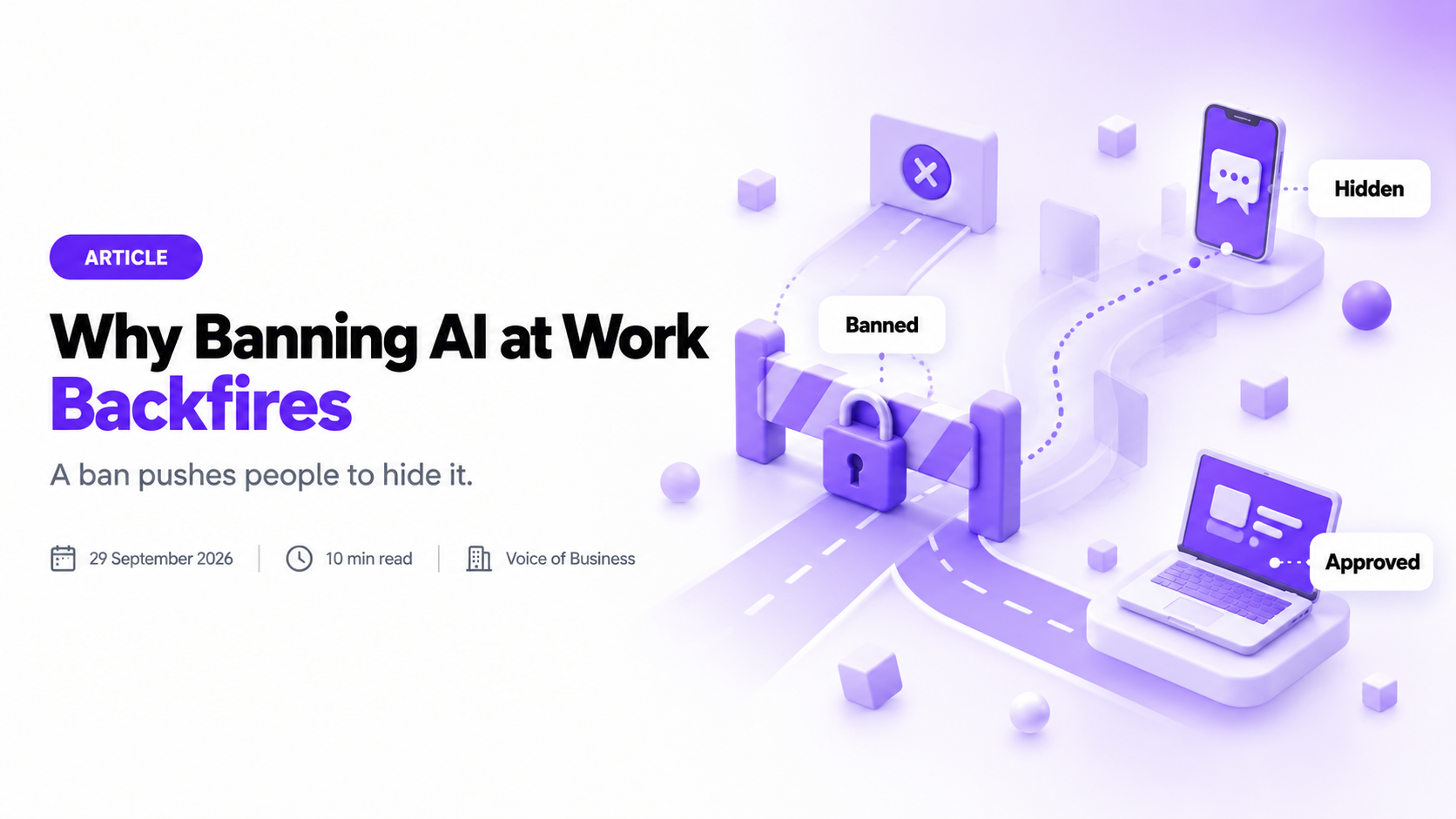
Banning AI tools at work does not stop staff using them. It only stops the business seeing it. Most small businesses have not banned anything. They have never said what is allowed, and their staff have answered the question themselves.
This article covers what recent surveys show about how people use AI where the rules are missing, why a ban makes the situation harder to manage, what to put in its place, and the cases where a ban is still the right call. It deals with behaviour and the daily fix. For inventory, risk classification and regulation, read our article on AI governance for small and mid-sized businesses.
Key Takeaways
- The usual situation is not a ban that staff ignore. It is no clear rule at all, so each person decides alone.
- Where there is no rule, a large minority of staff enter real client, HR and financial information into personal AI accounts.
- A ban removes the approved route but leaves the task, so the use moves onto accounts and devices the business cannot see.
- Draw the line by the kind of data, not by the name of the tool, and explain the reason for each line.
- Give staff an approved tool that is good enough for daily work, then ask each team what it needs without blame.
- Keep bans for specific tools and data, with a reason and an alternative attached.
Banning AI at work solves a problem most businesses do not have
The picture most managers carry is a workforce that has been told no and is quietly saying yes. The survey data describes something different. A July 2026 survey of 500 employed US adults, run by a law firm, found that only 6.6% said their employer bans AI tools outright. Just 35.8% said their employer has a clear written policy on what work information may be shared with AI tools. Forty per cent said no such policy exists, and another 24.2% were not sure. That leaves 64.2% of the workforce improvising. The name for what fills that gap is shadow AI: tools and personal accounts in use for work that the business never approved or reviewed.
An accountancy firm’s survey of more than 1,000 employees points the same way. It found 36% of workers said their company has a formal AI policy, and only 22% said their employer actively monitors AI use. So the real choice in most workplaces is not between a ban and permission. It is between a rule and silence.
Silence has a predictable result. In the law firm’s survey, 38% of workers admitted entering at least one type of work information into a personal AI account their employer does not control. Some 23% had pasted in internal emails, memos or documents. Another 11.8% had entered customer or client information, 11.4% contracts or legal documents, and 10.6% employee or HR information. The accountancy survey found 60% of workers rely on consumer AI platforms rather than tools their company provides, and 28% said they would use AI at work even if it were banned.
Both surveys are self-reported and were run by commercial firms, so read them as direction, not as precise measurement. The direction is consistent across both. People use AI because it is useful, and without an approved option they use whatever is closest.
It also matters what “AI tool” covers. It is no longer one app that a manager can list and block. Today generative AI sits inside email clients, meeting software, document editors and browsers, often switched on by default in products the business already pays for. A rule written as “no AI tools” has no clear edge, and staff are left to guess where it stops.
Banning AI at work pushes the use out of sight
The mechanism is simple. A ban removes a tool, but it does not remove the task. The client email still needs an answer by five o’clock. The forty-page report still needs summarising before tomorrow’s meeting. The person facing that deadline has a phone in their pocket and a personal account already set up, so the work gets done there.
That single move changes what the business can see. Use on a company-approved tool can be reviewed, logged and improved. Use on a personal account on a personal phone leaves no record anywhere the business runs. The risk has not gone down. The visibility has, and shadow AI is what a ban leaves behind. A survey of 25,000 UK workers by a professional services firm, reported in the trade press, found that almost one in ten had used an AI tool their employer had banned or would disapprove of. The reporting does not say how many of those workers were under a formal ban, so treat that figure as a floor for hidden use, not a full count.
The same survey found half of AI users said they had received no formal guidance or training. Set that beside the 64.2% improvising and the pattern is clear. Staff are deciding for themselves which data is safe, with no training in how to decide. A ban does not fill that gap. It adds a prohibition on top of it.
A ban also asks people to do by hand what they know can be done faster, while colleagues elsewhere are not under the same restriction. Staff who see AI skills as part of their own career development read that as a limit on them, and the people most keen to use AI well are the ones most likely to work around it.
A blanket ban also treats every use the same, and the uses are not the same. Rewriting a paragraph that is already public carries almost no risk. Pasting in a client contract carries a lot. When a rule refuses to tell those apart, staff learn that the rule is crude, and people discount crude rules. The one distinction that matters, which data is safe and which is not, is the one a ban never teaches.
Managers add a further problem. A ban that managers quietly bend, because a deadline needs the work done, teaches everyone that the rule is optional. The team then learns two things at once: the rule can be ignored, and the way to ignore it is to say nothing. Both lessons are hard to reverse once they set, and neither can be fixed by repeating the ban more firmly.
The last effect is on trust. When use is prohibited, nobody says when it goes wrong. A person who pasted the wrong document into a personal account has every reason to stay quiet, and the business hears about it later, usually from a client. Incident reporting only works when reporting is safe. A rule that treats all use as misconduct makes the honest report the riskiest thing an employee can do, and that is how a small mistake becomes a serious one.
What to put in place instead of banning AI
Five steps replace a ban, and the first two can be in place this week.
1. Provide approved AI tools for employees that are good enough. If the approved option is slower or weaker than the personal one, people will keep using the personal one. Set it up on a business account, where data-handling and retention settings are under your control, which a personal account never gives you. Test it on the tasks your staff actually do, such as drafting from notes, summarising long documents and restructuring text, and fix what it cannot do before you announce it. If you are choosing between platforms, our reviews compare the main options for business use.
2. Draw the line by data, not by tool. Write one page in plain language. This page is your AI acceptable use policy for staff, and one page is the right length for a small team. A workable version has three parts. The first lists what may never be entered into any AI tool: client names and contact details, contracts, HR records, credentials and anything under a confidentiality agreement. The second lists what is fine in the approved tool, such as drafting from your own notes, summarising public documents and editing text with the names removed. The third says anything else goes to one named person before it is entered. Client and HR data is exactly what your data protection duties already cover, so the page adds no new principle. It makes an existing one usable on a busy afternoon.
3. Explain the reason behind each line. A rule people understand gets followed in cases it did not anticipate, and that is where most real decisions happen. This is the point at which training does more than a memo, because staff need enough AI literacy to judge a case the page never covered. Before any session, decide how to brief a team on AI so that people arrive knowing what is being asked of them. A set course suits a whole team that needs the same foundations, while one function whose data and workflows are specific is better served by bespoke training. Either way, what makes training stick is practice on the person’s own work, not a slide of prohibited actions.
4. Ask before you audit. Hold a short conversation with each team about what tools they use, what for, and what the approved option lacks. Open with the reassurance that nobody is being disciplined for an honest answer, and mean it. The answers give you a list of needs to meet. A team that says it uses a personal account for meeting summaries has told you what the approved tool is missing. That is more useful than a scan, and it works on the accounts a scan cannot reach.
5. Set an owner and a review date. A rule filed once goes stale within months, because new tools and new features keep arriving. Name a person who owns the page, put a review date in the calendar and rerun the team conversations on that date. Keep a short record of which tools and uses were approved and when, so that you can show a client or regulator how the rule was decided. If you want the whole picture mapped and classified properly, that is what an AI audit does across every team.
A worked example shows the sequence. Take a 25-person professional services SME. This is an illustration, not a real client. The owner finds two people summarising client calls in a personal AI account. Under a ban, the owner sends a warning email and the summaries carry on, now on phones. Under the approach above, the owner asks the two people what the summaries are for and learns that follow-up notes take an hour after every call. The owner then picks an approved tool with a meeting-summary feature and data terms that suit client material, and the one-page rule says call content goes in only through that tool. The aim is that the approved route is faster than the workaround, and that the business can see what is used because it runs through an account the business controls. None of it needs a policy manual or a compliance department. It needs a conversation, a tool and a page.
When banning AI tools is still the right call
Nothing above argues against ever prohibiting anything. It argues against prohibiting everything with one sentence. Some restrictions are correct and should be firm.
A specific tool can be unacceptable for a specific kind of data. If a consumer service’s terms let it retain and reuse what you enter, and you handle client material under confidentiality obligations, that tool should be off the table for that material. Say so by name. Regulated data is another case. Where GDPR applies to the personal data involved and no approved tool with suitable terms exists yet, the honest answer is not to use AI on that data until one does. Certain uses fall under the EU AI Act, which restricts some practices and imposes obligations on others according to what the system does, not how large the organisation using it is. Those need a classification before anyone uses them, and that is a decision for the person who owns the rule, not for each employee.
What separates a good narrow ban from a bad broad one is four things. It names the tool or the data. It gives the reason in a sentence. It points to the approved alternative. It says who to ask when a case is unclear. A rule with those four parts is one people can follow, and one a manager can defend if a client asks why.
Keep the list of narrow bans short and dated. Every entry should carry the reason it exists and the date it will be reviewed, because the reason often expires. A tool whose terms were unacceptable last year may have changed them, and an approved alternative that did not exist in spring may exist now. A ban list that only grows becomes the same blanket prohibition by accumulation, and staff will treat it the same way.
For most small and mid-sized businesses the practical order is to write the data rule, provide a tool that works, explain the reasons, and then add the narrow bans where the risk justifies them. Reversing that order, starting with a ban and hoping the rest follows, is the sequence that produces hidden use.
Stop treating staff AI use as a discipline problem and treat it as a gap in what you have provided. Start with the one-page data rule and the honest team conversation, because both can happen this week. If you want every team’s actual use mapped and classified against the rules that apply to you, every audit begins with a scoping conversation, and you can get an audit to start one.
Sources
- Nearly 2 in 5 US workers have put company information into personal AI accounts: findings of a July 2026 survey of 500 US employees on entering work data into personal AI accounts, and on written AI policies and awareness of the legal position.
- 28% of Employees Would Use AI at Work Even if Banned: findings of a survey of more than 1,000 employees on formal AI policies, monitoring, reliance on consumer platforms and willingness to use AI under a ban.
- UK Workers Hide AI Use From Their Bosses, Survey Finds: trade-press report of a 25,000-respondent UK survey on use of banned or disapproved AI tools and on the share of AI users given no formal guidance or training.
FAQ
Questions we get asked
Should a small business ban AI tools at work?
In most cases no. A blanket ban removes the approved route without removing the reason staff use AI, so the use carries on out of sight, often on personal accounts and phones the business cannot see. A July 2026 survey of 500 US employees found only 6.6% said their employer bans AI tools outright, so most staff are working with no clear rule at all. A better starting point is an approved tool that is good enough for daily work, plus a short rule about which data must never be entered into any AI tool.
What should an AI acceptable use rule for staff say?
It should draw the line by the kind of data, not by the name of the tool. List what may never be entered into an AI tool, such as client information, contracts, HR records and credentials. Say what is fine, name which tool is approved for which task, and give one person to ask when a case is unclear. One page that staff read does more good than ten that they do not, and it should say why each line exists so people can judge cases the page did not anticipate.
How do we find out which AI tools our staff already use?
Ask, and make it safe to answer. A short, no-blame conversation with each team about what they use and what for will surface far more than a technical scan, because much of the use happens on personal accounts and phones. Treat the answers as a list of needs the approved tool has to meet, not as a list of offences. Repeat the conversation every few months, because new tools and new features appear faster than a written rule gets updated.
Is it against the law for staff to put client data into a personal AI account?
It depends on the data and on the contracts involved, but it is often a breach of something. Personal data entered into a tool the business has not assessed can breach its GDPR duties, and confidentiality clauses in client contracts apply whichever tool is used. A July 2026 survey of 500 US employees found only 35.6% knew that entering confidential company information into a personal AI account can be against the law. Take legal advice on your own contracts and sector.
When is banning a specific AI tool the right call?
A narrow ban is right when a tool's terms are unacceptable for the data involved, when the data is regulated and no approved alternative exists yet, or when a use case falls into a category the EU AI Act restricts. The difference from a blanket ban is that a narrow one names the tool or the data, gives the reason, points to an approved alternative and says who to ask. Staff follow a rule with a reason far more readily than a general prohibition.