
Structured Content
Content laid out so a reader or an AI model can take an answer from it as written, with a direct answer near the top of a section and clearly labelled lists, steps, tables or question blocks. The site's articles treat it as what decides whether a trusted page actually gets used in an AI answer.
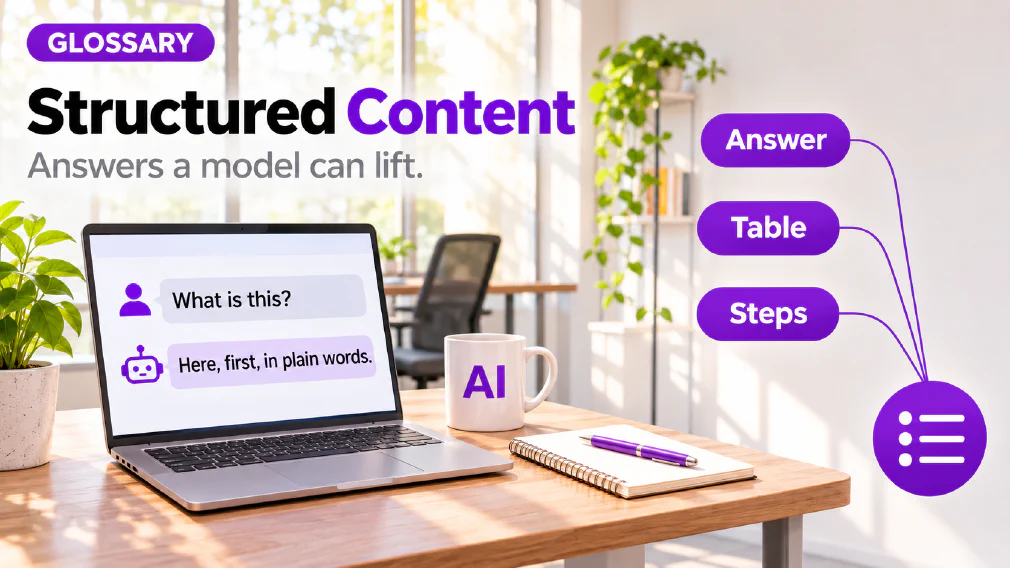
What Structured Content is
Structured content is content laid out so that a reader, or an AI model, can take an answer from it as written. The site’s definition names the signs: a direct answer near the top of a section, and clearly labelled lists, steps, tables or question blocks.
It is a way of writing and laying out a page. It is not a special file, a code snippet or a separate version made for machines. The test is simple. If a model, or a person in a hurry, lifted one section out of the page, would it still make sense, and would it contain the answer?
Authority and extraction are two questions
The AI Overviews article says a page has to pass two separate tests to be cited. The first is whether the page is trusted enough to be a source at all. That depends on clear authorship, demonstrated experience and the signals grouped under E-E-A-T. The second is more mechanical: can the model extract a clean, self-contained answer from the page without doing a lot of interpretive work.
Structured content answers the second question. A page can be trusted and still go unused, because the answer is buried. The article puts the two in order. Clearing the authority bar is half the job, and the other half decides whether the page is actually used.
Why a Model lifts and does not compose
The ranking article explains why layout matters. A model choosing what to cite is doing extraction work, not composition. It reaches for whatever it can lift without reinterpreting a paragraph or hunting further down the page for the point.
That is why the article calls its throughline simple. A direct answer near the top of a section, a labelled table in place of a wall of prose and a clearly formatted question and answer block each hand the model a claim it can use as written, not a claim it has to work to extract. The article adds that none of this is exotic. It is closer to what a good editor would tell a writer anyway, applied to a reader that skims faster and more literally than any person does.
The habits that make a page liftable
The two articles and the SEO and GEO review describe the same short list.
- A direct answer first. State it plainly near the top of a section, before any build-up.
- Labelled lists and steps. A clearly formatted list or set of steps is easier to lift intact than the same information in a long, discursive paragraph.
- Tables for comparisons. A labelled table carries a comparison that prose would make a reader, or a model, untangle.
- Facts in sentences that stand alone. A claim that needs the paragraph before it to make sense is harder to lift.
- The evidence and its source beside the answer. The review says to place them together, so a figure can be repeated with confidence and checked by a reader.
- A checkable date and a specific figure. The AI Overviews article says that between two similar sources, a model leans towards the one with a checkable date and a specific figure over one making the same claim in vaguer terms.
What the Evidence reports
The ranking article gives figures from outside sources. It reports, from a search industry guide, that opening paragraphs which answer the query at once are cited 67% more often than ones that bury the answer, that pages carrying original data tables earn 4.1 times more AI citations than pages making the same claim in prose, and that FAQ schema is linked to a 28% rise in citation rate. A separate study it cites, mapping where in 100 real AI Overview citations the cited passage sat, found 55% came from the first 30% of the page.
These are not the site’s own measurements, and they are linked effects, not guarantees. The study of one search feature does not describe every assistant. The practical reading the article draws is modest: put the answer where it can be found, and put comparisons in a form that can be lifted.
What it does not mean
The SEO and GEO review adds a counterweight that this page should not skip. It reports that Google’s own published guide to its generative AI features says a business does not need new machine-readable files, AI text files, special markup or Markdown, there is no special schema.org markup to add for AI features, and pages do not need splitting into small chunks.
The review says to read that for what it covers. It describes Google’s own AI features, and signals for other assistants may differ. It also says markup still earns rich results in ordinary search and costs little to keep accurate, so it is worth maintaining on its own merits, and that any claim of guaranteed benefit should be treated with suspicion.
So structured content is not fragmenting a page into pieces or adding code for machines. The review says writing each section so it makes sense if lifted out on its own is not a licence to fragment pages. It is a writing habit.
One page for two readers
The most reassuring point in the AI Overviews article is that the two readers want nearly the same thing. A page written to be extracted cleanly by a model and a page written to be scanned quickly by an impatient person reward largely the same habits. Say the answer first, format for skimming and keep a claim specific.
The article says this is one of the few parts of the shift that does not need an entirely new set of habits, only more consistent use of the old ones. The citation article says the same from the other side: none of this is an argument for abandoning conventional search engine optimisation, and an organisation with sound, well-structured content is closer to benefiting than one starting from nothing.
Visible question blocks
The review says visible question and answer blocks work because each answer stands alone. A reader, or a model, can take one answer without needing the surrounding text. The ranking article gives the same reason when it discusses FAQ schema: it hands a model a self-contained question and answer in place of a paragraph it has to reinterpret first.
The word that matters in the review is visible. The block is there for the person reading the page, and a page that shows its questions and answers plainly is doing the job whatever else is in the code. The AI citation page covers what being named as a source involves.
Editing a page you already have
The citation article says the gap most organisations need to close is not a rewrite but a targeted pass over pages they already have. The AI Overviews article describes most of the work as an audit of what a site has. For structure, a pass can ask six plain questions of each page.
- Does each section open with its answer?
- Is any list or sequence buried in a paragraph?
- Is any comparison written as prose that would read better as a labelled table?
- Does each key sentence stand alone?
- Does each figure have its source next to it, and a date where it matters?
- Would the section still make sense if it were lifted out?
The statistics density page explains what goes inside the structure. It describes the habit as putting the direct answer first, the figure and its source next to it and any comparison in a labelled table, and notes that a well-laid-out page with nothing specific on it gives a model very little to use.
A worked example
An illustration, not a case study. A small training provider has a page explaining what its main service involves. It is accurate and written by a named expert, but it opens with a paragraph about the company’s history, and the answer to the question people actually ask sits in the fourth paragraph.
The provider does not rewrite the page. It moves a two-sentence plain answer to the top of the section. It turns a paragraph that compares three options into a labelled table. It splits a run-on description of a process into numbered steps. It puts the source and date next to the one figure the page relies on. It adds a visible block of questions that people ask, each answered in a sentence or two that stands alone.
Then it checks. It reads what an AI answer says for the question the page is meant to answer, and notes whether the business is named. It repeats the check on a schedule. The page says the same things as before, in an order and a form that can be lifted.
Mix-ups worth avoiding
Four confusions come up often enough to name. The first is treating structure as code, when the review reports that Google says no special markup or files are needed for its AI features. The second is splitting a page into fragments, when the review says writing each section to stand alone is not a licence to fragment. The third is expecting structure to make up for missing trust, when the AI Overviews article treats authority and extraction as two separate tests. The fourth is treating the reported percentages as promises, when they are linked effects from outside sources.
How we use it
The SEO and GEO comparison turns this into a writing rule: put the direct answer first, in plain words, with the evidence and its source beside it, so each section stands alone if lifted out. The ranking article says checking whether a site’s content is structured to be cited, and not only ranked, is part of what an AI audit looks at, run through the steps in how we audit.
If you would like that check run on your own pages, a discovery call is a quick way to start.
Sources
- How AI Overviews are changing what counts as SEO: authority and extraction as two tests, the habits a model can lift, freshness and specificity, and most of the work being an audit of what a site has.
- Why ranking on Google isn’t enough anymore: extraction not composition, the 67%, 4.1 times, 28% and 55% figures as the article reports them, and the AI audit check.
- SEO vs GEO: the direct answer first with its source beside it, visible question blocks, what Google’s guide says to skip and the fixed set of customer questions.
- What gets content cited in AI answers: well-structured content as a head start and the targeted pass over existing pages.
- Statistics density, AI citation, AI Overviews, Query fan-out, Content strategy, Generative engine optimisation, Search engine optimisation, E-E-A-T and AI audit: the neighbouring terms this page links to.
FAQ
Questions about Structured Content
What makes a page easy for an AI Model to cite?
The AI Overviews article names a direct answer stated plainly near the top of a section, a clearly labelled list or set of steps, and specific facts in sentences that stand on their own. Each is easier for a summarising model to lift intact than the same information buried in a long paragraph.
Is there Evidence that Structure changes how often a page is cited?
The ranking article reports, from a guide it cites, that opening paragraphs which answer the query at once are cited 67% more often, original data tables earn 4.1 times more AI citations and FAQ schema is linked to a 28% rise in citation rate. A separate study it cites found 55% of cited passages came from the first 30% of the page. These are linked effects, not guarantees.
What is Structured Content?
Content laid out so a reader or an AI model can take an answer from it as written, with a direct answer near the top of a section and clearly labelled lists, steps, tables or question blocks. It is a way of writing and laying out a page, not a special file or markup.
How AI Overviews are changing what counts as SEOSEO vs GEO: What changes and what doesn't
Does Structured Content mean special markup or splitting pages into chunks?
No. The SEO and GEO review reports that Google's own guide says its AI features need no new machine-readable files, no special markup and no splitting of pages into small chunks. The review says that covers Google's features and that other assistants may differ. It also says each section should still make sense if lifted out, which is a writing habit and not a reason to fragment a page.
Do I need to rewrite my pages?
Usually not. The AI Overviews article describes most of the work as an audit of what a site already has, and the citation article says the gap is a targeted pass and not a rewrite. The pass adds the elements that make a page liftable: a plain answer near the top, labelled lists and tables, and specific, sourced facts.
How AI Overviews are changing what counts as SEOWhat actually gets Content cited in AI-generated Answers
Is a page written for people Different from one written for a Model?
Less than it sounds. The AI Overviews article says a page written for skimming humans and a page written for extraction by a model reward largely the same habits: the answer first, clear formatting and specific claims. What has changed is who is doing the skimming, so the old habits need to be applied more consistently.
Why do visible question blocks work?
The SEO and GEO review says each answer in a visible question and answer block stands alone, so a model can lift it without reading the paragraph before it. The ranking article gives the same reason for its reported link between FAQ schema and citation rate: it hands a model a self-contained question and answer.
SEO vs GEO: What changes and what doesn'tWhy ranking on Google isn't enough anymore
How do I check whether my Content is Structured to be cited?
Read what AI answers say for the queries that matter and note which sources they name. The SEO and GEO review suggests running a fixed set of real customer questions on a schedule and recording whether the business is named. The ranking article adds that checking whether content is structured to be cited, and not only ranked, is part of what an AI audit looks at.
What it means for a Business
Most of the work is a pass over pages a business already has, not a rewrite. The AI Overviews article says a page written for skimming humans and one written for extraction by a model reward largely the same habits.
Ready to Put This to Work?
Tell us where your team is with AI and we will tell you honestly what would make the biggest difference.