Claude Fable 5.2 Review
Claude Fable 5.2 launched on 9 November 2026. What it does, what it costs relative to Opus 5.5, what the benchmarks show and whether a small business needs it.
Anthropic released Claude Fable 5.2 on 9 November 2026, two days before this review. It is the company’s most capable model, it costs less than the Fable it replaces, and it arrives with some striking claims: an operating system built by an army of agents over eight days, and two open physics problems solved. Almost every number in the launch comes from Anthropic itself. This review covers what the model is, what the tests show, what it costs compared with the rest of the family, and whether a small business should use it.
The short version: Fable 5.2 is a genuine step up for hard, long-running work, but Anthropic’s own advice is to start with a cheaper model, and most businesses should follow it.
Key takeaways
- Claude Fable 5.2 launched on 9 November 2026. It has a 1 million token context window and writes up to 128,000 tokens in one reply.
- It costs 20% less per token than Fable 5.1, and still twice as much as Opus 5.5. Anthropic says it can cost less per task on some hard jobs.
- On Anthropic’s tests it beats Opus 5.5 on coding, business workflows and research. Those results are Anthropic’s own and have not yet been repeated by independent testers.
- Anthropic still recommends Opus 5.5 as the strongest daily driver, and Fable for the most ambitious technical work.
- It needs 30-day data retention, and the Free plan does not include it.
- Mythos 5.2 is the same model for verified security and life sciences organisations, so most businesses will only ever meet Fable.
What is Claude Fable 5.2?
Fable 5.2 is the newest model in Anthropic’s Claude range and a large language model aimed at the top end of the market. Anthropic’s documentation describes it as built for demanding reasoning and long-horizon agentic work. Typical uses it lists are agent sessions that run for hours, multistep deep research, and analysis carried through to a finished document, spreadsheet or deck. If the word “agentic” is new, our entry on agentic AI explains it, and so does the article on what an AI agent is.
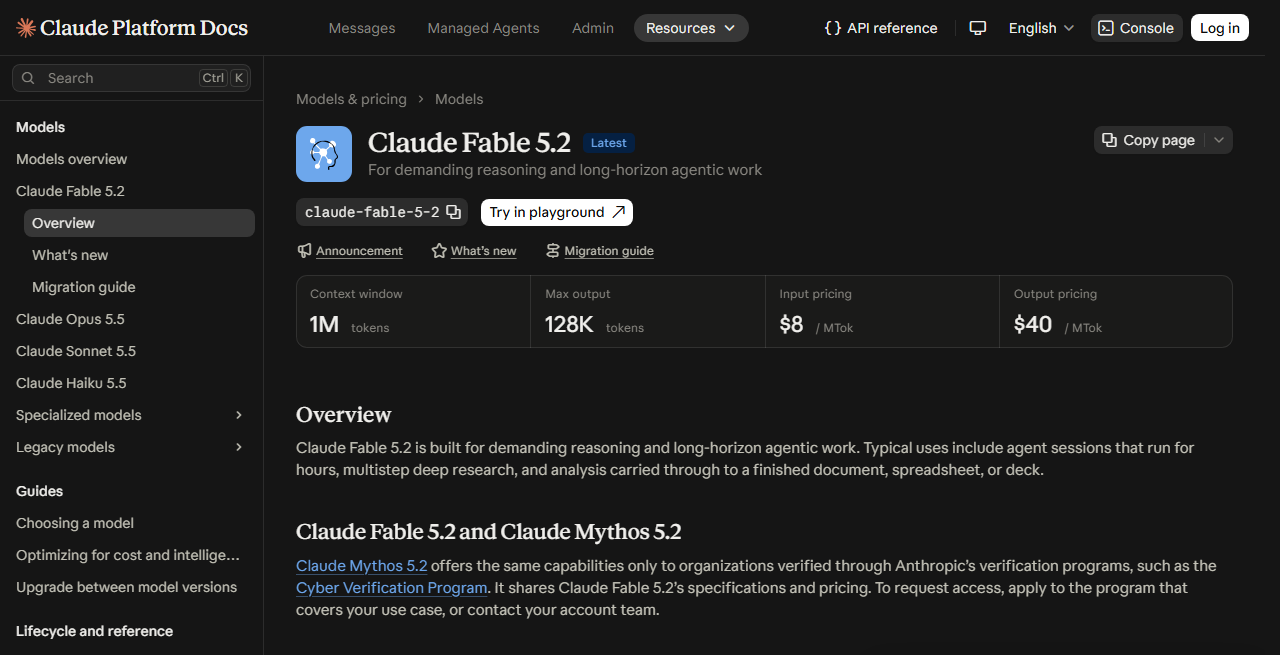
The practical specifications are these. It reads text and images and replies in text. It has a 1 million token context window, which Anthropic’s documentation puts at roughly 555,000 words. Its knowledge runs to June 2026, the same as Opus 5.5, Sonnet 5.5 and Haiku 5.5. It always thinks before it answers, and you steer how hard it thinks with an effort setting, from low to max. It succeeds Fable 5.1, and Anthropic says it produces output up to 30% faster than that model.
How is Claude Fable 5.2 Different from Opus 5.5?
The simplest way to see the difference is to put the family side by side. Anthropic’s documentation lists all four current models with the same context window and output limit, so the gaps are in price, speed and ambition and not in size.
| Model | Positioning | Price relative to Opus 5.5 | Speed |
|---|---|---|---|
| Fable 5.2 | Demanding reasoning, long agentic work | Twice as much | Moderate |
| Opus 5.5 | Long-running coding and knowledge work | The reference | Moderate |
| Sonnet 5.5 | Best mix of speed and intelligence | Half as much | Fast |
| Haiku 5.5 | High-volume, latency-sensitive tasks | A small fraction | Fastest |
Our earlier review of Sonnet 5.5 against Opus 5.5 covers the middle of that table in detail. Fable sits above it as the dearer option for work that Opus cannot finish. Anthropic’s advice in its documentation is to start with the latest Opus model and move to Fable “when your evals on a Claude Opus model at higher effort still don’t meet your requirements”.
What do the Claude Fable 5.2 benchmarks show?
Anthropic published results for a long list of tests. All of them are the company’s own, run at the effort levels it chose, so read them as a claim to check and not a verdict. Here are the ones that matter most to a business, with Opus 5.5 as the comparison.
- FrontierCode 2.0 (coding): 49.1% at the Xhigh setting, against 45.5% for Opus 5.5. Anthropic says this is the best result of any released model it tested. One press summary of Anthropic’s table puts GPT-6 Astra at 42.8%.
- FrontierSWE v2 (software engineering): 69.9% against 62.3%.
- AutomationBench (business workflows): 51.4% against 42.5%. One report lists Gemini 4 Carbon higher still on this test.
- Humanity’s Last Exam, with tools (hard reasoning questions): 74.2% against 67.7%.
- Remote Labor Index (paid freelance-style jobs): 41.3% against 21.3%.
- OSWorld 2.1 (using a computer): 89.3% against 87.2%, a small gap.
- Chartography (reading charts, no tools): 73.4% against 64.4%.
The chart shows the Remote Labor Index, the widest gap in the list. A test built from real paid remote jobs sounds close to office work, which is why it gets attention. It is still a benchmark, and the lesson from every launch is the same: a gap on a test does not tell you the gap on your own task.
Two further results are worth knowing. Anthropic reports that its Fable 5.2 at High effort roughly matches Opus 5.5 at Max effort on FrontierCode, at about half the cost per task. And on the Humanity’s Last Exam, Fable at Low effort matches Opus’s best score at under a tenth of the cost. Those are cost-per-task claims, not price-per-token claims, and the next section is about the difference. For how we judge vendor numbers in general, see our review of GPT-6 Astra, which covers the same problem.
How much does Claude Fable 5.2 cost?
This review does not quote prices, because they change and Anthropic’s own page is the only reliable place to read them. What can be said safely is the relationship between the models.
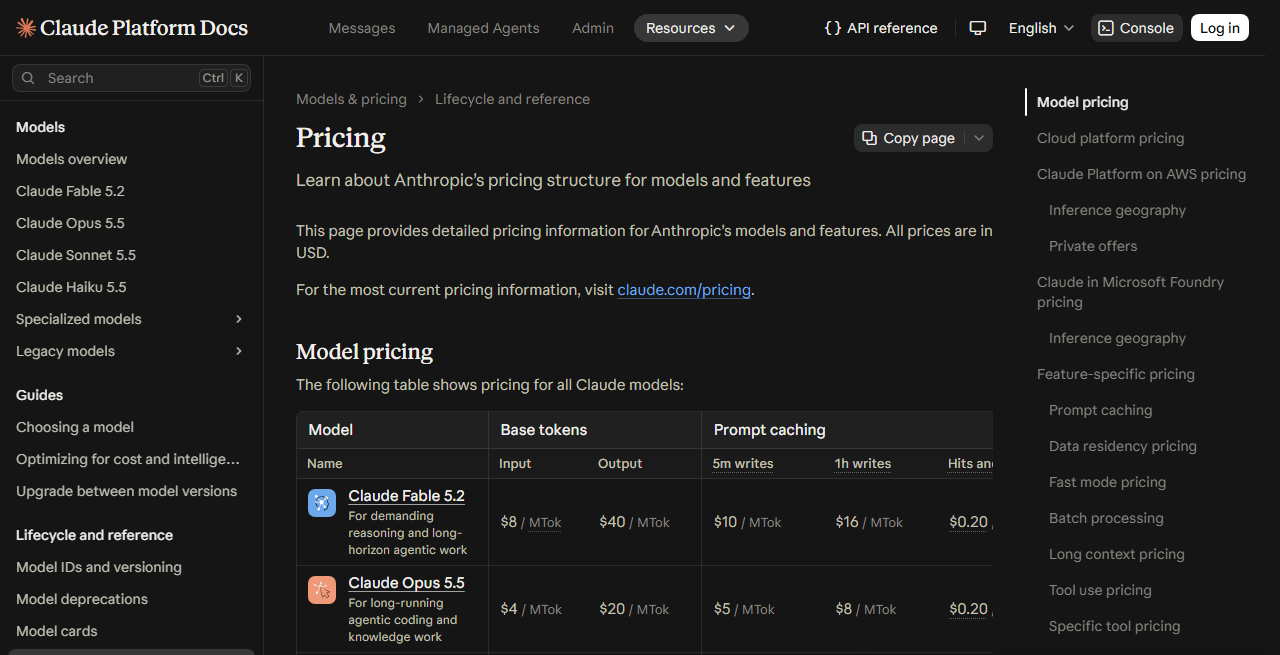
- Fable 5.2 costs 20% less per token than Fable 5.1.
- It still costs twice as much per token as Opus 5.5, and four times as much as Sonnet 5.5.
- The Batch API, for work that can wait, is half price on both input and output.
- Repeated, cached input is far cheaper than fresh input.
- An optional fast mode runs up to 2.5 times faster at double the price of standard Fable.
The part that confuses people is the difference between price per token and cost per task. Because Fable thinks efficiently, Anthropic says it can finish some hard jobs using far fewer tokens, so the bill can end up lower than Opus even though each token costs more. That is plausible, and it matches what Anthropic reports on its own tests. It has not been shown on a typical office task, and your bill depends on your workload. For a method of working out what an AI tool really costs you, see our entry on total cost of ownership.
Who can use Claude Fable 5.2, and on which plan?
Anthropic made Fable 5.2 available the same day on its own API and on Amazon Web Services, Google Cloud and Microsoft’s Foundry. In the Claude apps it is included in paid plans in supported countries, and the Free plan is excluded.
The launch came with conditions that will matter to anyone who pays for a seat. Pro and standard Team seats get Fable for up to 50% of their weekly limits, with one reset of the Fable allowance. Higher plans get more resets. Anthropic’s help page warns that Fable models use your limits faster than other Claude models. If you are deciding between plans, our review of Claude Free against Pro explains how the limits work and where Fable fits.
What is Claude Mythos 5.2, and can my Business use it?
Anthropic launched two models together, and they are the same model. Fable carries safeguards around cybersecurity and biology, and it is open to all. Mythos offers the same capabilities without those safeguards, but only to organisations that Anthropic has verified through its cyber or life sciences verification schemes.
For most businesses this changes nothing. You will use Fable, and Fable will sometimes decline a request that touches high-risk hacking or most biology research. Anthropic says it now blocks about 55% less often than Fable 5.1, and refused requests can be passed to an older model. If you work in security and need the broader version, you apply to the verification scheme that covers your use case.
What can Claude Fable 5.2 actually do that other Models cannot?
The headline claims are dramatic. According to Anthropic and press coverage of the launch:
- An Anthropic engineer gave Fable an empty folder and asked for a prototype operating system. It coordinated more than 1,000 subagents over eight days, and the result boots on a laptop with drivers, file storage, windows and an installer.
- A team of 1,000 Fable agents formalised a proof of Fermat’s Last Theorem in 30 hours. Opus 5.5 completed 26% of the same job in 18 hours.
- It designed three working electronic devices, a voice-assistant hub, a USB speakerphone and a handheld virtual pet, that worked without electrical fixes.
- It solved two open problems in black hole physics.
None of this has been checked independently. It also describes work done with heavy support and a large budget, so it says little about what the model does with your inbox. What it does show is the direction: a model that can be handed a goal and left running for days, coordinating other agents. If that is where you want to go, our glossary entry on AI agents is a good place to start.
What are the downsides of Claude Fable 5.2?
Independent results are still to come. Every headline performance figure comes from Anthropic and its customers. Anthropic also admits the models suspect they are being tested more often than recent models, which makes their behaviour in the real world harder to judge.
It uses more of your allowance. On paid plans, Fable burns through your usage limits faster than the other Claude models. A task that fits easily on Sonnet can eat a surprising share of a week’s Fable allowance.
Data retention. Fable 5.2 requires 30-day data retention and is not offered under zero data retention unless Anthropic expressly authorises it. If your policy forbids that, or your data is covered by GDPR, check this before you switch. Our guide to what is safe to paste into AI tools is a useful companion.
It can stop early. Anthropic’s documentation says that on long, multistep tasks the model sometimes ends a turn with a list of what remains, or an offer to continue, especially at lower effort settings. It also overthinks easy requests unless you lower the effort.
It can still be wrong. A bigger model does not remove the hallucination risk. A confident wrong answer is still possible, and the answer to that is not a better model but a person who reads the result. That is the idea behind human in the loop, and the practical steps are in our article on checking AI output before it goes to a customer.
Software built on it may break. If your business has software that calls the API, Anthropic lists breaking changes from Fable 5.1, including the fact that forcing a specific tool now returns an error and that one older computer-use tool is no longer accepted. Ask whoever maintains that software before changing the model name.
Should a Small Business use Claude Fable 5.2?
For most small businesses, not as the default. Three questions settle it.
- Does a cheaper model already do the job? If Sonnet 5.5 or Opus 5.5 handles your drafting, summaries and spreadsheets well, Fable adds cost and usage drain for little visible gain. Our comparison of Claude against ChatGPT is a good starting point if you are still choosing a tool at all.
- Is the task genuinely hard and long? Fable’s edge shows on work that runs for hours, spans many files or sources, and needs sustained judgement. Think a large contract review, a long research brief, or a complicated data analysis, not an email.
- Can your data rules allow it? The 30-day retention requirement is the one that can rule it out quickly.
If you answer yes to all three, test Fable on one real task. If you cannot answer the second question, you almost certainly do not need it yet.
How to test Claude Fable 5.2 on your own work
A fair test costs an afternoon, and it is worth more than any benchmark.
- Pick one task you actually do, such as summarising a long customer contract or turning a messy spreadsheet into a report.
- Run it on the model you use now, then on Fable 5.2, with the same instructions and the same files.
- Score both against a short list of what a good answer contains.
- Try Fable at its default effort first, and only move up if it falls short.
- Compare the time taken and how much of your usage allowance each run consumed, not only the quality.
If you want a second pair of eyes on which model suits which job, an AI audit looks at your actual tasks and tools.
Verdict
Claude Fable 5.2 is a real advance for hard, long-running work, and the price cut makes it easier to try. It also arrives in a market where the gap between the top model and the one just below it matters less to most businesses than how well the work is checked. The company that made it says to start with Opus 5.5, and that is sound advice.
The sensible move is to keep your current model for everyday work, test Fable on the one or two hardest jobs you have, and judge it on your own results and your own usage. Treat every benchmark here as a hint until independent testers have had their turn. If you want to compare it with the competition, our reviews of GPT-6 Astra and Mistral Large 4 show how the other frontier models measure up.
Further reading
- Claude Sonnet 5.5 vs Opus 5.5: the middle of the Claude family and where each model fits.
- Claude vs ChatGPT: Which fits your business best?: how the two main assistants differ on data, admin and access.
- Claude Free vs Pro: which plan gets you which models.
- What is an AI agent?: the idea behind long-running agent work.
Sources
- Claude Fable 5.2 and Mythos 5.2 (Anthropic): the official announcement, benchmark results, safety figures, effort and cost claims, and launch availability.
- Claude Fable 5.2 model overview (Claude Platform Docs): specifications, comparison with the other models, knowledge cutoff, platforms and data retention.
- What’s new in Claude Fable 5.2 (Claude Platform Docs): breaking changes, behaviour differences, refusal and fallback handling and the retirement date.
- Pricing (Claude Platform Docs): the full price list, including batch, caching and fast mode rates.
- Anthropic debuts Claude Fable 5.2 and Mythos 5.2 models as IPO nears (Yahoo Finance): the launch date, the price cut and the context of Anthropic’s expected IPO.
- Anthropic cuts Claude Fable price 20% (DEV Community): the relationship to Opus 5.5 pricing and the cost-per-task claims.
- Claude Fable 5.2 released: price and benchmarks (Mad Robot): benchmark comparison with GPT-6 Astra and Gemini 4 Carbon, the operating system claim and launch-week plan details.
FAQ
Questions we get asked
What is Claude Fable 5.2?
Claude Fable 5.2 is Anthropic's most capable model, released on 9 November 2026. Anthropic built it for demanding reasoning and long agentic jobs, such as sessions that run for hours, multistep research and analysis carried through to a finished document or spreadsheet. It has a 1 million token context window and can write up to 128,000 tokens in one reply.
How much does Claude Fable 5.2 cost?
Through the API it is billed per million tokens, and Anthropic cut the rate by 20% compared with Fable 5.1. It still costs twice as much per token as Opus 5.5. This review does not quote the figures: check Anthropic's pricing page. Anthropic also argues that Fable can finish some hard tasks for less than Opus because it uses fewer tokens.
Is Claude Fable 5.2 better than Opus 5.5?
On Anthropic's published tests, yes, and by a clear margin on some of them. But Anthropic itself still calls Opus 5.5 the strongest daily driver for most people and keeps Fable for the hardest work. For routine business tasks such as drafting, summarising and spreadsheets, the difference may not justify the extra cost.
What is the difference between Claude Fable 5.2 and Mythos 5.2?
They are the same underlying model with the same specifications and price. Fable has safeguards around cybersecurity and biology and is open to everyone. Mythos offers the same capabilities without those limits, but only to organisations that Anthropic has verified through its Cyber or Life Sciences programmes.
Can I use Claude Fable 5.2 on the Free plan?
No. Anthropic's launch details list Fable as included on paid plans, in supported countries, and exclude the Free plan. During launch week, Pro and standard Team seats get Fable for up to 50% of their weekly limits. Anthropic warns that Fable uses up your usage limits faster than other Claude models.
Is Claude Fable 5.2 Safe to use with company Data?
It depends on your data rules. Anthropic requires 30-day data retention for Fable 5.2 and does not offer it under zero data retention unless Anthropic expressly authorises it. If your policy needs zero retention, or your data is regulated, check this with Anthropic and your data protection officer before you switch.
Do I need Claude Fable 5.2 for everyday work like Emails and reports?
Almost certainly not. Anthropic says to start with Opus 5.5 for most coding and knowledge work, and to go down to Sonnet 5.5 or Haiku 5.5 for simpler tasks. Move up to Fable only when a task fails on a cheaper model even after you have tried a higher effort setting.
Can Claude Fable 5.2 make mistakes?
Yes. Every language model can produce a confident wrong answer, and a stronger model does not remove the need to check. Anthropic's own results come from its tests and its customers, and independent testing is still to come. Keep a person in the loop for anything that reaches a customer.
How long will Claude Fable 5.2 be available?
Anthropic's documentation lists the model as active and says it will not be retired sooner than 9 November 2027. If your business builds software on it, that gives you at least a year before a forced move.
Ready to Put This to Work?
Tell us where your team is with AI and we will tell you honestly what would make the biggest difference.