Is your E-Commerce Brand Visible to AI?
Shoppers can now ask AI what to buy and check out in the same place. Here is how to test whether AI names your products, and what to fix if it does not.
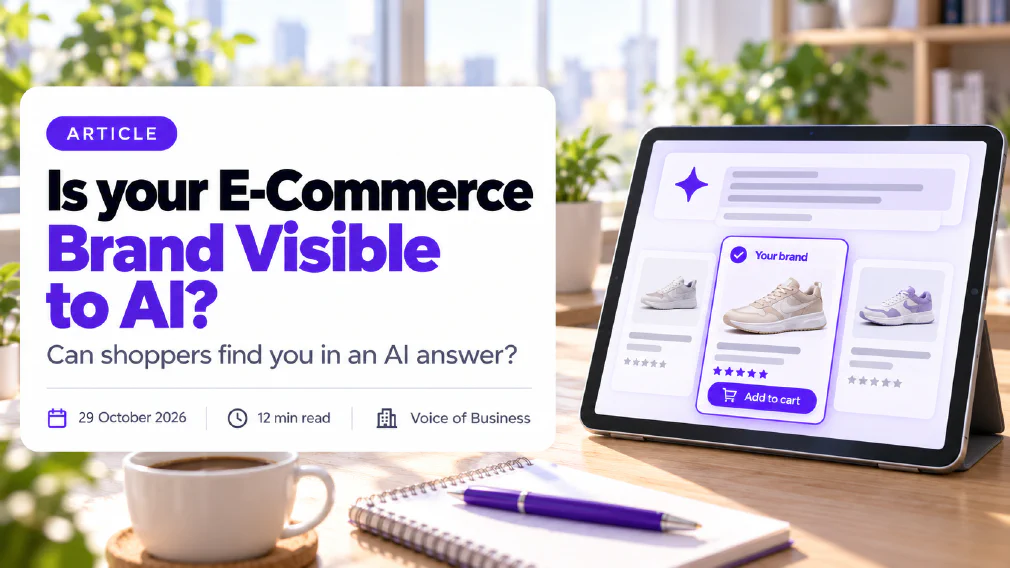
If your website is invisible to AI, you will struggle to be found by the shoppers who now start with a question and not a search box. That is no longer a forecast. On 15 October 2026 Google began rolling out Universal Cart in Search and the Gemini app, so a shopper can ask an AI what to buy, save the products it suggests, and move towards checkout without ever visiting a website to compare.
This article is about the part most ecommerce brands have not looked at yet: whether AI names you at all. It covers what has actually launched, why an AI answer works differently from a results page, how to run a quick test with three tools, and what to fix first if your brand does not appear.
Key takeaways
- Universal Cart launched in the US on 15 October 2026 across Google Search and the Gemini app. It is US-only for now, and Google has given no date for other regions.
- AI Mode has passed one billion monthly users, according to Google. A growing share of shopping questions now end in a written answer and not a list of links.
- A results page has ten blue links and a second page. An AI answer names a handful of options. Being outside that handful is the same as not being listed.
- Only about 12% of citations from ChatGPT, Gemini, Copilot and Perplexity came from pages in Google’s top 10 for the same prompt. Ranking well does not guarantee a mention.
- You can test your own position in ten minutes: ask three AI tools the question your customers would ask, and write down who comes up.
- Fix the basics first: complete product data, clear product pages, real reviews and mentions on other sites.
What is Google’s Universal Cart?
Universal Cart is a shopping cart that works across retailers instead of inside one shop. A shopper can save products from different stores into a single cart, follow price drops and restocks, and see offers that apply to the cards they use. It works in Google Search, including AI Mode, and in the Gemini app.
According to the launch report, it began rolling out on 15 October 2026, and the wording was “US-only for now”. The report says checkout is powered by the Universal Commerce Protocol, usually shortened to UCP. Google’s own guide for merchants describes UCP as an open standard that lets an AI conversation lead to a direct purchase on surfaces like AI Mode and the Gemini app, and it states that the merchant remains the merchant of record.
Two things are worth keeping straight, because early coverage blurs them.
It is not an AI that shops on its own. The shopper chooses, saves and pays. Google positions the cart as something that gives a shopper control and confidence, not as an AI agent that places orders unprompted. If you want the wider picture of software that acts for a user, our guide to agentic AI explains where this sits.
The launch details are still settling. Outlets disagree on how much of the purchase happens inside Google and how much is handed to the retailer’s own checkout. Read Google’s current merchant documentation before you plan any work around it.
The size of the audience is the other half of the story. Google says AI Overviews now reaches over 2.5 billion monthly active users, while AI Mode has surpassed one billion monthly users. The cart is arriving on top of an audience that is already asking questions and reading answers.
Why is there no page two in an AI Answer?
A results page gives a shopper ten links, a second page, and a third. Your product might be seventh and still get visited by someone who scrolls. The shopper does the comparing.
An AI answer moves the comparing to the assistant. The shopper asks “What are the best running shoes for flat feet?” and gets a short written recommendation that names a few products, with reasons. Most people read that and act on it. They do not open ten tabs.
That is our reading of how the format works, and it is worth being clear that it is a reading and not a measured law. The practical effect is still easy to see. In a list, a weak position costs you some clicks. In an answer, a weak position can cost you the whole sale, because you were never part of the comparison the shopper saw.
This is the same shift we describe in why ranking on Google isn’t enough anymore and in how AI Overviews are changing what counts as SEO. Shopping simply adds the checkout step, which makes the stakes concrete. An answer that used to end in a visit now has a route to a purchase attached.
It also means the old scoreboard is incomplete. Most brands track Google rankings, ad spend and conversion rate. None of those tell you what ChatGPT or Gemini says when a customer asks for the best product in your category. You can have healthy figures on all three and still be missing from the answer.
How do you check whether AI recommends your brand?
You do not need a tool for a first look. You need ten minutes and a notes sheet.
- Write five customer questions. Use the questions a buyer asks before choosing, not your product names. “What are the best running shoes?” “Which running shoes suit wide feet?” “What should I buy for a first marathon?” Include one that names your category and your type of customer.
- Ask each question in three tools. Use ChatGPT, Gemini and Perplexity. Use a fresh conversation for each question so earlier answers do not colour the next one.
- Record what comes back. For every answer, note which brands are named, in what order, and which pages are cited as sources. Note whether your brand appears and whether the description of it is accurate.
- Repeat the next day. Answers vary between runs. One reply tells you very little. Several replies show a pattern.
- Score yourself. Count how many of the fifteen answers named you. Do the same for your two closest competitors.
If your brand did not come up, that is the finding, and it is useful. It tells you where the gap is before the shopper does. If you came up but the description was wrong, an out-of-date range or a feature you do not have, that is a different problem: the assistant is working from stale or thin information, and the fix is on your own pages. An AI tool can also state something confidently and be wrong, so treat a surprising answer as something to check and not something to accept.
Keep the sheet. The first run is your baseline, and every later run shows whether your changes are doing anything.
Why would an AI Tool skip your products?
There is no single switch, and nobody outside the AI companies can see inside the ranking. What can be said is where the evidence points.
Ranking and citing are different things. In a study of 15,000 long-tail prompts, only about 12% of citations from ChatGPT, Gemini, Copilot and Perplexity came from pages that ranked in Google’s top 10 for the same prompt. Perplexity was closest to Google at 28.6%, and ChatGPT was around 8%. That is a long-tail study from 2025, so treat the exact figures as a snapshot. The direction is the point: a page can be cited without ranking first, and rank first without being cited.
Thin product pages give an assistant nothing to quote. A page with a name, a photograph and a one-line description cannot answer “Which of these suits wide feet?” A page that states who the product is for, what it is made of, how it fits and what it does not do can.
Your brand may be mentioned too rarely elsewhere. Assistants lean on what other sites say. A brand that is only described by itself is a weaker candidate than one that is reviewed, compared and mentioned across independent sources. This is the logic behind generative engine optimisation, and our SEO vs GEO review compares the two approaches side by side.
Your pages may not answer the connected questions. An assistant often splits one question into several related searches before it answers, a process called query fan-out. A page built around one product name is less likely to be pulled in than one that also covers sizing, care, comparisons and common problems.
Crawlers may be blocked. Some stores block AI crawlers in robots.txt by accident, or hide product detail behind scripts a crawler cannot read. If an assistant cannot read the page, it cannot recommend what is on it.
Your product data may be incomplete. Google says merchants can use their existing shopping feeds to reach shoppers during discovery. A feed with missing attributes, old stock status or mismatched titles gives every system a weaker picture of what you sell.
What should an ecommerce brand fix first?
Work in this order. Each step is cheap to start and builds on the one before.
1. Make product data complete and consistent. Titles, descriptions, sizes, materials, availability and delivery details should match across your product pages, your feed and your listings elsewhere. Inconsistency makes you harder to trust for people and for machines.
2. Rewrite your most important product pages so they answer first. Open with a direct statement of what the product is, who it is for and what makes it different. Put the specifics near the top, in plain sentences an assistant can lift. This is the same technique we cover in what actually gets content cited in AI-generated answers.
3. Add the questions customers really ask. A short, visible set of questions and answers on the product or category page, such as sizing, returns and compatibility, gives an assistant a self-contained passage to quote. The answers must be real, and they must be on the page.
4. Earn genuine reviews and mentions. Ask satisfied customers to review on the platforms your buyers use. Get your products into independent roundups and comparisons where it is honest to do so. A mention counts even without a link, because it is evidence that someone other than you chose the product. Strong E-E-A-T signals, such as named authors and clear sourcing, support the same goal.
5. Check that crawlers can read you. Look at your robots.txt on purpose, and make sure product detail is in the page itself and not only behind a script. Do not block the crawlers you want to see you.
6. Protect your branded searches. People who already know your name search for it directly, and those searches tend to hold up as generic queries get absorbed into answers. Keep your name, your site and your listings consistent, and read about branded search to see why it is worth watching separately.
7. Keep the basics of SEO in good order. Most of what AI tools cite is still found through ordinary search practice. There is no point polishing a page for an assistant if nobody can find the page.
None of this needs a rebuild. Most of it is an edit to pages and data you already have, and it compounds, because every improvement makes you a stronger candidate in both a results page and an answer.
Is this only a US problem?
For Universal Cart, yes, for now. Google described the launch as US-only and the sources we checked gave no date for the UK or the rest of Europe. We have not found a confirmed timetable, so we are not going to guess one.
That is a reason to prepare, and not a reason to wait. Shoppers in Europe already ask ChatGPT, Gemini and other assistants what to buy, and they read the answers. The cart adds a checkout route to a behaviour that already exists. A brand that does the groundwork now will be ready whichever way the rollout goes, and a brand that waits will be starting from zero when it arrives.
There is also a plain business argument. Everything on the list above improves your product pages and data for human shoppers too. You lose nothing by doing it early.
What mistakes should you avoid?
Judging yourself on rankings alone. A top position is still valuable, but it is not the same as being recommended.
Running one check and drawing a conclusion. Answers change between runs and between tools. Look for the pattern across several.
Writing for the assistant and forgetting the shopper. Pages stuffed with repeated keywords were never good writing, and they do not make an assistant more likely to name you. Write clearly for a person and the rest follows.
Inventing claims. A made-up statistic, an inflated review count or an unsupported “best in class” is a risk to your credibility, and an assistant may repeat it. Say only what you can prove.
Assuming the cart changes everything overnight. Universal Cart is new, regional and still changing. The lasting lesson is the habit it signals: shoppers asking an assistant first.
What should you do this week?
Pick your single best-selling category and run the five-question test in three tools. Write down who comes up, and whether you did. If you were missing, rewrite the page for your best-selling product so the first paragraph says what it is, who it is for and why it suits them. Then add a short, real set of customer questions to the page and check that a crawler can read it.
If you would rather have someone look at the whole picture, an AI audit covers what an assistant can see of your business and where the gaps are. Our piece on what an AI audit actually checks explains what that involves.
Sources
- Universal Cart launch report, 15 October 2026: Universal Cart is rolling out in the US across Search and the Gemini app, “US-only for now”, with checkout powered by the Universal Commerce Protocol.
- Google’s post for website owners, published 3 June 2026 and updated 31 August 2026: AI Overviews has over 2.5 billion monthly active users and AI Mode has surpassed one billion monthly users.
- Google’s Universal Commerce Protocol guide for merchants: UCP is an open standard for purchases that start in AI conversations, merchants can use existing shopping feeds, and the merchant remains the merchant of record.
- Study of AI search and Google overlap, August 2025: across 15,000 long-tail prompts, about 12% of citations from four AI assistants ranked in Google’s top 10 for the same prompt, ranging from 8% for ChatGPT to 28.6% for Perplexity.
FAQ
Questions we get asked
Can AI Tools really buy products for shoppers?
Not on their own. Google's Universal Cart lets a shopper save products from different retailers into one cart inside Search and the Gemini app, and checkout runs on an open standard called the Universal Commerce Protocol. The shopper stays in control of the purchase, and Google says the merchant remains the merchant of record.
Is Universal Cart available in the UK or Europe?
Not yet. At launch on 15 October 2026 Google described it as US-only for now and gave no date for other regions. People in Europe already ask ChatGPT, Gemini and other assistants what to buy, so the habit does not wait for the feature.
How do I check if ChatGPT recommends my products?
Write down the five questions a customer would ask before buying what you sell, then ask each one in ChatGPT, Gemini and Perplexity. Note which brands are named, in what order, and which pages are cited. Repeat it once a month and keep the results in one sheet.
Do I still need to rank on Google?
Yes, but ranking is not enough on its own. In a study of 15,000 long-tail prompts, only about 12% of citations from ChatGPT, Gemini, Copilot and Perplexity came from pages in Google's top 10 for the same prompt. A strong ranking is worth having, and it does not guarantee a mention.
Does a product feed matter for AI Search?
It matters for Google's shopping surfaces. Google says merchants can use their existing shopping feeds to reach shoppers during discovery, and the Universal Commerce Protocol builds on that. Complete, accurate product data is also what any assistant needs to describe your product correctly.
How often should I check what AI says about my brand?
Once a month is enough for most small brands, and again after any change to your range, your product pages or your reviews. Answers vary from one run to the next, so judge the pattern over several checks and not a single reply.
Do Reviews affect whether AI recommends my products?
They are likely to. An assistant that is asked for the best option looks for evidence that real customers chose it, and independent reviews and mentions are evidence it can quote. Treat genuine reviews on the platforms your customers use as part of your AI visibility work.
Is AI Visibility the same as SEO?
No, though they overlap. SEO is about where your page sits in a list of results. AI visibility is about whether an assistant names you inside the answer. Fix the SEO foundations first, then make your pages easy to quote.
Ready to Put This to Work?
Tell us where your team is with AI and we will tell you honestly what would make the biggest difference.