How to increase Business Visibility with SEO and GEO
A practical plan for getting your business found on Google and named in AI answers: what to fix first, what to add, and how to check that it is working.
Being found used to mean ranking on Google. Now a customer can ask an AI tool for a recommendation and get one written answer, with two or three businesses named in it. If yours is not one of them, you were never in the running.
This article is a plan for both. It covers what to fix first for ordinary search, what to add so AI tools can quote you, how to rewrite a real page, and how to check that any of it is working.
Key takeaways
- SEO gets you found in a list of results. GEO gets you named inside an answer. A business now needs both.
- Do the SEO foundations first. Most pages that AI tools cite also do well in conventional search.
- Ranking first no longer guarantees a citation. Only 12% of citations from ChatGPT, Gemini and Copilot came from top-10 pages in one large study.
- Adding statistics lifted AI visibility by 41% in a peer-reviewed study, and quotations lifted it by 28%. Keyword stuffing did nothing useful.
- A first paragraph that answers the question outright is cited 67% more often.
- Being mentioned on other credible sites matters more than backlinks for AI visibility.
- Track citations separately from rankings. They move independently.
What is the difference between SEO and GEO?
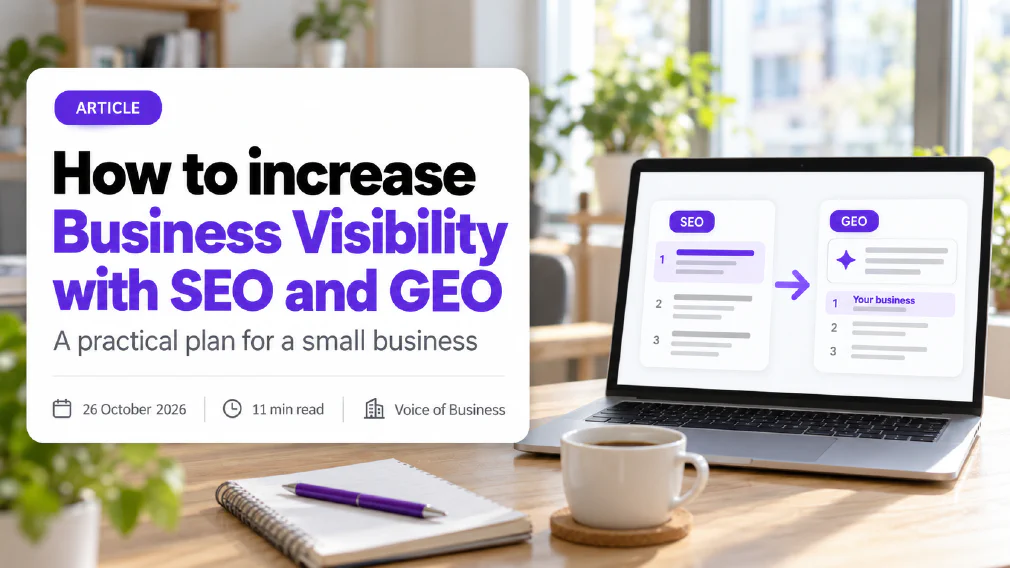
SEO is the work of making your pages easy for a search engine to find, understand and rank. The customer sees a list of links and chooses one.
GEO, short for generative engine optimisation, is the work of making your pages easy for an AI tool to quote. The customer sees a written answer, sometimes with a few sources underneath, and often never visits a website at all. A source that gets named in that answer has earned an AI citation.
The two overlap heavily. Clear structure, credible sourcing and real relevance to the question help in both. The difference is the target. SEO asks where your page sits on a results page. GEO asks whether an AI tool would choose your page as a source worth naming. If you want the two compared side by side, our SEO vs GEO review does that.
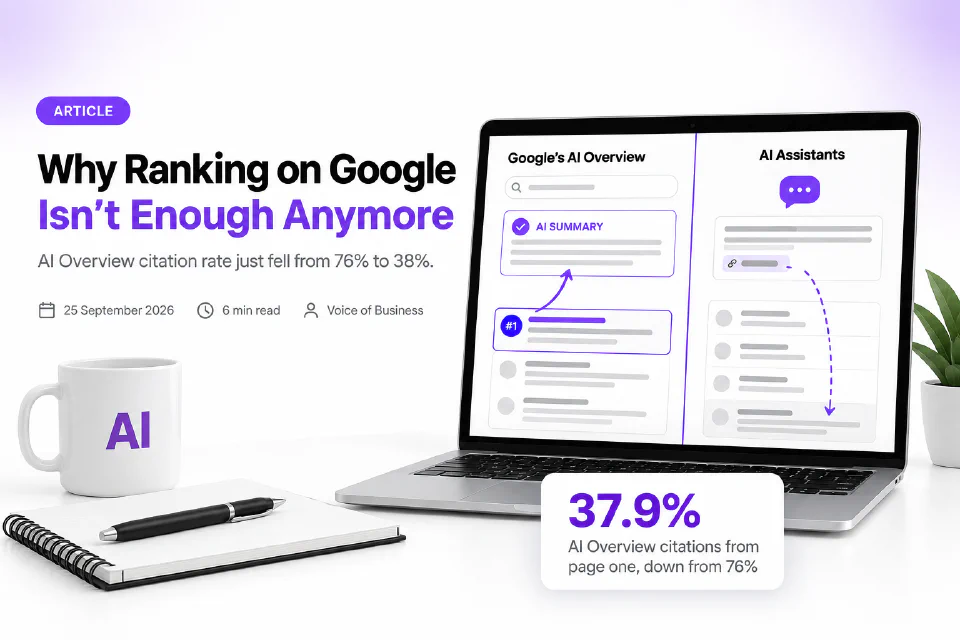
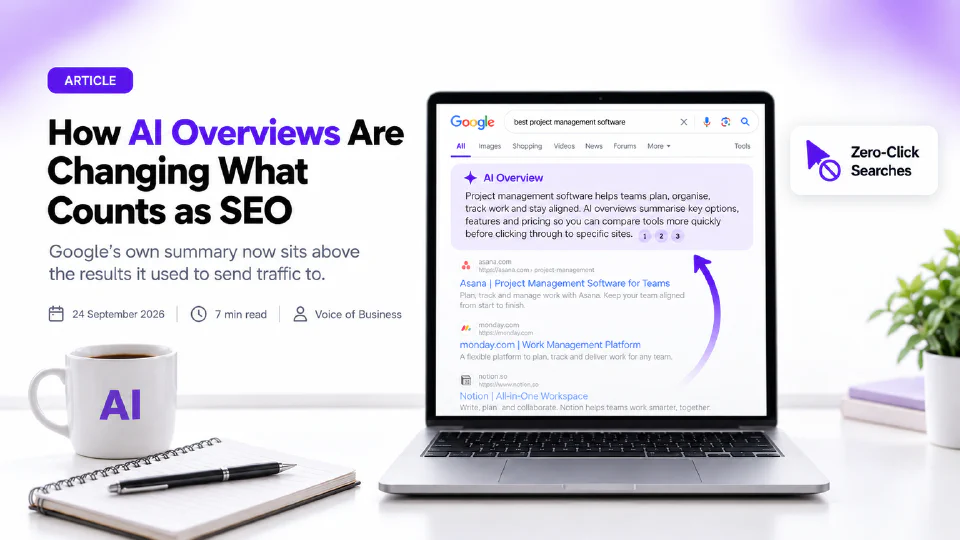
That second question matters more each year. Google’s own AI Overviews cited top-10 pages 76% of the time in July 2025. By March 2026 a much larger study put the figure at 37.9%. The standalone assistants, such as ChatGPT, Gemini and Perplexity, were never close to Google’s rankings in the first place. For a fuller account of why, read why ranking on Google isn’t enough anymore, and for the wider shift in search, how AI Overviews are changing what counts as SEO.
What should a Small Business fix first for SEO?
Start with the basics, because AI tools lean on the same sources that search engines already trust. There is no point polishing a page for AI if nobody can find the page.
Make every page answer one clear question. Each service or topic gets its own page, with a heading that matches how a customer would ask it. “How much does an AI audit cost?” beats “Our pricing philosophy”.
Use the words customers use. Write the way people search, and use those terms naturally. Repeating a phrase in every sentence does not help. In the peer-reviewed study behind most GEO advice, keyword stuffing produced negligible or negative effects.
Keep your business details consistent. Your name, address, services and contact details should match everywhere they appear: your site, your Google Business Profile, directories and social profiles. Inconsistency makes you harder to trust, for people and for machines.
Show who is behind the content. Name the author, say what they know, and link to where the facts come from. This is what E-E-A-T, short for experience, expertise, authoritativeness and trust, is shorthand for.
Check the technical basics. Pages should load quickly, work on a phone, and be readable by a crawler. Make sure your robots.txt does not block the AI crawlers you want to see you.
How do you get cited in AI Answers?
Once the foundations are in place, make your pages easier to quote. The evidence on what works is more consistent than most marketing advice.
Put the answer first. Pages that open with a direct answer were cited 67% more often in one study. A separate study found 55% of cited passages came from the first 30% of the page. An AI tool is extracting, not composing, so it reaches for whatever it can lift without rewriting.
Add specific numbers. In the peer-reviewed study, adding statistics improved AI visibility by 41%, the largest gain of the nine techniques tested. “Adoption is rising” is hard to cite. “Adoption rose by a named percentage, according to a named source” is easy.
Quote named sources. Direct quotations from named people or organisations lifted visibility by 28%. They are specific, attributable and easy to lift into an answer.
Cite your own sources. Citing external sources improved visibility by 115% for lower-ranked content. This is the finding that matters most for a smaller business, because it shows GEO does not simply reward whoever ranked first.
Use tables and short Q&A blocks. Pages with original data tables earned 4.1 times more AI citations than pages making the same claim in prose. A visible FAQ section, with real questions customers ask, was linked to a 28% rise in citation rate.
Cover the whole topic, not one phrase. AI tools often split a question into several related searches before answering, a process called query fan-out. A page that covers the connected questions gets pulled in more often than one built around a single phrase.
Do not just write more. Adding words alone produced no improvement. Data density and source credibility are what AI tools respond to. That is good news if you have limited time: most of these changes are additions to pages you already have.
The full study is covered in what actually gets content cited in AI-generated answers.
What does a rewritten page look like?
Take a made-up bookkeeping firm with a page that opens like this:
“At Example Books we pride ourselves on a bespoke, client-first approach to everything finance. For over a decade our passionate team has worked tirelessly to deliver solutions that make a difference.”
It sounds warm and says nothing an AI tool can lift. There is no service, no audience and no number. Now compare an answer-first version:
“Example Books provides fixed-price monthly bookkeeping for businesses with up to ten staff. The service covers invoicing, VAT returns and payroll, and starts from the price listed on our pricing page. Clients are matched with one named bookkeeper.”
The second version answers “what do you do, for whom, and roughly what does it cost” in three sentences. A person skimming gets it at once, and so does a model looking for a passage to quote. Beneath it you would add the supporting detail: a short table of what is included, a sourced figure for how much time clients save, and a visible FAQ with the five questions new clients actually ask.
The rewrite adds no extra words of fluff. It swaps vague claims for facts the business can stand behind. That is the whole technique, and it works on almost any service page.
Do brand mentions help your Visibility?
Yes, and probably more than backlinks do. One analysis measured brand mentions as correlating with AI visibility at 0.664, against 0.218 for backlinks. That is roughly three times stronger. A mention counts even when no link is attached.
For a small business this is a practical to-do list rather than a link-building campaign:
- Get listed accurately in the directories and industry bodies your customers use.
- Contribute a quote, a data point or a short guest piece to publications in your field.
- Encourage genuine customer reviews on the platforms that matter in your sector.
- Publish something original, such as survey results or a worked example, that others will want to reference.
None of this is quick. All of it compounds, because each mention gives an AI tool one more reason to treat your name as credible. It also helps your branded search, the searches for your business by name, which are the ones that tend to hold up best as AI answers take over generic queries. To see how your name currently comes across, read does your brand show up when people ask AI about you.
Does Local Search still matter?
Yes. Many customers still look for a business near them, and the same trust signals apply. A complete Google Business Profile, opening hours that are correct, a phone number that matches your website, and genuine reviews all make you easier to find and easier to believe.
Treat local listings as part of the foundation rather than a separate project. The rule is the same as everywhere else in this article: one set of facts, stated the same way in every place it appears. When your own site, your directory entries and your social profiles disagree, an AI tool has less reason to trust any of them.
What mistakes should you avoid?
Chasing a rank position and nothing else. A top ranking is still valuable, but it is no longer the whole job, and it does not guarantee you are cited.
Stuffing keywords. It was never good writing, and the research shows it does not help with AI tools either.
Publishing more instead of better. Length alone did not improve visibility. Ten thin pages do less than one page that answers the question properly.
Inventing or rounding statistics. A number only helps if it is real and attributable. A made-up figure is a risk to your credibility and to anyone who repeats it. AI tools can also state wrong things with confidence, so a wrong claim on your page can travel further than you expect.
Letting pages go stale. An out-of-date price or figure undermines the specific, checkable facts that make a page worth citing.
Blocking the crawlers you want. Some businesses block AI crawlers by accident. Check your robots.txt on purpose rather than discovering the problem later.
How do you know if it is working?
Rankings alone will not tell you. Google’s ranking, Google’s AI Overview and each standalone assistant are separate outcomes, and they move independently.
Three habits cover most of it.
Watch Search Console for the AI pattern. If impressions hold steady or climb while clicks on the same query drift down, your page may be answering the question on the results page itself. That is a different outcome from losing your ranking.
Split branded from non-branded searches. Track searches for your business by name separately from generic searches. Generic searches are most exposed to AI answers. Branded searches are the ones that tend to hold.
Check by hand, and track over time. Once a month, ask ChatGPT, Gemini, Copilot and Perplexity the five questions your best customers ask. Note whether you are named and which sources are. For tracking over time, Am I Cited, our partner tool, measures how often and how prominently a brand is cited in AI answers.
What should a Small Business do this week?
Pick one important page and do five things to it:
- Rewrite the first paragraph so it answers the question outright.
- Add at least two specific, sourced numbers.
- Add a short FAQ with real customer questions, visible on the page.
- Name the author and link to your sources.
- Check that your business details match everywhere they appear online.
Then repeat for the next page, starting with the ones that already perform reasonably well, since they are best placed to benefit first.
If you would rather know where to start, an audit looks at which pages are best placed to benefit and what to change on each. Read what an AI audit actually checks and how we audit, then get an audit.
Sources
- A large keyword study comparing how often ChatGPT, Gemini, Copilot, Perplexity and Google’s AI Overview cite pages ranking in the top 10: found only 12% of citations from three major assistants came from top-10 pages in 2025 data.
- A follow-up study of 863,000 keywords and 4 million AI Overview URLs: put the top-10 overlap for Google’s AI Overview at 37.9% by March 2026, down from 76% in July 2025.
- A step-by-step guide to optimising content for AI search engines: reported that answer-first openings are cited 67% more often, original data tables earn 4.1 times more citations, and FAQ schema is linked to a 28% rise in citation rate.
- A study of where Google AI Overviews cite from within a source page: found 55% of cited passages came from the first 30% of the page.
- An explainer of the Princeton generative engine optimisation study: set out the nine techniques tested, with statistics (41%), quotations (28%) and cited sources (115% for lower-ranked content) producing the largest gains and keyword stuffing none.
- A roundup of generative engine optimisation statistics: reported brand mentions correlating with AI visibility at 0.664 against 0.218 for backlinks.
FAQ
Questions we get asked
Is GEO replacing SEO?
No. Most pages that AI tools cite also perform well under long-established search practice, so GEO builds on SEO rather than replacing it. Fix the SEO foundations first, then add the specific changes that make a page easier for an AI tool to quote.
How do I get my Business to show up in ChatGPT and other AI Tools?
Publish pages that answer a question directly, back claims with specific numbers and named sources, and get your business mentioned on other sites. AI tools pull from pages they can quote cleanly, so clear answers near the top of the page matter more than length.
Do I need to rank on page one of Google to be cited by AI?
No. In one large study, only 12% of citations from ChatGPT, Gemini and Copilot came from pages ranking in the top 10 for the same search, and Google's own AI Overview fell to 38% by March 2026. A page can be cited without ranking first, although good rankings still help.
Does keyword stuffing still work?
No. A peer-reviewed study tested it directly and found negligible or negative effects on AI visibility. Statistics, quotations and cited sources produced real gains. Write for the person asking the question and use the words they would actually search for.
What is the quickest change to improve Visibility in AI Answers?
Rewrite the opening of your most important pages so the first paragraph answers the question outright. Pages that answer immediately were cited 67% more often in one study, and most cited passages came from the first third of the page.
Do backlinks still matter?
They still matter for SEO, but for AI visibility brand mentions look more important. One analysis found brand mentions correlated about three times more strongly with AI visibility than backlinks did. Being named on other credible sites is worth pursuing even when no link is attached.
Does adding an FAQ section to a page help?
It can. FAQ markup was linked to a 28% rise in citation rate in one study, because it gives an AI tool a self-contained question and answer to lift. The questions must be real ones your customers ask, and the answers must be visible on the page.
How do I track whether AI Tools mention my Business?
Check by hand for the handful of questions that matter most, and note which sources are named. For tracking over time, use a tool that measures how often your brand is cited in AI answers, separately from your Google ranking.
Does Local Search still matter if AI Tools Answer questions directly?
Yes. Customers still look for businesses near them, and a complete, consistent Google Business Profile and matching directory listings make you easier to find and to trust. Treat local listings as part of the foundation, not a separate project.
How often should I update my pages?
Review your most important pages at least a few times a year, and whenever a figure, price or service changes. Out-of-date numbers weaken the very thing that makes a page citable: specific, checkable facts with a named source.
Ready to Put This to Work?
Tell us where your team is with AI and we will tell you honestly what would make the biggest difference.