How to run a 30-day AI pilot in a Small Business
A 30-day AI pilot tests one task, with a named owner, a baseline and a decision rule set in advance. Week-by-week plan, scorecard and what to do on day 30.
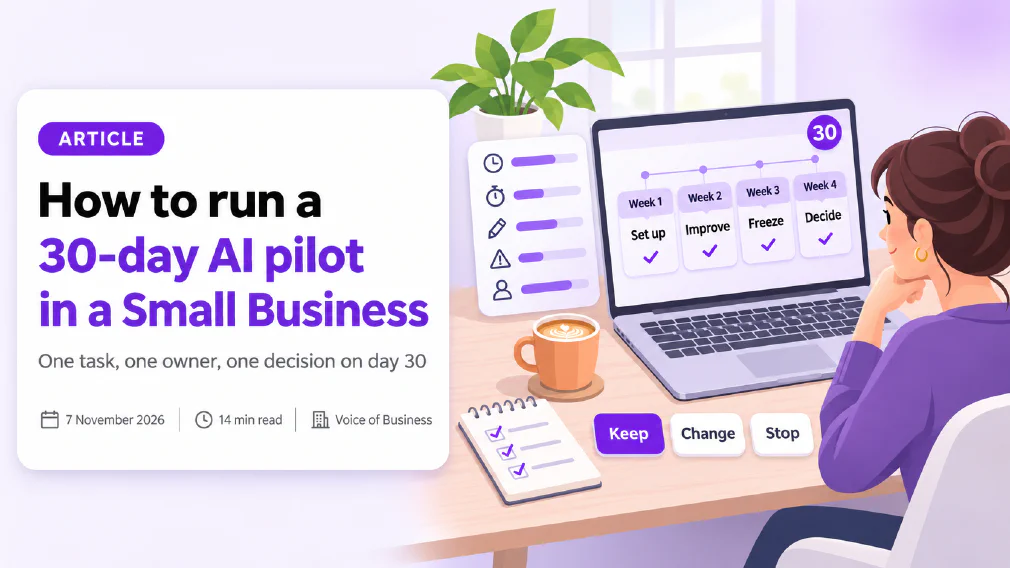
A 30-day AI pilot is a small, time-boxed test of one task, run by one person, with the success rules written down before it starts. It is not a rollout, a training programme or a bet on a particular tool. Its only job is to give you enough evidence, in one month, to say keep it, change it or stop.
Most Small Businesses skip this step. They buy a subscription, tell the team to “try it”, and three months later nobody can say whether it helped. This article sets out what to decide before day one, what each of the four weeks should contain, the five numbers worth recording, and how to make the call on day 30 without relying on how the month felt.
Key takeaways
- A pilot tests one task for about 30 days. It is not a company-wide launch.
- Before day one, write down five things: the task, the owner, the baseline time, the checking step and the stop rules.
- Spend the first two weeks adjusting the brief, then freeze it for the last two. A moving target cannot be measured.
- Bring in a second person in week three. If it only works for the person who built it, it has not been proved.
- Five numbers carry the decision: time before, time with AI including checking, corrections per ten outputs, serious errors, and whether people kept using it.
- Decide the keep, change or stop thresholds in advance. A decision made afterwards drifts towards what everyone already hoped.
What is a 30-day AI pilot?
A pilot is a deliberately small version of a bigger decision. If you are considering rolling out an AI assistant to a team of twelve, the pilot is one person using it on one repeated task for a month, with the results counted.
Four things make it a pilot and not just “trying it out”. It has a fixed end date. It has a single owner who is accountable for it. It is measured against a baseline that was recorded before the tool was switched on. And it ends with a decision that was agreed in advance.
Without those four, you have an experiment with no conclusion. The tool might be good, and the person using it might be pleased, but you cannot tell a good tool from a pleasant one, and you cannot defend the spending to anyone else.
Why run a pilot before you roll AI out?
Because the cheapest place to find out something is wrong is a month-long test with one person. The most expensive place is a rollout across a team.
Interest in AI is already widespread. Eurostat reports that 20.0% of EU enterprises with ten or more employees used AI technologies in 2025, up from 13.5% in 2024. That tells you what businesses are doing, not what is working, and the gap between the two is exactly what a pilot measures. Plenty of businesses in that 20% are using AI without being able to say what it saves.
A pilot also protects you from two common errors. The first is concluding too early that it works, because the first few outputs looked impressive. The second is concluding too early that it does not, because the first few needed fixing and nobody tried changing the brief. A month gives you enough repetitions to tell the difference.
There is a legal reason as well. Article 4 of the EU AI Act requires organisations that deploy AI to take measures to support the AI literacy of their staff, and the obligation has applied since 2 February 2025. The Commission’s own questions and answers say this does not mean testing employees or issuing certificates, and that organisations can keep an internal record of the training and guidance they provide. A structured pilot, with a log of what the tool got wrong and what the team learned, is a practical way to start that record.
There is also a useful model outside Europe. The NIST AI Risk Management Framework, which is voluntary, is built around four functions: govern, map, measure and manage. A 30-day pilot is a small-scale version of the same habit. You name who is accountable, define the task, measure it against a baseline, and then decide how to manage it.
How do you choose the task for a pilot?
Choose a task that happens at least a few times a week, that you can check in under a minute, and where a wrong first draft costs nothing outside the team. That is the same test set out in which AI tasks a small business should start with first, and it applies to a 30-day pilot just as it does to a two-week one.
Frequency matters more than people expect. A task that happens daily gives you twenty to thirty examples in a month, which is enough to see patterns. A task that happens once a month gives you one. If your best candidate is infrequent, pick a more frequent neighbour for the pilot.
Avoid anything where an unnoticed error reaches a customer, affects a person’s job or pay, or involves a statement about prices, law, finance or health. These are not banned for ever. They need more oversight than a first pilot should carry, and the difference between automating a task and automating a decision is worth reading before you get there.
Choosing the tool comes second. For a first pilot, a general-purpose assistant your team can already open in a browser is usually enough, and ChatGPT and Claude compared is a reasonable place to start if you have not chosen one. The task, the owner and the checking step decide the result far more than the product name.
What should you write down before day one?
Spend two or three hours before the pilot starts on a one-page plan. Without it, the month will be spent arguing about what you were trying to find out.
The task, in one sentence. For example: “Turn the notes from each client call into a follow-up email draft and a list of actions.” If the sentence needs the word “and” more than once, the task is too big.
The owner. One person is accountable for the setup, the log and the recommendation. Having a named owner is the difference between a pilot that ends with a decision and one that simply fades, which is the pattern behind what happens when nobody owns the AI.
The baseline. How long does the task take now, from start to finished, and how many times a week does it happen? Time it properly for a few days, or ask the person to estimate honestly and mark it as an estimate. Everything you measure later is compared against this number.
The checking step. Who reads the output, what do they compare it against, and what do they do when it is wrong? This is the heart of checking AI output before it reaches a customer, and in a pilot it has to be a step, not a good intention. Make sure that a person stays in the loop for every output.
The information rules. List what may and may not be typed into the tool. If you are unsure about customer details, read what is safe to paste before the pilot starts, and run it on internal material until you have an answer. Your data protection obligations do not pause for a trial.
The stop rules. Write down in advance what would make you end the pilot early. One serious error that reached a customer is an obvious example. So is the owner reporting that checking takes longer than doing the task by hand.
What does the 30 days look like week by week?
Each week has one job. Resist the temptation to do everything in week one.
Week one: set it up and run it alongside the old way
Write the brief, run the task, and do it by hand as well for the first few days so you can compare. A good brief gives the tool the context, the audience, an example of a good result and a list of things to leave out, which is what it means to brief it like a new hire. Log every output that needed a correction and what was wrong with it. Do not worry about speed yet. Week one is for learning what good looks like.
Week two: improve the brief
Use the log to fix the brief. If the same mistake appears three times, the instruction is missing. Change one thing at a time and note the date you changed it, so you can tell which change helped. By the end of week two the brief should be stable enough that you stop changing it.
Week three: freeze it and add a second person
Stop editing the brief. Give it to a colleague who did not help write it, and ask them to run the task with the same checking step. This is the most revealing week of the pilot. If the second person gets a similar time saving and a similar error rate, the result does not depend on one person’s skill with the tool. If they do not, you have found out before it cost you anything.
Week four: measure and decide
Keep running the frozen task for the first half of the week while the owner collects the five numbers. Spend the last two or three days on the review: add up the log, fill in the scorecard, ask the people involved what they would miss if you stopped, and make the call.
How do you measure whether an AI pilot worked?
Count five things and nothing more. A long dashboard hides the answer.
- Minutes per task before. Your baseline from before the pilot.
- Minutes per task with AI, all in. Include the time spent briefing, waiting, checking, fixing and re-running, not only the seconds the tool took. This is the number that tells you whether the tool is actually saving time, and it is often disappointing when it is counted honestly.
- Corrections per ten outputs. How many of ten outputs needed any change at all. A falling number across the month means the brief is working.
- Serious errors. The number of outputs that would have caused harm if nobody had checked them: a wrong figure, a made-up detail, a claim that is not true. AI produces fluent text whether or not it is right, so plausible but wrong output is the thing to watch for, and even one serious error is worth a note in the log.
- Voluntary use. Did the owner and the second person keep using it in the last week when nobody was asking them to? A tool that saves time on paper but is quietly abandoned has a problem the numbers do not show.
A simple example, with made-up figures to show the arithmetic. A call-notes task takes 25 minutes by hand. With AI, the owner spends 3 minutes briefing, 1 minute waiting, 6 minutes checking and 4 minutes fixing, so 14 minutes all in, a saving of 11 minutes a task. Across 40 tasks in the month that is about seven hours. Whether seven hours is worth the subscription, the setup time and the checking effort is now a sum you can do, instead of a feeling.
How do you decide whether to keep it, change it or stop?
Agree the thresholds on day zero, not day 30. Once the month is over, everybody wants the result to be a good one, and the thresholds quietly move.
Keep it if the all-in time is clearly lower than the baseline, serious errors were zero or rare and caught by the checking step, the second person got a similar result, and people kept using it. “Clearly lower” is yours to define. Many businesses use around a quarter off the baseline, but the right figure depends on how much setup effort it took and what the tool costs.
Change it if the saving is real but the corrections per ten outputs are still high, or the second person struggled. Change one variable, such as the brief, the checking step or the task boundary, and run a shorter second pilot of two weeks.
Stop it if checking ate the saving, there was a serious error the checking step missed, or nobody used it when they did not have to. Stopping is a legitimate and cheap result. The log and the baseline are not wasted, because they make the next task easier to choose.
Whichever you choose, write the decision and the reason on one page and give it to the person who signs off the spending.
What usually goes wrong in a pilot?
Five things account for most failed pilots.
The task is too big. “Use AI for customer service” is not a task. Cut it down until it fits in one sentence and one person’s week.
The baseline was never recorded. The month ends with a feeling that it helped and nothing to prove it.
The brief keeps changing. If you are still editing it in week four, you are comparing different versions of the experiment. Freeze it in week three.
Nobody owns it. The pilot is everyone’s idea and nobody’s job. By week two the log has stopped being kept. A named owner prevents that.
The checking is skipped when it gets busy. Checking is the cost that makes AI output safe to use, so when it is dropped, the numbers look better than the truth. If the owner reports that there is no time to check, treat that as a result in itself.
There is also the problem of the pilot nobody told anyone about. People find out, assume the worst and start using their own tools on the side, which is how shadow AI grows. Tell the team what is being tested and why, and put the basics in an AI use policy so that what the pilot is allowed to do is written down.
How much does a 30-day AI pilot cost?
For most Small Businesses the cost is mainly time, not licence fees. Expect two to three hours of planning, a few hours of setup in week one, the owner’s checking time throughout, an hour or so of the second person’s time in week three, and half a day on the final review. A single assistant subscription for one or two people for a month is usually a small figure next to those hours, but prices and plans change, so check the current pricing for whichever tool you choose.
Count your own time at what it is worth. It is easy to say a pilot “cost nothing” because no invoice arrived, and then conclude that a tool that takes fourteen hours to set up and check is free. The honest figure is what you will compare against the saving.
If the result is a keep, the running cost is the next question, and it is a different calculation from the pilot’s. The article on what an AI workflow costs to run covers what to budget once the tool is part of normal work.
What happens after day 30?
If you keep it, do three things in the first week. Write the final brief and the checking step into a short procedure so the task does not depend on the owner’s memory. Set a date, about thirty days on, to look again, because AI routines drift when nobody is watching them. And choose the next task, using the pilot’s log to see what you learned about how your team checks AI output.
When one task has run reliably, the natural next move is to connect it to the steps either side of it, which is how a single task grows into an AI workflow. Do that slowly. Research on what predicts whether an AI project reaches production points much less to the technology than to ownership, a defined scope and a checking routine, which is exactly what a good pilot builds.
If you would rather have the sorting and the scoping done alongside your own processes instead of from an article, a scoping conversation is where that starts, and an AI audit is the fuller version.
Sources
- Eurostat, “AI adoption among EU enterprises surges in 2025”: the EU statistics office reports that 20.0% of enterprises with ten or more employees used AI technologies in 2025, up from 13.5% in 2024.
- European Commission, “AI Act” regulatory framework page: the Commission’s overview of the EU AI Act, which states that the prohibited practices and AI literacy obligations entered into application on 2 February 2025.
- European Commission, “AI literacy: questions and answers”: the Commission’s guidance on Article 4, which says the article does not oblige employers to measure staff knowledge of AI, that no certificate is needed, and that organisations can keep an internal record of training and guidance.
- NIST, “AI Risk Management Framework”: the US standards body’s voluntary framework for managing the risks AI poses to people, organisations and society, released on 26 January 2023 and organised around Govern, Map, Measure and Manage.
FAQ
Questions we get asked
How long should an AI pilot run?
Thirty days is a good default for a Small Business. It covers four full working weeks, which is enough to see a repeating task many times, to change your approach once or twice, and to run the final stretch without touching anything. A task that only happens monthly needs a longer pilot, because you need at least fifteen to twenty examples to judge it. If you cannot get that many in thirty days, pick a more frequent task instead of stretching the calendar.
Who should run an AI pilot in a Small Business?
One named person who does the task today and will still be doing it afterwards. They set it up, check the output, keep the log and make the recommendation on day 30. A manager sponsors the pilot by agreeing the time and the stop rules, but the person closest to the work runs it. A pilot run by someone who never does the task tends to measure enthusiasm, not usefulness.
How many people should take part?
One owner for the first fortnight, then a second person from week three. The second person matters because a result that only works for the person who built the brief proves very little. If it works for a colleague who had no part in setting it up, you have evidence that it will survive a rollout. More than three people in a first pilot makes the log hard to keep consistent.
What should we measure in an AI pilot?
Five numbers are enough: minutes per task before AI, minutes per task with AI including briefing, checking and fixing, how many outputs out of ten needed a correction, how many errors were serious enough to cause harm if nobody had caught them, and whether the person kept using it when nobody was asking. Write the first number down before the pilot starts, because you cannot reconstruct it afterwards.
Is it Safe to put customer details into a pilot?
Only if you have decided where that information goes before you start. Check what the tool does with what is typed into it, whether your plan keeps it out of model training, and whether your own privacy notice covers the use. If you have not answered those questions, run the pilot on internal material or on made-up examples. A pilot is meant to teach you something cheaply, not to create a data protection problem.
Can we use a Free plan for a pilot?
Often yes for the learning, but check the terms before any business information goes in. Free plans can differ from paid business plans in how data is handled, in usage limits and in which features are available. If the pilot depends on a feature that only exists on a paid plan, test on the paid plan for the month. The cost of one month is small next to the cost of drawing a wrong conclusion.
What if the pilot fails?
Then it has worked as a pilot. Failing means you found out in thirty days, with one task and one person's time, that the checking cost ate the saving or the output was not reliable enough. Write down why, keep the baseline and the log, and use them to pick a better task. The expensive failure is the one that is discovered after the tool has been rolled out to everyone.
Do we need to tell staff about a pilot?
Yes. Tell the people whose work the pilot touches what is being tested, what it is for and what happens on day 30. A pilot nobody knows about is how shadow AI starts, and staff who find out later tend to assume the tool is there to replace them. Telling them also gives you more honest feedback, because people will tell you where the tool got it wrong if they know you want to hear it.
Ready to Put This to Work?
Tell us where your team is with AI and we will tell you honestly what would make the biggest difference.