AI Voice Agents for Small Business
What an AI voice agent can do for a small business: answering calls, booking, handing over, what it costs to think about, and the EU rules on telling callers.
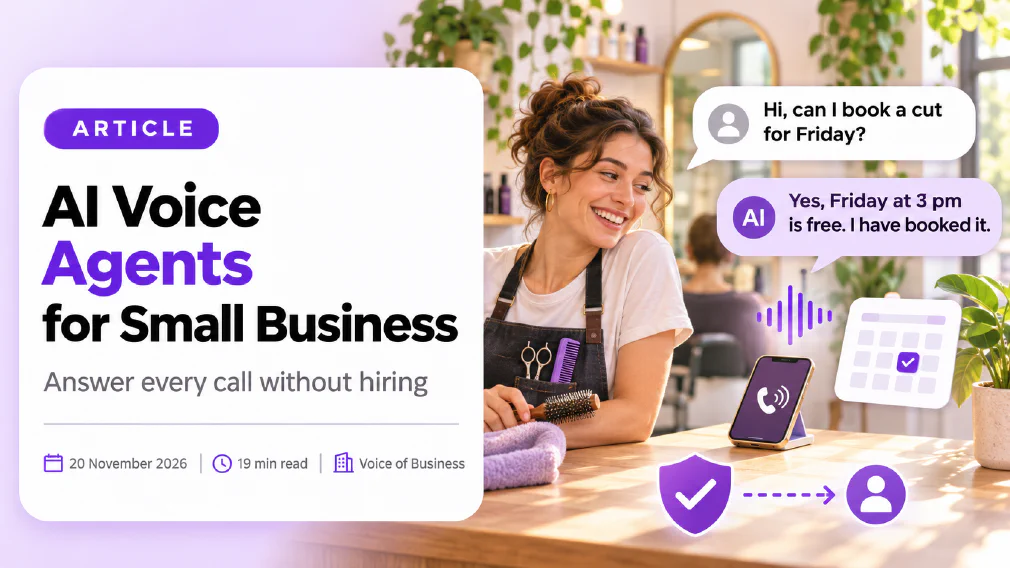
An AI voice agent is software that answers the phone, understands what the caller says, replies in a spoken voice and does something useful with the call, such as booking an appointment or taking a message. For a small business it solves a simple problem: the phone rings when nobody can pick it up, and the caller does not leave a message.
This guide explains what an AI voice agent is, how it works, what it can and cannot do, whether it can replace a receptionist, how the main tools differ, what it costs to think about, how the EU rules apply, and how to set one up without upsetting your callers.
Key takeaways
- An AI voice agent suits calls where the answer is already written down: opening hours, prices as published, directions, booking a slot, taking a message.
- It does not replace a person. It covers the calls you would otherwise miss and removes routine questions, so staff can give time to the callers who need judgement.
- The voice is the least important part. What decides whether it works is the quality of your written answers and the rules for handing a call to a person.
- Tell callers at the start of the call that they are speaking to an AI. The EU AI Act points that way, and so does ordinary good practice.
- Treat recordings and transcripts as personal data under the GDPR. Keep card numbers and other sensitive details out of the call.
- Run a short pilot on one phone line, read the transcripts every week, and widen only when the results hold up.
What is an AI Voice Agent?
An AI voice agent is a system that holds a spoken conversation over the telephone. The caller dials your usual number, the system picks up, and the caller says in ordinary language why they are calling. Unlike the old phone menus that say “press one for sales”, the caller does not have to fit their question into a list of options. The agent works out what they want and responds.
The technology behind it is the same family as the tools you may already use for writing. A large language model decides what to say, and two further components turn speech into text and text back into speech. That is why a voice agent is closely related to a text chatbot, with one important difference: a phone call happens in real time, the caller cannot reread anything and mistakes are heard immediately.
You will see several names for the same thing: AI receptionist, AI phone answering service, AI call handler, voice bot. Some products are narrow and only take messages. Others connect to your calendar and your customer records and can act on a call. If you want the wider background on software that takes actions rather than only answering, our guide on what an AI agent actually is explains how a chatbot differs from an agent.
How do AI Voice Agents work?
A voice agent runs a loop that repeats many times during a call. The caller speaks, the system turns the speech into text, a language model decides what to say or do, and a voice reads the reply back. One vendor describes this loop as taking a couple of seconds, and it names delay as the main limit: long pauses make a conversation feel unnatural and can lead callers to hang up.
There are two common ways to build it. The developer documentation of one major AI provider describes them like this. In a chained design, the system runs three separate stages, speech to text, the agent’s own logic, then text to speech. This suits businesses that want to see the intermediate text, store transcripts, run checks before the agent replies or swap one component for another. In a speech-to-speech design, a single model listens and answers directly in audio, which can feel more fluid. You do not need to choose between them as a small business buyer, but the difference explains why some products can show you a transcript of every call and rules you can inspect, while others are harder to check.
Around that loop sit the parts that make it useful for a business:
- A phone connection. The agent answers your existing number or a number you forward to it.
- Your content. Opening hours, services, policies and answers to common questions, usually gathered from your website and documents. This is a form of retrieval-augmented generation, where the answer is drawn from approved material instead of from the model’s general knowledge.
- Connections to your tools. A calendar for bookings, a customer record system for logging calls, a way to send a text or an email.
- Rules. What the agent may say, what it must never say and when it hands the call to a person.
What can an AI Voice Agent do for a Small Business?
An AI voice agent can answer, book, collect and route. Vendor pages for these tools describe the same short list of jobs, and they are the ones worth planning around.
Answer common questions. Opening hours, location, parking, services offered, delivery areas and prices that you publish. The agent answers from the content you have given it and, if it is set up well, says so when a question falls outside it.
Book and change appointments. The agent checks availability in your calendar, books a slot, and can move or cancel one. For a clinic, a salon, a trades business or a small practice, this is often the largest saving, because booking calls are repetitive and arrive at awkward times.
Take messages and capture leads. When nobody is available, the agent records the reason for the call and the best way to reach the caller, then sends you a summary by text or email. You start the next morning with a list, not with a voicemail you have to listen to.
Route calls. It can pass a caller to the right person, or to a different line, based on what they say. This is the old phone menu without the menu.
Make outbound calls. Some tools also call out, for example to confirm an appointment or chase a missed one. Outbound calls bring extra rules about contacting people, so treat them as a later step and not as a first project.
A useful test is the one we use for other first AI tasks: could a new colleague answer this call correctly on day one from a single page of notes? If so, a voice agent probably can too. If the call depends on a judgement, an exception or an apology, it needs a person.
Safe for the voice agent
Opening hours, location and the services you offer
Booking, moving and cancelling appointments
Taking a message and sending you a summary
Send to a person
Complaints, refund disputes and exceptions
Anyone distressed, vulnerable or in an emergency
Legal threats, safety concerns and payments
Can an AI Voice Agent replace a receptionist?
It can replace some of the work, not the role. In many small businesses the person answering the phone is also doing something else: serving a customer, working on a job or driving to a site. The agent takes the calls that would otherwise go unanswered, and the saving is real when call volume is steady and the questions repeat.
What it cannot take over is the part customers remember. A caller who is angry about a missed delivery, anxious about a health matter or negotiating a large order wants someone who can listen, take ownership and make a decision. A voice agent can collect the details and promise a call back. It should not be the one that promises the outcome.
A better question than “can it replace a receptionist” is “which layer of our calls should it own”. For most small businesses there are three:
- Agent first. Routine calls with stable answers, handled at any hour, including evenings and weekends.
- Person with the agent’s notes. Anything the agent cannot finish arrives with a transcript and a summary, so the person starts halfway through.
- Person only. Complaints, exceptions and sensitive calls, routed straight to a named owner.
This is the principle of keeping a human in the loop. The agent does the routine work, and a named person stays accountable for what callers are told and for every decision that affects them. The same approach applies to AI customer support in writing, and the two work well together if you use both.
What are the Best AI Voice Agent Tools for a Small Business?
The best tool is the one that fits your phone system, your calendar and the way your callers speak. Product names, plans and limits change often, so confirm details on each vendor’s own pages before you decide. What follows reflects what three types of vendor say about their products.
A developer platform built for voice. One vendor aimed at small businesses says its agent answers every call to the business line, takes new enquiries, books into your calendar, and passes anything it cannot handle to a person along with the transcript. According to the page, you set the escalation rules, including which questions always go to a human, and an owner can listen to calls live and take them over. It lists connections to common calendar, customer record and accounting tools, and charges by usage. This type suits a business with someone who is comfortable configuring a tool, or that is willing to pay for set-up.
A voice platform from a speech specialist. Another vendor describes an AI receptionist that routes calls, books, cancels and reschedules appointments, answers questions from a knowledge base built from your content or website and captures lead details. It says leading systems handle dozens of languages, and that integrations cover customer records, calendars, phone systems and helpdesk software. This type suits a business that cares about how natural the voice sounds.
An enterprise call platform. A third vendor describes a platform for contact centres and multi-location brands, with a visual builder for call flows, a library of phone system connections, hosting in the EU or the US chosen at set-up, and an option to delete recordings and transcripts automatically after a set period. It is sold on annual agreements scoped to call volume. For a very small business this is usually more than you need, but the data controls it lists are the kind to ask any vendor about.
You do not have to start with a dedicated product. Your phone provider may already offer an AI answering feature, and your calendar or booking software may offer one too. Check what you already pay for before you add another subscription. When you compare tools, put the same questions to each vendor:
- Can the agent be restricted to my own content, and will it say when it does not know?
- How do I set rules that send certain callers straight to a person, and can the agent transfer the call live?
- Does the person receive the transcript and a summary when the call is handed over?
- Where are recordings and transcripts stored, for how long, and are they used to train models?
- Can I listen to calls, read transcripts and correct what the agent has said?
- Will it work with my current phone number and my calendar?
- What happens to my data and my set-up if I leave?
Our guide to choosing an AI vendor goes through these questions in more detail.
How much does an AI Voice Agent cost?
Cost is more than the subscription. Prices and plan limits change often, so check each vendor’s current page; this guide does not quote figures for that reason. What stays stable is how vendors charge.
Vendors tend to bill in one or more of these ways: by the minute of conversation, by a monthly plan with a set number of minutes, by the number of calls or bookings handled, or by an annual agreement scoped to your volume. Each behaves differently as you grow. A per-minute price looks cheap at low volume and rises with a successful launch, while a flat plan is predictable but may include minutes you never use. Check whether time spent on hold or in transfer counts as minutes.
The full cost also includes:
- The time to write and maintain accurate answers.
- The time to read transcripts and correct mistakes each week.
- Connecting the agent to your calendar, phone system and customer records.
- Any set-up work from the vendor or a consultant.
- The cost of a wrong answer, such as a missed booking, a lost customer or a complaint.
To judge whether it pays, compare the total with what missed and routine calls cost you today, measured over a month. Count the calls that went to voicemail and were never returned, and the hours spent on questions with the same answer every time. Our guides on what an AI workflow costs to run and on whether the tool is actually saving time show how to measure it without guesswork.
Is an AI Voice Agent legal in the EU?
Yes, it is legal to use one, provided you follow the rules that already apply to phone calls and personal data. Two sets of rules matter most: data protection law and the AI Act.
Data protection. A caller’s voice, name, phone number and what they say are personal data, so a voice agent is a system that processes personal data. The GDPR applies in full. In practice that means a lawful basis for handling the call, a short notice to the caller at the start, a sensible retention period for recordings and transcripts, a data processing agreement with the vendor, and a way to answer a request to see or delete a recording. Check where the vendor stores recordings and whether it uses calls to train its models. Some vendors let you choose where your data is hosted and set automatic deletion, and those controls are worth asking for.
The European Data Protection Board has also published guidelines on virtual voice assistants. They were written mainly for consumer products such as smart speakers, so they are not a rulebook for a business phone line, but they cover the same ground of transparency, legal basis and privacy by design, and they are a useful reference when you set yours up.
Recording and consent. Rules on recording calls differ between countries and depend on the purpose. If you record, tell the caller and tell them why. The same questions arise with AI meeting notes, and our guide on that topic is a good companion. If your business is in a regulated field, such as health, legal or financial services, check with your adviser before you record anything.
The AI Act. Article 50 sets a transparency duty, covered in the next section. Most voice agents used for answering calls are not high-risk systems, but that depends on what they decide. Our guide to what the EU AI Act requires of a small business explains which duties reach you and when.
For a plain-language rule of thumb on what information should and should not enter an AI tool at all, see our guide on what is safe to paste. The same thinking applies to what a caller says, with one difference: you cannot stop a caller reading out their card number, so decide in advance what the agent does when they try.
Do you have to tell callers it is an AI?
You should, and from 2 August 2026 the EU AI Act points firmly that way. Article 50 says that providers must ensure AI systems intended to interact directly with natural persons are designed so that the people concerned are informed they are interacting with an AI system, unless that is obvious from the point of view of a reasonably well-informed, observant and circumspect person. A voice that sounds like a person is exactly the case where it is not obvious.
The duty is placed mainly on the provider of the system, not on you, but you decide what your callers hear. The simplest approach is the one that also protects your reputation: say it in the greeting. Something like “Hello, this is the AI assistant for [business name]. I can answer questions and book appointments, or pass you to a colleague” does the job. Offer a route to a person in the same breath. A caller who later finds out they were speaking to a machine is likely to feel misled, whatever the law says.
The same article also deals with synthetic audio. It says outputs of systems that generate synthetic audio should be marked in a machine-readable way, which is mainly a duty for the vendor. If you ever cloned a real person’s voice for your agent, get that person’s clear agreement in writing, and take legal advice first. Details and timing of the rules are still being refined, so read the current position and check with your adviser if you operate in a regulated sector.
How do you set up an AI Voice Agent?
Set it up in small steps, on one phone line, with a named owner. A realistic plan for a small team takes about two weeks.
Days 1 to 2
List your ten most common calls
Days 3 to 4
Write the approved answers
Days 5 to 6
Set the rules for handing over
Days 7 to 9
Test with real and awkward calls
Days 10 to 11
Switch on for one line, labelled as AI
Week 3
Read transcripts, fix, then widen
List your ten most common calls. Go through the last month of missed calls, voicemails and messages, and write down what people ask. Count them. This list decides the scope of the pilot and, later, how you measure it.
Write the approved answers. The quality of the agent is the quality of the material behind it. An out-of-date price or a wrong opening time will be repeated with confidence to every caller. Keep the answers short, because long answers are hard to listen to on a phone.
Set the rules for handing over. Write a short list of triggers: the caller asks for a person, mentions a complaint or a refund, repeats a question twice, sounds upset, or raises anything on your never list. Planning for the calls that do not fit is called exception handling, and these guardrails matter more than the choice of voice. Decide where the call goes, who picks up and what happens outside opening hours.
Test with real and awkward calls. Call it yourself, and ask colleagues and friends to call. Try a vague request, a strong accent, a noisy room, a caller who changes their mind halfway, a question the notes do not cover and a caller who asks for a person. Brief it in the way our guide on briefing it like a new hire describes: who it is speaking to, which facts to use and what to do when unsure.
Switch on for one line, labelled as AI. Start with the line that gets the most missed calls, or with after-hours only. Say clearly in the greeting that it is an AI assistant, and make the route to a person obvious.
Read transcripts and widen slowly. Every week, read a sample of transcripts and listen to a few calls, including the ones that were handed over. Correct the source material when you find a wrong or weak answer. Add the next topic only when the first one behaves well. A 30-day pilot with a clear measure at the end is a good way to make that decision on evidence.
Agree who owns it. Prices, opening hours and policies change, and the agent keeps repeating the old ones until someone updates it. When nobody owns the tool, quality falls quietly.
What can go wrong with AI Voice Agents?
The main risks are wrong answers, wrong promises, poor handling of difficult callers and data that ends up where it should not. Each has a practical control.
Made-up answers. A language model can state something false in a confident voice. This is a hallucination, and no setting removes it entirely. Restrict the agent to your approved content, tell it to say “I do not know” and hand over, and test it with questions it should not be able to answer.
Promises you cannot keep. An agent that says “we will refund you” or “someone will be with you in ten minutes” has made a statement your caller will rely on. Write rules that stop it making commitments about money, dates or outcomes, and let a person confirm those.
Mishearing. Speech recognition makes mistakes with names, addresses, phone numbers and unusual words. Have the agent read back anything important, such as a booking time or a number, and confirm it with the caller.
Callers who feel trapped. Few things annoy a caller more than a machine that will not let them speak to a person. Make the route to a person easy and treat repeated requests for one as an automatic trigger.
Sensitive details. Callers will read out card numbers, health details and passwords. Decide what the agent does when they do: stop them, move the payment to a link, and avoid keeping the recording. Our guide to automating a task is not the same as automating a decision explains why anything involving money or a significant outcome should stay with a person.
Unchecked quality. The routine for checking what goes out is the same whether a person or a machine said it. Our guide to checking AI output before it reaches a customer sets it out step by step.
What to do this week
You do not need a project to begin. Today, count your missed calls over the last month and write down the ten questions callers ask most. Tomorrow, decide who owns the answers and which calls must always go to a person. By Friday, check whether your phone provider or your booking software already offers an AI answering feature, and ask each vendor you are considering the seven questions above.
If that looks worthwhile, start with the first AI tasks that carry least risk: after-hours calls and message taking. Draft your AI use policy so that your team knows what the agent may and may not do. If you want an outside view of which tools your business already uses and where customer data goes, an AI audit maps it in a structured way.
Sources
- Artificial Intelligence Act, Article 50: transparency duties for AI systems that interact with people, including the duty to inform them they are dealing with an AI system unless this is obvious, and the marking of synthetic audio. The page states that it applies from 2 August 2026.
- Regulation (EU) 2016/679, the General Data Protection Regulation: the rules on personal data that apply to recordings and transcripts of calls.
- European Data Protection Board, Guidelines 02/2021 on virtual voice assistants: final guidelines dated 7 July 2021 on virtual voice assistants, covering basic principles, legal basis and privacy by design.
- OpenAI, Voice agents guide: the developer description of speech-to-speech and chained designs for voice agents, and when each suits.
- ElevenLabs, AI virtual receptionist: the vendor’s description of the call loop, the tasks a receptionist agent handles, its integrations, language support and the effect of delay.
- Retell AI, small business virtual receptionist: the vendor’s description of call answering, booking, escalation rules, live listening, transfer with transcript and usage-based pricing.
- Synthflow, AI voice agents: the vendor’s description of phone system connections, hosting in the EU or the US, a data processing agreement and automatic deletion of recordings.
FAQ
Questions we get asked
Is an AI Voice Agent the same as an AI receptionist?
In practice, yes. An AI receptionist is a voice agent set up for one job: answering the business line, handling the routine questions, taking messages, booking appointments and passing the call to a person when it cannot go further. Voice agent is the wider term, because the same technology can also make outbound calls, such as appointment reminders. For a small business the two names describe the same product bought for the same reason.
How much does an AI Voice Agent cost for a Small Business?
Prices change often, so check each vendor's current page, but the charging models are stable. Some bill by the minute of conversation, some by a monthly plan with a set number of minutes, and some by an annual agreement scoped to your call volume. Add the cost of the time you spend writing the answers, testing the agent and reviewing calls each week, because that work is usually larger than the subscription.
Can callers tell they are talking to an AI?
Often they can, and some tools sound very natural while others pause or talk over the caller. Delays of even a second or two make a call feel strange, and long gaps can lead people to hang up. Do not rely on callers failing to notice. Tell them at the start of the call, because that is both the honest approach and the direction the EU AI Act points in.
Do I have to tell callers it is an AI?
You should always do so. Article 50 of the EU AI Act requires AI systems that interact directly with people to be designed so that the person is told they are dealing with an AI system, unless that is obvious to a reasonably well-informed, observant person. The article is stated to apply from 2 August 2026. The duty falls mainly on the provider of the tool, but you control the greeting your callers hear, so say it in the first sentence.
Is it legal to record calls handled by an AI Voice Agent?
It can be, but the rules depend on your country and on how you use the recording. A voice recording and its transcript are personal data under the GDPR, so you need a lawful basis, a clear notice to the caller at the start of the call, a limit on how long you keep it and a data processing agreement with the vendor. Some countries add their own rules on recording calls. Check the position with your legal adviser before you switch recording on.
Can an AI Voice Agent take card payments over the phone?
It is safer not to let it. Card numbers spoken aloud end up in recordings and transcripts, which then become something you must protect. A better pattern is for the agent to send the caller a payment link by text message or email, so the card details never pass through the call. Ask any vendor how it handles payment details before you rely on it for anything involving money.
What happens when an AI Voice Agent cannot Answer?
That depends on how you set it up, which is why the rules for handing over matter more than the voice. A well-configured agent transfers the call to a named person with the conversation so far, or takes a message and texts it to you with a transcript, so the caller does not have to repeat themselves. A badly configured one guesses or loops. Test the hand-over route first, before you test anything else.
Does an AI Voice Agent work in other languages?
Many of them do, and vendors describe support for dozens of languages, but what they say about the platform is not the same as how it performs on your callers. Accents, local place names, product names and background noise all affect accuracy. Make test calls in each language you need, with the kind of speech your callers actually use, and read the transcripts before you rely on it.
How long does it take to set up an AI Voice Agent?
A basic receptionist that answers from your website and books into your calendar can be running on a test number within a few days. The slower part is the preparation: writing accurate answers, deciding what goes to a person and testing awkward calls. Plan for a two-week pilot on one phone line, with a named person reading the call transcripts, before you route all your calls through it.
Which calls should never go to an AI Voice Agent?
Complaints, anything involving safety or a vulnerable caller, legal threats, disputes about money, and any call where a wrong answer causes real harm. Set rules so these go straight to a person, and so that a caller who asks for a person at any point gets one. The agent should take routine calls off your day, not make the decisions that need judgement.
Ready to Put This to Work?
Tell us where your team is with AI and we will tell you honestly what would make the biggest difference.