Perplexity Pro Review
Is Perplexity Pro worth it for a business? What it adds over Free, how accurate its cited answers are, what happens to your data, and who should pay.
Perplexity Pro is the paid version of an answer engine that searches the web for you and replies with a written answer and numbered source links. Plenty of small businesses use it to research suppliers, competitors and rules, and it has become a standard second tool next to ChatGPT or Claude. This review covers what Pro adds, how far you can trust its answers, what happens to the data you type into it, and who should pay.
The short version: Perplexity Pro is a good research tool with a real accuracy problem and thin data protections on its individual plans. It is worth paying for if you use it for fact-finding every week and check what it tells you. It is not a replacement for a writing assistant.
This review draws on Perplexity’s own documentation and privacy notice, an independent study of AI search tools and press coverage of the lawsuits against the company. We have not run our own benchmark, and where a figure comes from Perplexity or a third-party summary, the text says so.
Key takeaways
- Perplexity Pro is built for finding and citing information on the web, not for drafting long documents or running a business process.
- Pro adds about ten times as many citations per answer, extended Pro Search and Research, higher upload limits and a choice of models, according to Perplexity’s documentation.
- A 2025 Columbia Journalism Review study found Perplexity answered 37% of its news-citation queries incorrectly, and that premium versions of AI search tools showed higher error rates as well as more correct answers.
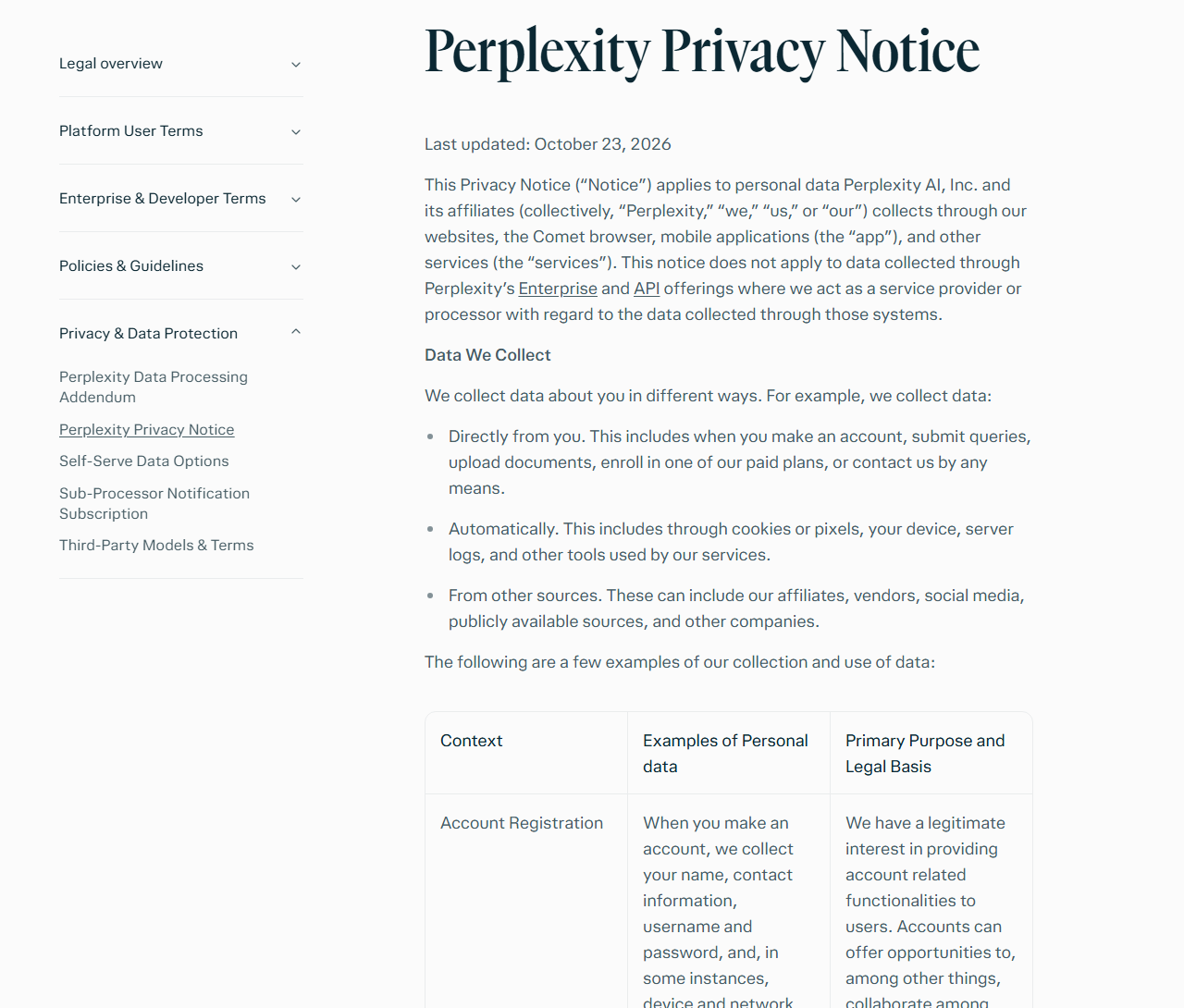
- The privacy notice lists improving Perplexity’s AI models as a use of your data and describes no training opt-out, and its self-service page offers export and deletion only, so keep confidential and personal data out of individual accounts.
- Exact usage limits are not published on the main pages and have changed several times in 2026, so verify them before you pay.
- It earns its place if research is a weekly task. If it is not, the Free plan or the search in your existing assistant is enough.
What is Perplexity Pro?
Perplexity describes itself as an answer engine. You type a question, it searches the web, reads the pages it finds and writes a short answer with numbered links to the sources. Under the surface it uses a large language model to write the answer, and a search step to fetch the pages first. That combination is often called retrieval-augmented generation, and its aim is to keep the answer grounded in real pages instead of the model’s memory.
Pro is the paid tier. It sits between the Free plan and Perplexity’s much more expensive Max plan, and Enterprise plans cover teams. The company has changed what each plan contains several times during 2026, so the details below are a snapshot and not a promise.
What do you get with Perplexity Pro?
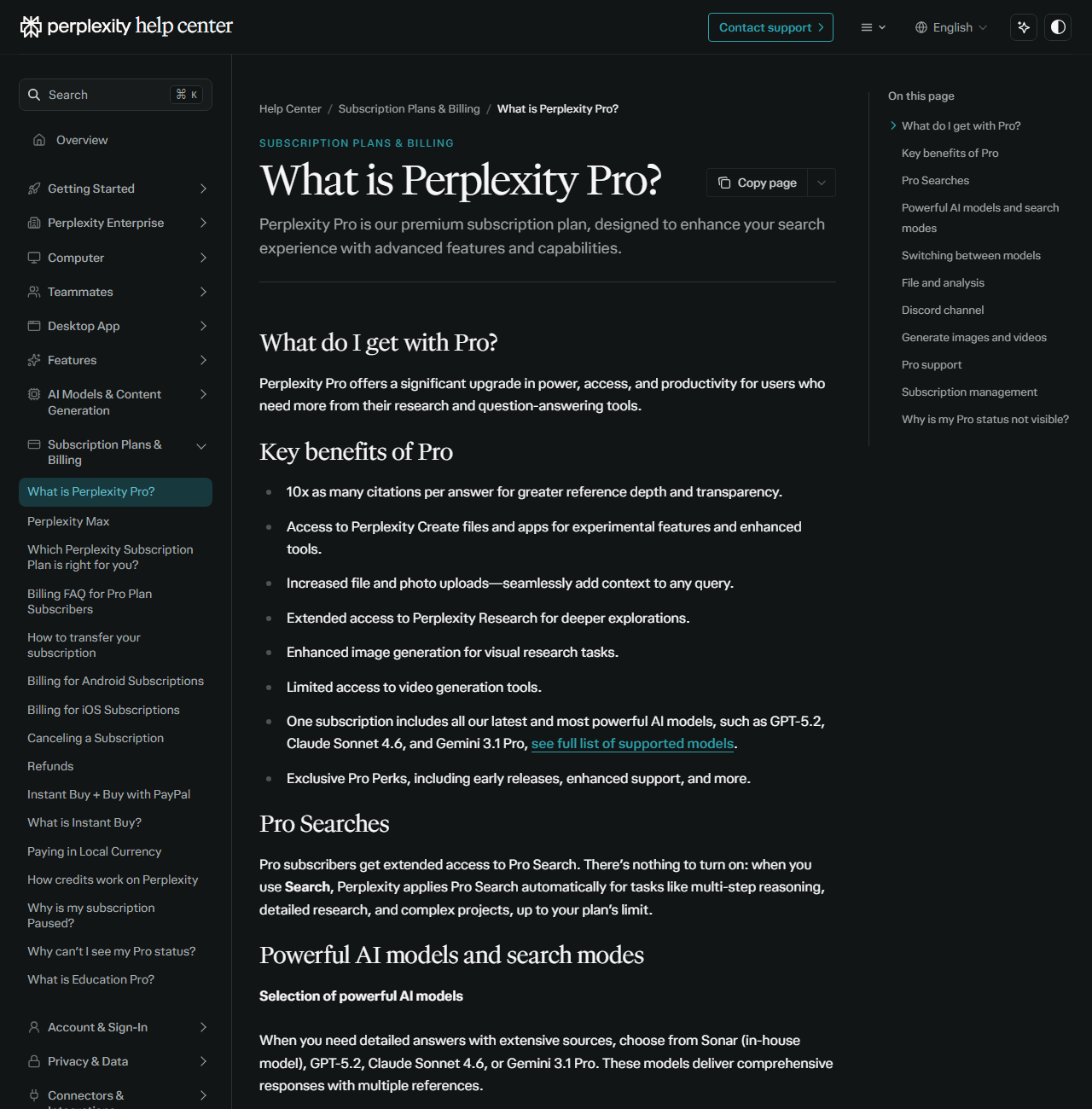
Perplexity’s own article “What is Perplexity Pro?” lists the following as included:
- About ten times as many citations per answer.
- Extended Pro Search, applied automatically when you use Search.
- Extended access to Research, the mode that produces longer reports.
- Higher file and photo upload limits, for PDFs, spreadsheets, audio, video and images.
- The ability to create files and apps.
- Enhanced image generation and limited video generation.
- Early releases and enhanced support.
The same page lists the models behind these features and warns that access to the most advanced ones may be restricted during periods of heavy use. A review of the plans published by CloudZero in September 2026 adds that Pro routes questions across models from several labs or lets you choose one, includes premium financial and market data sources, offers hundreds of app connectors and gives limited access to Perplexity’s agent features.
Research mode. Research is the headline feature for business use. You ask a broad question, such as how a regulation affects a type of firm, and it runs many searches and returns a structured report with sources. It is much faster than doing this by hand. It is also where mistakes do most damage, because a long, confident report invites trust that its sources may not earn.
Choosing a model. The model picker is quietly one of the best reasons to pay. You can ask the same question of different models and compare. If you already weigh Claude against ChatGPT, the picker lets you test that choice on real research questions without paying for several subscriptions.
Uploads. Pro lets you attach reports, contracts, spreadsheets or audio and ask questions about them. Treat this as a data decision before it is a feature, as the privacy section below explains.
The Comet browser and agents. The CloudZero review says the Comet browser is free for everyone, with its assistant on the Free plan, and that agent features run with limited capacity on Pro. An agent that browses and acts on your behalf is a different level of risk from an answer engine, and our entry on agentic AI explains why. We would not give one access to business accounts without a written rule on what it may do.
How much does Perplexity Pro cost?
Perplexity lists Pro as a monthly subscription, with a discount reported for annual billing, and separate Max and Enterprise plans above it. This review does not quote the figures, because they change: check Perplexity’s own plans page on the day you decide. Two cautions apply.
First, limits matter more than the headline price. The CloudZero review notes that Perplexity does not state numeric limits for Pro’s deep research on its plans page, and that users have reported limits tightening without notice. Second, a subscription you rarely open is wasted money. Decide how many research tasks a week you expect to run and check whether you hit the Free plan’s ceiling first.
Is Perplexity Pro Accurate?
This is the question that matters most, and the independent evidence is not reassuring. Perplexity’s own Pro page leads with a claim of “the most accurate answers from all the top AI models”, so it is the claim to test.
Researchers at Columbia University’s journalism school, writing in the Columbia Journalism Review in March 2025, tested eight AI search tools. It gave each excerpts from news articles and asked the tool to identify the source: 20 publishers, 10 articles each, 1,600 queries in all, run in February 2025. The study reports that Perplexity answered 37 percent of its queries incorrectly. For the paid version, it gives no separate percentage, but says premium models answered more prompts correctly than free ones and “paradoxically also demonstrated higher error rates”.
Three cautions keep that in proportion. The test was about news sources, so it does not measure how good Perplexity is at researching a supplier or a regulation. It dates from early 2025 and the product has changed since. And we found no independent accuracy benchmark for Perplexity from 2026 to replace it. What the study does show is a pattern that applies to every answer engine: a fluent, linked answer can still be wrong. That is a hallucination with a citation attached, which can be more convincing than one without.
In practice the failures look like this:
- A link that exists but does not say what the sentence claims.
- A claim traced to a syndicated copy of an article instead of the original.
- A confident summary that merges two sources which disagree.
The fix is a habit, not a setting. Open the cited page for any figure, date or legal statement before it goes into a document. Our guide on checking AI output before it reaches a customer covers a simple routine, and keeping a human in the loop is the difference between a quick first pass and a published error.
Is Perplexity Pro Safe for Business Data?
Here the evidence points to caution, and the answer depends on which plan you are on.
What the notice says. Perplexity’s privacy notice, last updated on 23 October 2026, names Perplexity AI, Inc. as controller of the data it processes and says it applies to its websites, the Comet browser and its mobile apps. It lists “improve or create services and products, including our AI models” as a use of data, and it says it processes “prompts, queries, uploads, and any other data you choose to provide”. It states that it does not use the content of emails to train or improve its models, but it makes no such statement about prompts or uploads. The opt-outs it describes cover targeted advertising and tracking, and no opt-out from AI training appears in the text.
What you can control. Perplexity’s self-service page lets you export your data and delete your account, and says data is permanently deleted 30 days after you confirm. You can delete threads one at a time or all at once from the Library, and uploaded files are kept for 30 days by default and removed when you delete the thread that holds them. The page names no setting for turning off training.
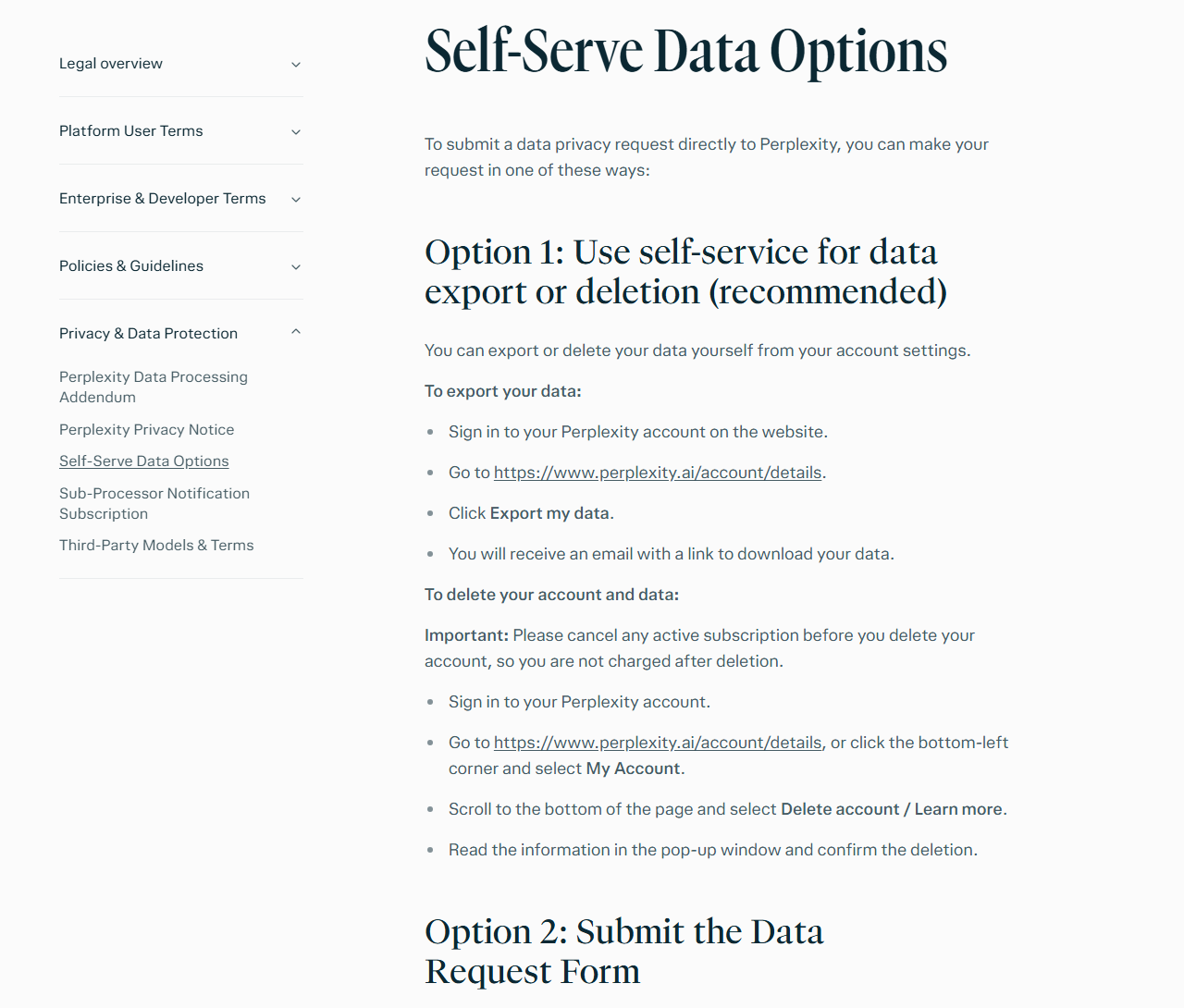
Several third-party guides describe an account setting that limits training. We could not find it on Perplexity’s own pages, so treat it as unverified until you see it in your account.
Where the data goes. The notice says personal data may be processed in countries with less strict privacy laws than yours, including the United States, and gives no fixed retention periods, only “as long as necessary”. It names a representative for the EEA and UK, which is a legal requirement for organisations outside the EU, but that does not make your use compliant. If you use the Comet browser while signed in, the notice also says that, depending on your settings, Perplexity records your browsing history. For anything involving personal data, our entries on data protection, the GDPR and data residency set out what to check.
What to do about it.
- Keep client names, personal data, contracts and unpublished financials out of individual Pro accounts.
- If staff already use it on their own, treat that as shadow AI and bring it into your approved list.
- Read the guide on what is safe to paste into AI tools and write the rule into your AI use policy.
- For team use, compare Perplexity’s Enterprise plans. The privacy notice says it does not cover Enterprise and API customers, where Perplexity acts as a processor, and the data processing addendum is where those terms sit. Ask for it in writing.
Where does Perplexity Pro fall short?
It is a research tool, not a writing tool. Perplexity can summarise what it finds, but for a first draft of a proposal, a policy or a client email, a general assistant gives you more control over tone and structure. See how ChatGPT compares with Copilot for that kind of work.
Limits are opaque. Pro advertises “extended” access without publishing numbers on its main pages. Plans have been reshuffled several times in 2026, and the documentation warns that advanced models can be restricted at busy times. If you plan a workflow around it, you are planning around a limit you cannot see.
Publishers dispute how it gathers content. Several publishers have sued Perplexity. News Corp’s suit, as reported by Maginative, accuses it of copying content and attributing invented text to real publications, and Digiday reports further legal pressure from other publishers. Perplexity rejects the claims, and we found no ruling. The Columbia study also reports that Perplexity identified paywalled articles from a publisher that blocks its crawlers. For a business user the risk is indirect: the tool you rely on for sources may change or lose content, and the legal situation is unsettled.
Source quality is uneven. An answer engine ranks pages by what it can find and read. A forum post and a regulator’s page can sit side by side. Ask it to prefer primary sources, and check which ones it used.
Does Perplexity Pro work for Visibility and marketing Research?
It is useful here for a reason that has nothing to do with answers. Perplexity is one of the places where customers now ask questions, and the sources it cites show you what an AI answer is built from. Asking it about your own company, your competitors and your category shows who gets cited and why. That is a quick, cheap check on your own AI citation footprint.
Do it with a clear goal. Our guides on what gets content cited in AI answers and whether your brand shows up when people ask AI about you explain what to look for, and our comparison of SEO and GEO explains why it matters. If you want to see where you stand across several engines, that is the job of an AI audit.
How does Perplexity Pro compare with ChatGPT and Claude?
| Perplexity Pro | ChatGPT or Claude | |
|---|---|---|
| Main strength | Searching the web and citing sources | Drafting, analysis, building and reasoning |
| Sources | Numbered links on every answer | Links when web search is used |
| Model choice | Several labs’ models in one place | One lab’s models |
| Best for | Fact-finding and market research | Writing and working with your own documents |
| Main risk | Confident errors with citations | Confident errors without citations |
Perplexity wins when the question is “what is out there on this?” The others win when the question is “write, analyse or build something from what I have”. If you can pay for only one, start with the assistant that matches most of your daily tasks, and add Perplexity when research becomes a regular job. Our reviews of Gemini against ChatGPT and Claude against ChatGPT explain how to pick that first assistant.
Who should pay for Perplexity Pro?
It suits:
- Consultants, analysts and marketers who research something new every week.
- Owners who track competitors, suppliers or regulations and want sources to follow up.
- Anyone who wants to compare several models on one question without several subscriptions.
It suits less:
- Teams that mainly write, summarise their own files or answer customers.
- Anyone handling personal, client or confidential data on an individual account.
- Casual users, who will rarely hit the limits of the Free plan.
How to test Perplexity Pro before you pay
Run three real tasks on the Free plan first, then on Pro if you hit a wall.
- A question you already know the answer to. Open every source it cites and mark each claim as supported, partly supported or unsupported.
- A question that matters to your business, such as a rule that applies to your sector. Compare its answer with the regulator’s own page.
- A comparison task, such as three suppliers against four criteria. See whether its table matches what the suppliers’ pages say.
If most claims are supported and you would use it weekly, Pro is probably worth it. If you keep correcting it, the problem is the task, not the plan.
Verdict
Perplexity Pro is one of the better tools for finding and citing information, and the model picker and Research mode add real value if research is part of your week. It is not a safe place for confidential data on an individual account, its accuracy needs checking every time, and its limits are harder to see than they should be.
Pay for it if you do weekly research and check what it says. Stay on Free if you search occasionally. And if you need it across a team, treat that as a data-protection decision first and a licensing decision second.
Further reading
- Claude vs ChatGPT: Which fits your business best?: how the two main assistants differ on data, admin and access.
- How to check AI output before it goes to a customer: the review step no tool removes.
- Customer data and AI tools: what is safe to paste: the rule to set before anyone uploads a file.
Sources
- What is Perplexity Pro? (Perplexity documentation): the features, models and file types included in Pro, and the warning that advanced models can be restricted at busy times.
- Perplexity privacy notice: the controller, the AI-model use of data, the email carve-out, retention wording, Comet browsing history and international transfers, as updated on 23 October 2026.
- Self-Serve Data Options (Perplexity): data export, account deletion, thread deletion and the 30-day file retention.
- We compared eight AI search engines. They’re all bad at citing news (Columbia Journalism Review): the Columbia test, with the 37 percent error rate for Perplexity and the finding on premium versions.
- Perplexity pricing in 2026 (CloudZero): a September 2026 review of the plans, the unpublished research limits and the changes made during the year.
- News Corp sues Perplexity over copyright infringement (Maginative): the claims in the publisher lawsuit, including false attribution.
- Perplexity faces new legal pressure (Digiday): further publisher legal action and Perplexity’s response.
FAQ
Questions we get asked
What is Perplexity Pro?
Perplexity Pro is the paid tier of Perplexity, an answer engine that searches the web and replies with a written answer and numbered source links. Perplexity's own documentation says it adds about ten times as many citations per answer, extended Pro Search, extended access to its Research mode, higher file upload limits and a choice of underlying models.
Is Perplexity Pro worth it for a Small Business?
It is worth paying for if you research suppliers, competitors, markets or regulations several times a week and need answers with links you can check. It is not worth it if you mainly draft emails or documents, because a general assistant does that better, or if you only search now and then, because the Free plan covers occasional use.
What is the difference between Perplexity Free and Pro?
Free gives you cited answers with limited use of the more powerful features. Pro, according to Perplexity's documentation, raises the number of citations per answer, extends Pro Search and Research, raises file and photo upload limits and adds image generation and the ability to create files and apps. Perplexity does not publish exact daily or monthly limits on its main pages, so check your account before you rely on a number.
Is Perplexity Pro better than ChatGPT?
They do different jobs. Perplexity is built around searching the web and showing its sources, which suits fact-finding. ChatGPT is a broader assistant for drafting, analysis and building custom tools. Many businesses use one for research and the other for writing, and Perplexity Pro lets you pick a ChatGPT or Claude model inside its own search.
Does Perplexity use your Data to train its AI?
Perplexity's privacy notice, last updated on 23 October 2026, lists improving or creating its services, including its AI models, as a use of the data it collects. It says it does not train on the content of emails, but it does not say the same about prompts or uploads, and it describes no training opt-out. Its self-service page offers data export and deletion only. The notice does not cover Enterprise and API customers, where Perplexity acts as a processor, so use those routes for confidential work.
Is Perplexity Pro GDPR Compliant?
Perplexity names itself as the controller of personal data and appoints a representative for the EEA and UK, which the GDPR requires of organisations outside the EU. That is not the same as being compliant for your use. The policy says data may be processed in countries with less strict privacy laws, and it gives no fixed retention periods. For personal or client data, ask for a data processing agreement and a documented lawful basis first.
Can Perplexity Pro be wrong?
Yes. In a Columbia Journalism Review study of eight AI search tools, Perplexity answered 37 percent of the test queries incorrectly. The study found that premium versions answered more prompts correctly than free ones but also showed higher error rates. A link next to a claim does not prove the page says what the answer says, so open the source before you rely on it.
Which AI Models does Perplexity Pro use?
Perplexity's documentation lists its own Sonar model alongside models from OpenAI, Anthropic and Google, and some plans add models from other labs. You can pick a model or let Perplexity choose. The list changes often, so look at the model selector in your account for the current options.
Is there a Perplexity Pro plan for a team?
Pro is sold to individuals. Perplexity lists separate Enterprise plans for teams, with admin controls, single sign-on and central billing. If more than one person needs access, or you need controls over data use, compare the Enterprise plans and not several individual Pro accounts.
Ready to Put This to Work?
Tell us where your team is with AI and we will tell you honestly what would make the biggest difference.