Jasper vs Copy.ai vs ChatGPT for Marketing Copy
Jasper vs Copy.ai vs ChatGPT for marketing copy: what each does, plans, brand voice, data defaults and which one a small business should pick.
Jasper, Copy.ai and ChatGPT can all write a headline, an email or a product description in seconds. They are not three versions of the same product, though. Jasper is a marketing platform with a saved brand voice. Copy.ai has turned into a workflow platform for go-to-market teams. ChatGPT is a general assistant that you brief yourself. Which one suits you depends on how many people write, how much you publish and how much you want to set up.
This review is based on the vendors’ own pages as we read them on 27 November 2026. We have not run a hands-on test of the three. We could not read ChatGPT’s current prices reliably, so we have not stated them. Prices change often, so check each vendor’s pricing page before you buy.
Key takeaways
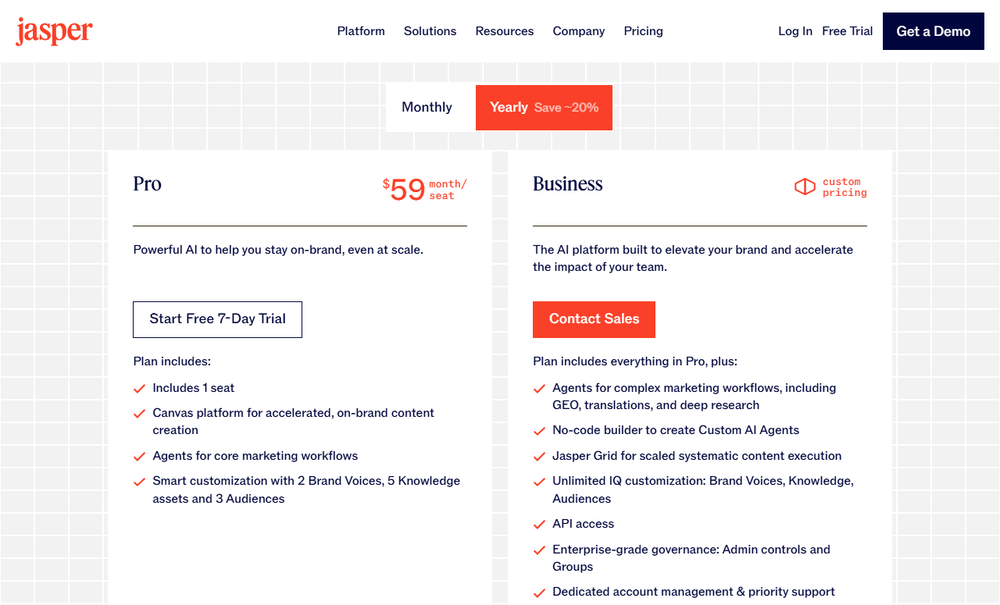
- Jasper is built for marketing teams. Its Pro plan lists two brand voices, five knowledge assets and three audiences, and its Business plan removes those limits.
- Copy.ai now presents itself as a platform for sales, marketing and operations workflows, with a small Chat plan alongside larger plans sold on seats and workflow credits.
- ChatGPT is the most flexible and the cheapest to try. It has no saved brand voice of its own, so you build one with instructions, projects or a custom GPT.
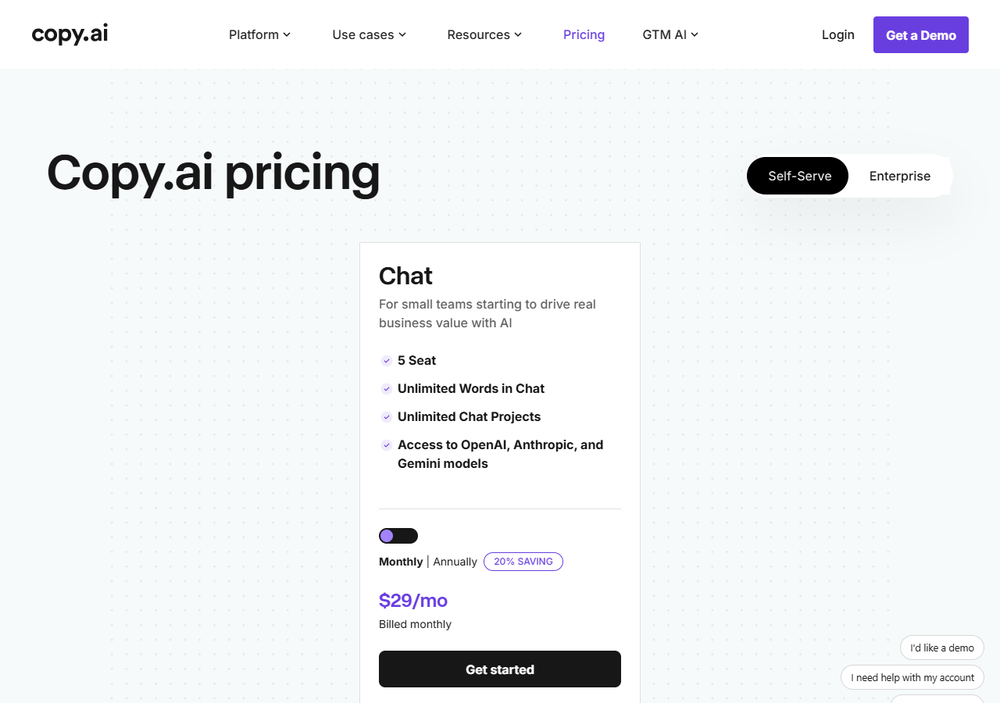
- Jasper’s Pro plan is listed at $69 per seat per month, or $59 on the yearly toggle. Copy.ai’s Chat plan is listed at $29 a month, or $24 billed yearly.
- Data defaults differ by account type. OpenAI says personal workspaces share data for training by default and Business workspaces do not.
- None of the three removes the need for a person to read the copy before it goes out.
- Test all three on five real pieces of your own copy, then decide.
What is the difference between Jasper, Copy.ai and ChatGPT?
Start with what each product is for, because that decides everything else.
You write marketing copy as a team
Several writers, one brand
A saved brand voice
Campaigns and repeat formats
Review and sharing built in
You write when you need to
One or two writers
Mixed jobs, not just copy
Instructions you write yourself
Lowest cost to start
If you are on the left, Jasper is built for you. If you are on the right, ChatGPT is the natural fit. Copy.ai sits to one side of both, because its current pitch is workflows for go-to-market teams rather than a writing desk.
Jasper. Its pricing page describes a Canvas platform for on-brand content creation, agents for marketing workflows, and a set of context features it calls Jasper IQ: brand voices, knowledge assets and audiences. The page says it works in more than 30 languages and lists a browser extension for Chrome and Edge.
Copy.ai. It describes itself as a GTM platform: sales, marketing and operations. Its navigation lists workflows, tables, actions and a brand voice feature, with use cases that include content creation and translation. The self-serve Chat plan gives a small team a chat interface with access to models from OpenAI, Anthropic and Gemini.
ChatGPT. A general chat assistant. You give it a prompt, a draft or a pile of notes, and it writes, rewrites or restructures. Our glossary entry on ChatGPT covers the basics, and our guide to ChatGPT for small businesses shows what it can do day to day.
Which is the Best Tool for marketing copy?
There is no single winner, but there is a clear pattern.
| If this describes you | Start with |
|---|---|
| One or two people write, and the jobs vary | ChatGPT |
| A team writes for one brand and style keeps drifting | Jasper |
| You need to turn lists of leads, products or accounts into drafts at scale | Copy.ai |
| You already pay for a chat assistant and want to test before buying more | Stay with it and write better instructions |
ChatGPT wins on range and price. It can write the copy, then summarise a report, then help with a spreadsheet, all in one place. Jasper wins on consistency across people, because the brand voice, knowledge and audiences sit in the platform and are applied each time. Copy.ai wins when the job is a process that repeats, not a single piece of writing.
If you are still working out where AI helps in marketing at all, read our guide to AI for marketing first. It covers the tasks that tend to pay off and the ones that do not.
How much do Jasper, Copy.ai and ChatGPT cost?
These are the figures on each vendor’s own page when we read it.
| Jasper | Copy.ai | ChatGPT | |
|---|---|---|---|
| Entry plan | Pro: $69 per seat per month, or $59 on the yearly toggle | Chat: $29 a month, or $24 a month billed at $288 a year | Page lists Free, Go, Plus and Pro for individuals. Check the vendor’s page for current prices |
| Seats on the entry plan | 1 | 5 | One person per plan |
| Free option | Seven-day free trial, no free plan listed | Not shown on the page we read | A Free plan is listed |
| Larger plans | Business, custom priced | Growth at $1,000 a month billed $12,000 a year, then Expansion and Scale | Business and Enterprise listed |
| What drives the price | Seats and brand limits | Seats and workflow credits | Plan tier and usage limits |
Three points about the numbers.
- Seats are the catch with Jasper. The Pro price is per seat, and the plan includes one seat. A team of four writers is four times the figure, so work out your real headcount before you compare.
- Copy.ai’s Chat plan is the cheapest dedicated option. It includes five seats at a single price. The larger plans are priced for companies, not for a team of three.
- ChatGPT’s price depends on the tier you need. The pricing page lists Free, Go, Plus and Pro for individuals, and notes that Go may include ads. The Plus plan lists projects, scheduled tasks and custom GPTs, which matter for marketing work. Look at the current page before you decide.
If you want to know what an AI tool costs once you add the time it takes to run, see our piece on how much an AI workflow actually costs to run.
Is Jasper worth it for a Small Business?
Sometimes. Jasper’s value is in the setup you do once and reuse. You describe your brand voice, upload your knowledge and define your audiences. After that, each person on the team starts from the same base, instead of from a blank prompt.
That is worth paying for when three things are true:
- More than one person writes for the brand. The saved voice is what keeps five writers sounding like one company.
- You publish often enough to repeat formats. Weekly emails, product pages, social posts and ad variants all benefit from a template.
- Someone owns the setup. A brand voice that nobody maintains goes stale in a few months.
It is harder to justify if you are a single founder writing a post a week. In that case the monthly seat cost is likely to be more than the time it saves. Test the free trial against ChatGPT with good instructions before you commit.
The pricing page also shows a limit worth knowing. Pro lists two brand voices, five knowledge assets and three audiences. If you run several brands, product lines or markets, you may hit those limits and be pushed towards Business, which lists unlimited brand voices, knowledge and audiences and is custom priced.
What is Copy.ai used for now?
Copy.ai has changed shape. Earlier versions were known as a quick way to generate short pieces of marketing text. The site now describes a GTM AI platform, with workflows as its core idea. Its own FAQ describes a workflow as a set of AI-powered actions stitched together to codify a process, such as creating an account plan or writing an SEO article.
For marketing copy, that matters in two ways.
- It suits bulk, repeatable jobs. If you have a table of products, accounts or leads and want a draft for each one, a workflow can run through the list. That is a different job from writing one good article.
- It is not the simplest tool for one-off writing. If you only want a better product description today, a chat assistant is quicker to start.
The Chat plan is the point of entry for small teams. It lists five seats, unlimited words in chat, unlimited chat projects and access to models from OpenAI, Anthropic and Gemini. If you mainly want a shared chat tool for a small team, that is the plan to read. If you want automation across systems, you move up to the plans sold on workflow credits, which are priced for larger organisations.
Can ChatGPT replace Jasper and Copy.ai?
For many small businesses, yes, if you are willing to do some setup.
What ChatGPT lacks is a marketing-specific layer. It does not come with a brand voice library, an audience builder or marketing templates. What it does have is flexibility, and several ways to build the missing pieces yourself:
- Custom instructions. Write your tone rules once and have them applied to every chat.
- Projects. Keep the brief, examples and past copy for one campaign together. The Plus plan on the pricing page lists projects and custom GPTs.
- A custom GPT. Turn your brief and examples into a shared tool your team can open and reuse.
- A prompt library. Our guide to building a prompt library your team will use shows how to keep the prompts that work.
The trade-off is discipline. A saved brand voice in a marketing platform is applied the same way each time. In ChatGPT, the result depends on whether people use the shared instructions or paste in their own version. If your team is small and one person owns the instructions, that is fine. If it is large, the platform’s guard rails earn their fee.
The quality of what you get also depends on the prompt. Give the tool the audience, the goal, the length, the channel and an example of copy you like. Our guide to writing a good prompt covers the structure that works.
How do the brand voice Features compare?
Brand voice is the feature that most separates the three, so it deserves a closer look.
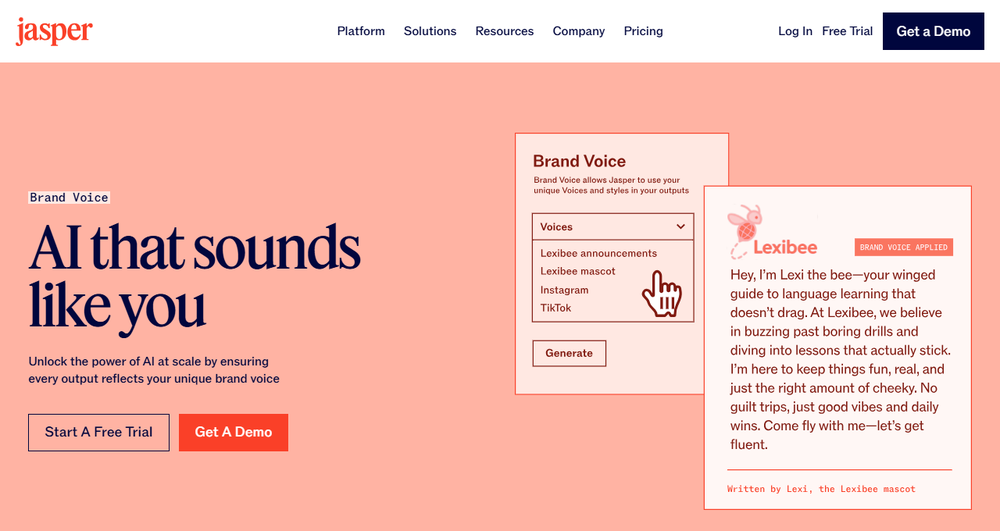
Jasper lists brand voice as part of its context layer. Its brand voice page says Jasper analyses your content’s tone of voice, lets you set tone and formatting rules, and flags places where the writing is off-brand with recommended changes. Pro includes two voices and Business includes unlimited voices.
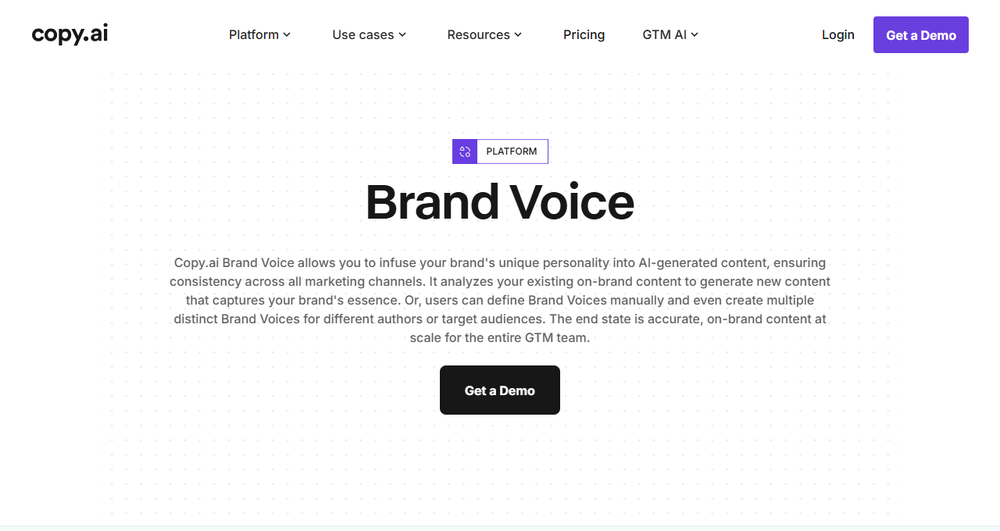
Copy.ai describes its brand voice feature as analysing your existing on-brand content to generate new content that captures your brand’s essence. Users can also define voices manually and create several distinct voices for different authors or audiences.
ChatGPT has no named brand voice feature on the pricing page we read. You get the same effect from instructions, projects and custom GPTs, as above.
A fair way to compare them is to give each the same three samples of your best copy and ask for a new piece in that voice. Then read it cold. A voice feature that sounds like you on a Tuesday but drifts by Friday is not doing its job. If you want help writing the brief that sits behind any of them, our guide to briefing an AI tool like a new hire shows how.
Is it Safe to put client Data into these Tools?
The answer depends on the account, not only the tool. This is what each vendor’s own pages said when we read them.
| What the vendor’s page says | What to check | |
|---|---|---|
| Jasper | Its trust page says company data and outputs are never used to train third-party models, and lists SOC 2 and GDPR compliance. Its security page says customers may receive the SOC 2 report through a compliance portal | Ask for the report and the data processing terms |
| Copy.ai | We could not find a data-handling statement on the pages we read. The Chat plan lists access to models from OpenAI, Anthropic and Gemini | Ask which model providers receive your text and under what terms |
| ChatGPT | OpenAI’s help centre says data sharing for training is on by default for personal Free, Plus and Pro workspaces, with a setting to turn it off. It says ChatGPT Business data is excluded from training by default | Which account type your team uses, and the Improve the model for everyone setting |
Three habits protect you whatever you choose.
- Pick the account type on purpose. A personal login and a company workspace can have different defaults for the same product.
- Keep personal data out unless you have a lawful basis. Our entry on data protection covers the basics, and our guide on what is safe to paste into AI tools gives a practical list.
- Know who is using what. Staff who paste work into personal accounts are the more common risk. See our entry on shadow AI.
Banning the tools rarely works. Our piece on why banning AI tools at work does not work explains why a clear rule beats a ban, and our guide to writing an AI use policy for your team shows how to set one. If you are choosing between several suppliers, our guide to choosing an AI vendor lists the questions to ask.
Does AI marketing copy rank on Google?
It can, but the tool is not what decides. Search engines and AI answer engines look for pages that are useful, accurate and specific. Generic copy that repeats what every other page says gives them no reason to pick yours.
Three practical rules help.
- Add what the tool cannot know. Your prices, your customers’ questions, your own numbers and your own examples are what make a page worth citing.
- Name a real author and check the facts. Our guide on how to reduce AI hallucinations explains why a tool can state something wrong with confidence.
- Write for questions, not only keywords. Our pieces on how AI Overviews are changing SEO and what gets content cited in AI answers explain what answer engines pick up.
Jasper’s pricing page also lists agents for GEO, which is the practice of making your content easy for AI answer engines to find and quote. It is a Business plan feature. If that is your goal, our guide to increasing business visibility with SEO and GEO shows what to do with any of the three tools.
There is also a legal side to AI-written material. Ownership and copyright of AI-generated work is not settled in the same way everywhere. Our guide to copyright and AI-generated content for business covers what to check before you publish.
How do you test them on your own marketing copy?
The best evidence is your own writing. Use real briefs, not demos.
Pick five real pieces
Email, post, product page, ad, reply
Give each tool the same brief
Same audience and examples
Read the drafts cold
Mark every edit you made
Check the settings
Training and sharing
Decide
Before you pay for a year
Run all five pieces in all three tools, with the same instructions, and count how many edits you had to make by hand. Write down how long each took and anything you wanted and could not find. Then check the data settings on every account you used. Our guide to whether your AI tool is actually saving time gives a simple way to measure the result.
Use the free trial of Jasper, the plan you already have on ChatGPT, and the Copy.ai Chat plan if you want to test it. Do not sign a yearly plan until the week is over.
When is each Tool the wrong choice?
Jasper is the wrong choice if you are a single writer with a light schedule, because the seat cost is likely to outrun the time saved. It is also the wrong choice if you need many brand voices on the Pro plan, since the page lists two.
Copy.ai is the wrong choice if you want a simple writing desk for one-off pieces. Its current direction is workflows and go-to-market operations, and you may pay for features you never open.
ChatGPT is the wrong choice if several people will each use their own personal accounts and their own prompts for client work with no shared rules. The defaults differ from the Business workspace, and the copy will drift in tone from person to person.
Whatever you choose, someone has to read the result. Writing tools can state invented facts and quotes with confidence. Our guide to checking AI output before it goes to a customer is the minimum routine, and our entry on hallucination explains why it happens. Keeping a person in the loop is the point of human-in-the-loop working.
Which one should you choose?
Match the tool to how your team writes.
- Choose ChatGPT if you write occasionally or with a very small team, and you can write good instructions. It is the cheapest way to find out how much AI helps your copy. Our review of Claude vs ChatGPT for business covers the other leading assistant.
- Choose Jasper if several people write for one brand and you want the voice, knowledge and audiences to be shared and enforced. Check the seat count first.
- Choose Copy.ai if your real job is a repeating process across lists of leads, accounts or products, and you have someone to build and run the workflows.
If your problem is editing and tone rather than drafting, a checker may be a better fit than any of these. Our review of Grammarly vs ChatGPT vs Copilot for business writing covers that choice. If the real gap is in how emails sound, see our guide to using AI for email without losing your voice. If your plan is to connect the writing to other systems, our comparison of Zapier vs Make vs n8n shows how automation tools differ. For the design side of a campaign, see Canva vs Gamma vs Claude Design.
Our verdict
There is no single winner, because the three tools solve different problems. ChatGPT is the best starting point for most small businesses: it is flexible, it is the cheapest to try, and with good instructions it gets close to what a dedicated tool does. Jasper earns its place when a team needs a shared brand voice that is applied the same way every time. Copy.ai is now a workflow platform, and it makes sense when the work is a repeating process.
Before you pay for anything, run the one-week test on your own briefs, open the data settings on every account, and decide on purpose what may be pasted in. Judge the tools by how many edits you make on your own work, not by the length of the feature list.
Further reading
- AI for marketing: where AI helps in a marketing team and where it does not.
- How to write a good prompt: the structure behind better drafts in any tool.
- How to brief an AI tool like a new hire: instructions that keep your tone steady.
- What is safe to paste into AI tools: a practical list for client work.
- How to check AI output before it goes to a customer: the review step for every tool.
- ChatGPT vs Copilot for business: how two leading assistants compare for a team.
Sources
- Jasper plans and pricing: the Pro and Business plans, seat counts, brand voice, knowledge and audience limits, agents and the seven-day trial, as read on 27 November 2026.
- Jasper brand voice: how brand voice analyses tone, applies formatting rules and flags off-brand writing.
- Jasper trust and security: the statements on SOC 2 and GDPR compliance and that company data and outputs are not used to train third-party models.
- Copy.ai plans and pricing: the Chat plan, its price and seats, the larger plans sold on seats and workflow credits, and the description of workflows.
- Copy.ai brand voice: how brand voices are learned from existing content or defined manually.
- ChatGPT pricing: the Free, Go, Plus, Pro, Business and Enterprise plans and the features each lists.
- Data controls in ChatGPT: that data sharing is on by default for personal Free, Plus and Pro workspaces and can be turned off.
- Managing data, sharing, and privacy in ChatGPT Business: the statement that Business workspace data is excluded from training by default.
FAQ
Questions we get asked
Is Jasper better than ChatGPT for marketing copy?
Jasper is built around marketing teams. It stores your brand voice, knowledge and audiences and applies them every time. ChatGPT is a general assistant that can write the same copy if you give it the right instructions. If you write a lot of copy across a team and want a saved house style, Jasper fits. If you write occasionally and are happy to brief the tool yourself, ChatGPT is usually enough.
Is Copy.ai still a writing Tool?
It now describes itself as a platform for sales, marketing and operations teams, built around workflows. The pricing page we read lists a Chat plan for small teams and larger plans sold on seats and workflow credits. You can still write marketing copy in it, but the product is aimed at repeatable processes more than at one-off drafts.
How much does Jasper cost?
On the pricing page we read, Pro is $69 per seat per month billed monthly, or $59 per seat per month on the yearly toggle, and includes one seat. Business is custom priced. There is a free seven-day trial. Prices change, so check the page before you buy.
How much does Copy.ai cost?
The Chat plan is listed at $29 a month billed monthly or $24 a month billed at $288 a year, with five seats and unlimited words in chat. The page also lists larger plans sold on seats and workflow credits, starting with Growth at $1,000 a month billed $12,000 a year. Check the page for the current figures.
Can ChatGPT keep a consistent brand voice?
Yes, but you build it yourself. You write your tone rules and a few examples of good copy into saved instructions, a project or a custom GPT, and you keep them up to date. It works well when one person owns the instructions. It works less well when ten people each paste in their own version.
Is it Safe to paste customer Data into Jasper, Copy.ai or ChatGPT?
Only after you have checked the account type and its settings. OpenAI's help centre says data sharing for training is on by default for personal Free, Plus and Pro workspaces and excluded by default for Business workspaces. Jasper's trust page says company data and outputs are never used to train third-party models. We could not find a data statement for Copy.ai, so ask it directly. Keep personal data out unless you have a lawful basis.
Does AI-written marketing copy rank on Google?
Google does not rank copy by who or what wrote it. It ranks pages that are useful, accurate and original, and thin, generic copy tends to do badly whoever produced it. Use the tool for the draft, then add your own facts, examples and a named author before you publish.
Which is the Best AI Tool for marketing copy for a Small Business?
For most small businesses, start with ChatGPT and a well-written set of instructions, because it costs least to try and does the widest range of jobs. Look at Jasper when several people write for the same brand and consistency starts to slip. Look at Copy.ai when the real need is a repeatable workflow, such as turning a list of leads or products into drafts.
Do you need to disclose that copy was written with AI?
There is no general rule that says every piece of marketing copy must carry a label, but some situations do need one, such as content that could mislead people about who produced it. Check any rules that apply to your sector and your advertising channels. Whatever you decide, a person should read and approve every piece before it goes out.
Ready to Put This to Work?
Tell us where your team is with AI and we will tell you honestly what would make the biggest difference.